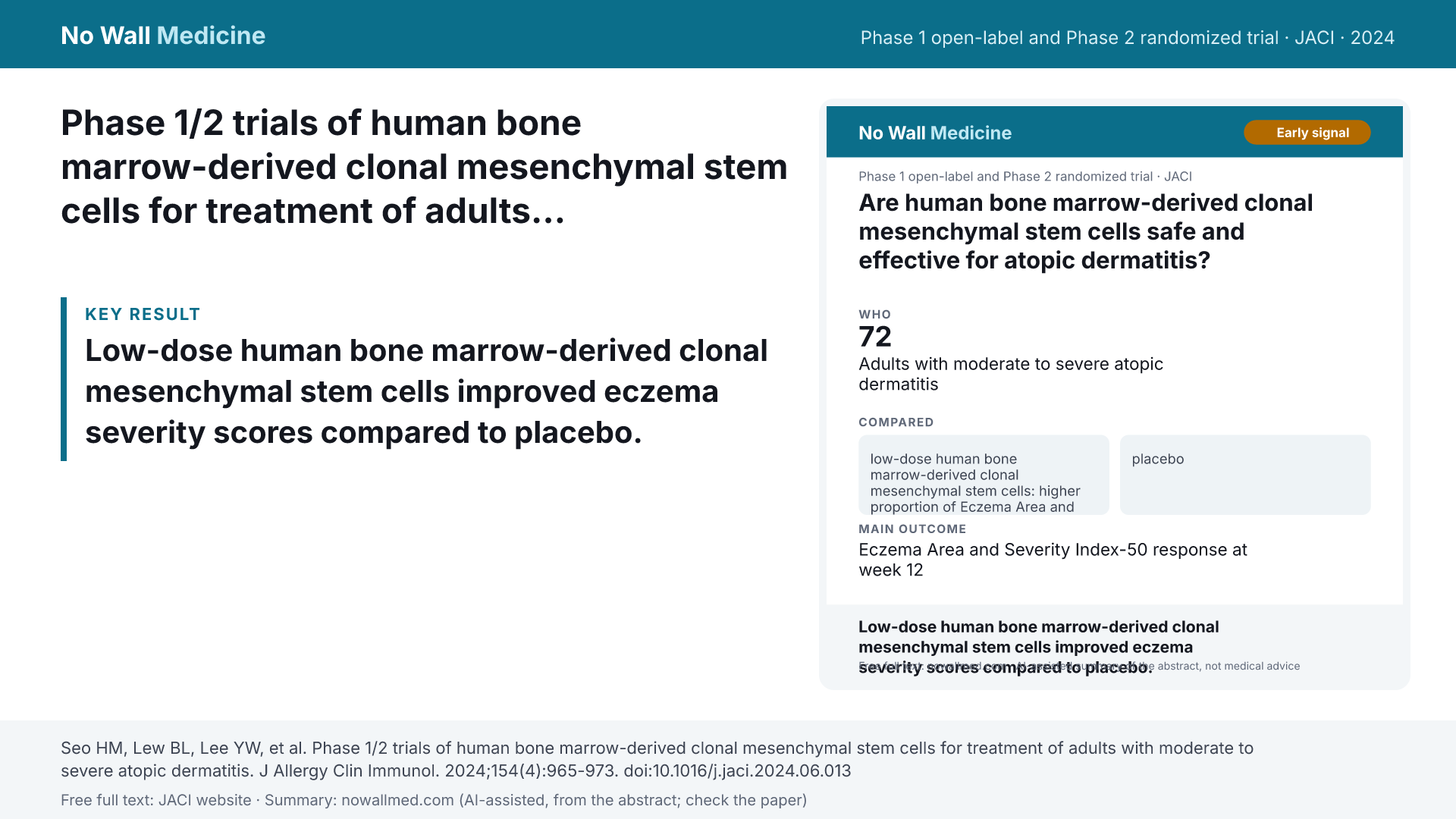
Phase 1/2 trials of human bone marrow-derived clonal mesenchymal stem cells for treatment of adults with moderate to severe atopic dermatitis
Phase 1 open-label and Phase 2 randomized trialEarly signal
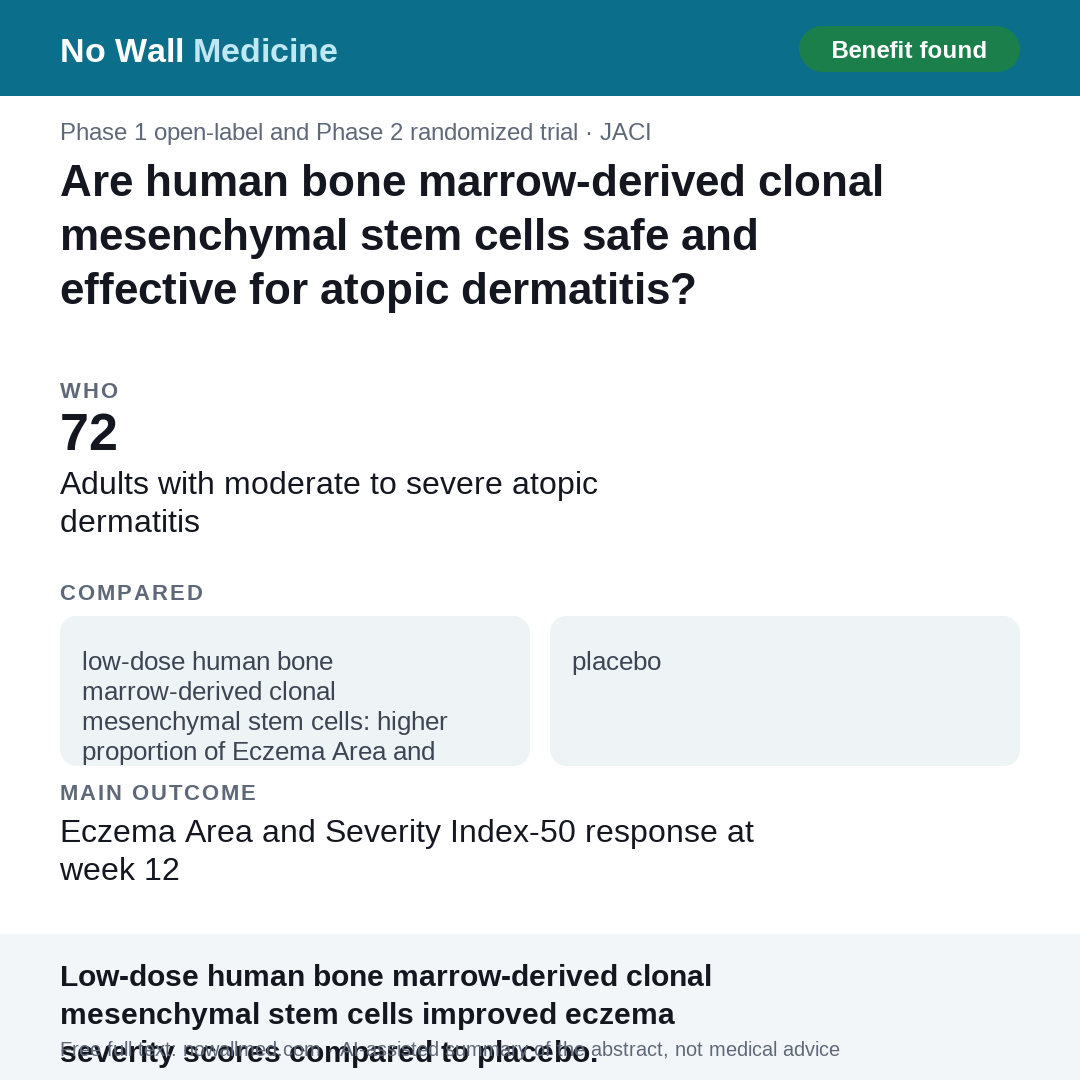
Are human bone marrow-derived clonal mesenchymal stem cells safe and effective for atopic dermatitis?
Who
72
Adults with moderate to severe atopic dermatitis
Compared
low-dose human bone marrow-derived clonal mesenchymal stem cells: higher proportion of Eczema Area and Severity Index-50 response
placebo
Main outcome
Eczema Area and Severity Index-50 response at week 12
Bottom line: Low-dose human bone marrow-derived clonal mesenchymal stem cells improved eczema severity scores compared to placebo.
JACI · 2024-06-27Download image
Clinical question: Are human bone marrow-derived clonal mesenchymal stem cells safe and effective for atopic dermatitis?
Abstract
Background
Mesenchymal stem cells (MSCs) play important roles in therapeutic applications by regulating immune responses. Objective
We investigated the safety and efficacy of allogenic human bone marrow-derived clonal MSCs (hcMSCs) in subjects with moderate to severe atopic dermatitis (AD). Methods
The study included a phase 1 open-label trial followed by a phase 2 randomized, double-blind, placebo-controlled trial that involved 72 subjects with moderate to severe AD. Results
In phase 1, intravenous administration of hcMSCs at 2 doses (1 × 10⁶ and 5 × 10⁵ cells/kg) was safe and well tolerated in 20 subjects. Because there was no difference between the 2 dosage groups (P = .9), it was decided to administer low-dose hcMSCs only for phase 2. In phase 2, subjects receiving 3 weekly intravenous infusions of hcMSCs at 5 × 10⁵ cells/kg showed a higher proportion of an Eczema Area and Severity Index (EASI)-50 response at week 12 compared to the placebo group (P = .038). The differences between groups in the Dermatology Life Quality Index and pruritus numeric rating scale scores were not statistically significant. Most adverse events were mild or moderate and resolved by the end of the study period. Conclusions
The hcMSC treatment resulted in a significantly higher rate of EASI-50 at 12 weeks compared to the control group in subjects with moderate to severe AD. The safety profile of hcMSC treatment was acceptable. Further larger-scale studies are necessary to confirm these preliminary findings.
Subject terms
Cite this article
Seo HM, Lew BL, Lee YW, et al. Phase 1/2 trials of human bone marrow-derived clonal mesenchymal stem cells for treatment of adults with moderate to severe atopic dermatitis. JACI. 2024. doi:10.1016/j.jaci.2024.06.013
Spotted a mistake? Suggest a correction