Anti-CD14 treatment did not improve time to recovery for hospitalized COVID-19 patients
Phase 2, randomized, double-blind, placebo-controlled multi-center trial of the clinical and biological effects of anti-CD14 treatment in hospitalized patients with COVID-19 pneumonia
Randomized, double-blind, placebo-controlled trialNo clear difference
Does anti-CD14 treatment improve time-to-resolution of illness in hospitalized COVID-19 patients?
Who
40
Hospitalized adults with COVID-19 requiring supplemental oxygen · 5 US sites
Compared
6 daysIC14 (95% CI, 5-11)
5 daysPlacebo (95% CI, 4-10)
Main outcome
time-to-resolution of illness
Result: recovery rate ratio: 0.77 (95% CI, 0.40, 1.48)
Bottom line: Anti-CD14 treatment did not improve time-to-resolution of illness in hypoxemic COVID-19 patients.
Funded by: National Institute of Allergy and Infectious Diseases
eBioMedicine · 2023-06-17Download image
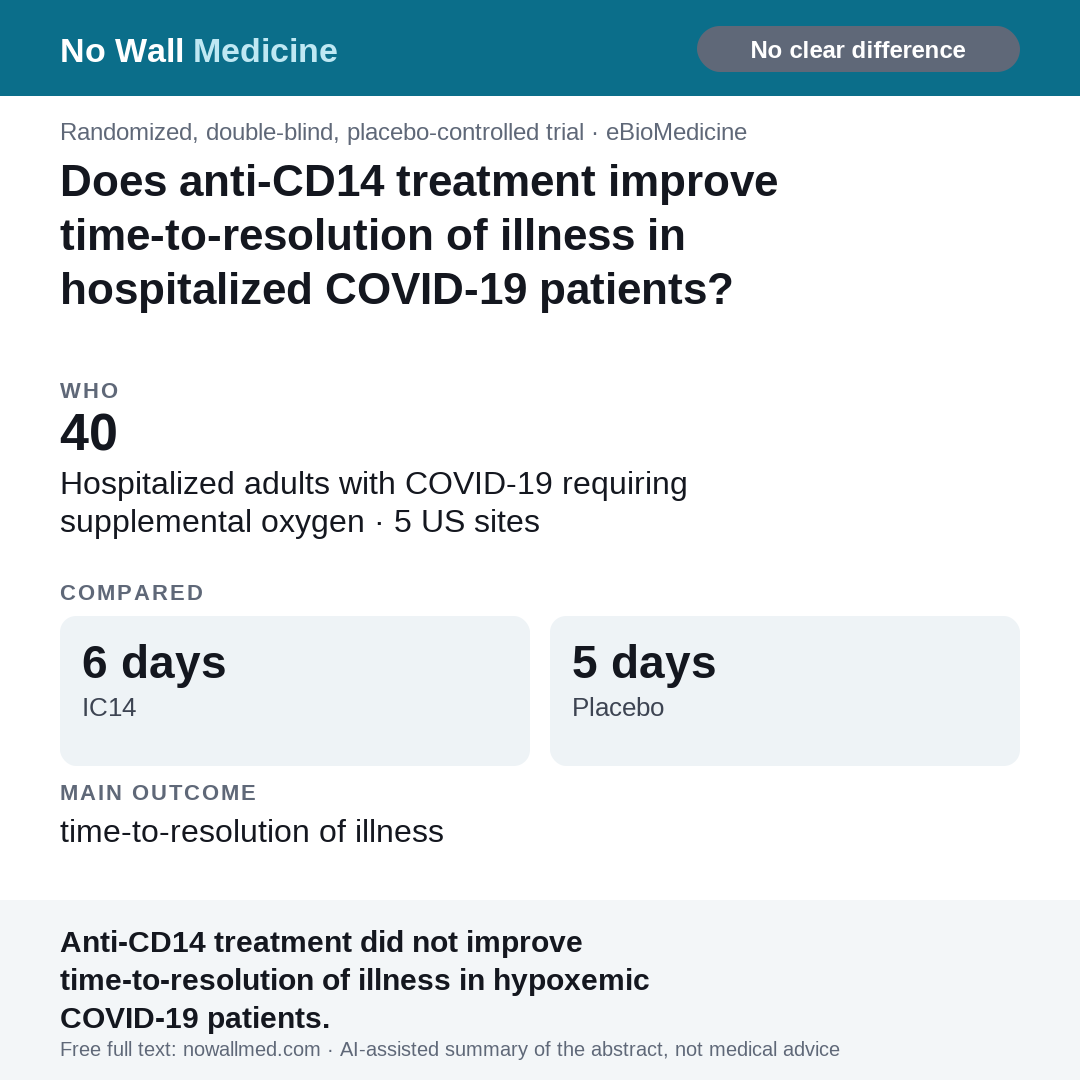
Clinical question: Does anti-CD14 treatment improve time-to-resolution of illness in hospitalized COVID-19 patients?
Why it matters: It was unknown if targeting CD14, a protein that activates innate immunity, could help treat severe COVID-19 pneumonia.
Key points
- The trial studied 40 hospitalized adults with COVID-19 pneumonia who were randomized to receive either the monoclonal antibody IC14 or a placebo.
- The median time to recovery was 6 days (95% CI, 5-11) for the IC14 group compared to 5 days (95% CI, 4-10) for the placebo group.
- IC14 treatment was associated with increased serum sCD14 concentrations and suggested decreases in the trajectories of circulating MIP-1β and TNF-α.
Limitation the authors note: The trial was stopped after 40 patients were randomized due to slow enrollment.
Headline and key points written with AI from the paper’s abstract, with every number checked against it. Read the paper before relying on them.
Topics
Cite this article
Mabrey FL, Nian H, Yu C, Barnes EM, Malhotra U, Mikacenic C. Phase 2, randomized, double-blind, placebo-controlled multi-center trial of the clinical and biological effects of anti-CD14 treatment in hospitalized patients with COVID-19 pneumonia. eBioMedicine. 2023. doi:10.1016/j.ebiom.2023.104667
Spotted a mistake? Suggest a correction
Top studies every Monday
The week’s key trials and guidelines in your specialties, plus any topics you follow. By email, free.
Get the weekly digest