Triheptanoin was associated with improved mitochondrial function and neurological scores in ataxia-telangiectasia patients
Phase 2a/b randomised placebo-controlled dose-escalation trial of triheptanoin for ataxia-telangiectasia: treating mitochondrial dysfunction with anaplerosis
PediatricsAdult and pediatric
Phase 2a/b randomized placebo-controlled dose-escalation trialMixed results
Does triheptanoin improve mitochondrial dysfunction and clinical symptoms in ataxia-telangiectasia?
Who
31
31 participants with ataxia-telangiectasia aged 4 to 37 years
Compared
Maximum dose triheptanoin: percent nasal cell death (mean difference -9.7%)
Placebo or no dose
Main outcome
cell death in respiratory epithelial cells
Result: mean difference -9.7%, 95% confidence interval -16.0, 4.6
Bottom line: Triheptanoin improved mitochondrial function and several clinical scales, though adverse gastrointestinal events occurred in 38% of participants.
Funded by: Medical Researcher Futures Fund Australia, University of Queensland, Wesley Research Institute, BrAshA-T
eBioMedicine · 2025-07-04Download image
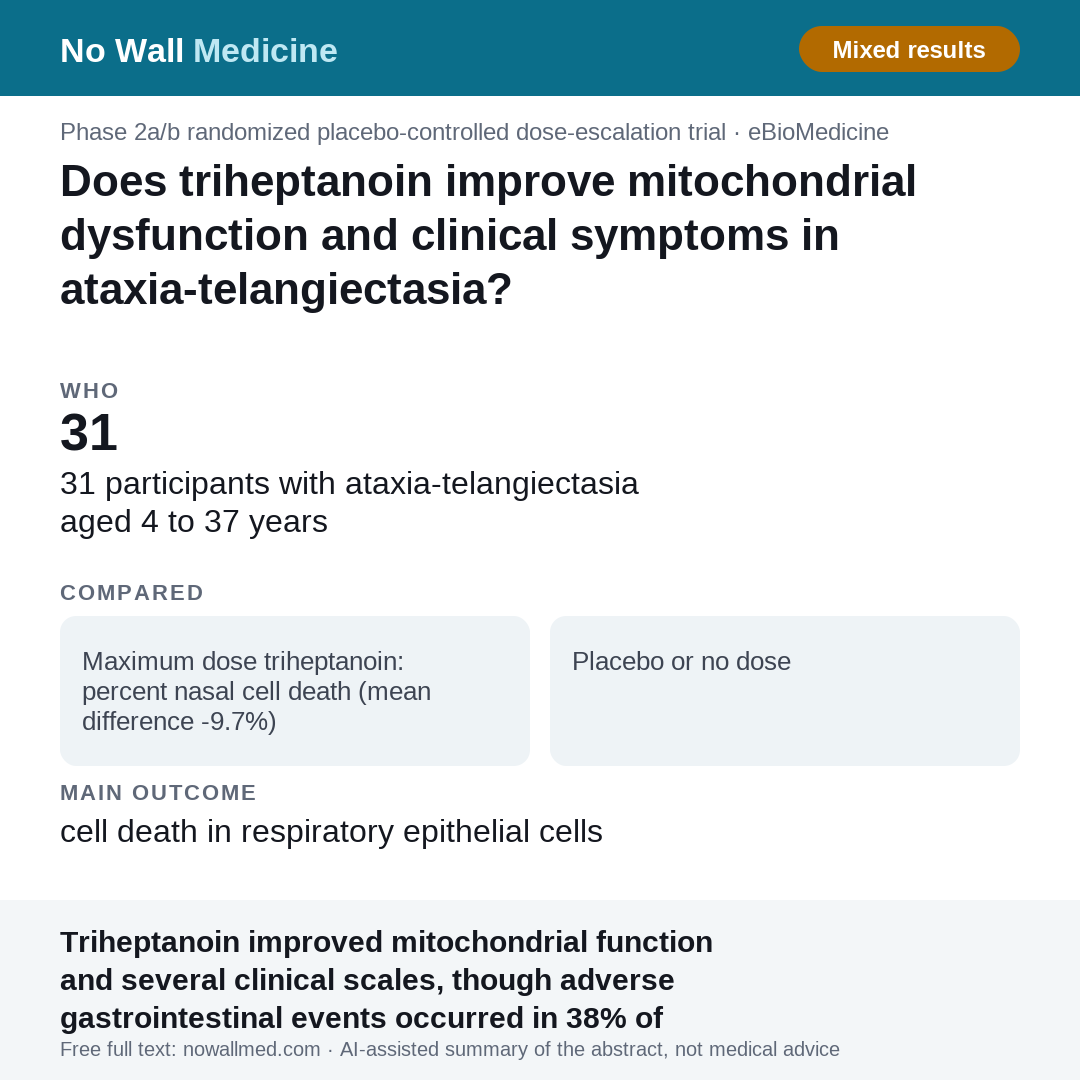
Clinical question: Does triheptanoin improve mitochondrial dysfunction and clinical symptoms in ataxia-telangiectasia?
Why it matters: Ataxia-telangiectasia involves mitochondrial dysfunction and defective cell connectivity that may be corrected by the triheptanoin metabolite, heptanoate.
Key points
- The study enrolled 31 participants with ataxia-telangiectasia, aged 4 to 37 years, to test different doses of triheptanoin against a placebo.
- At the maximum dose, the SARA subscale kinetic function improved with a mean difference of -5.8 and speech intelligibility improved with a mean difference of -12.8.
- Adverse events such as abdominal pain, nausea, vomiting, and diarrhoea occurred in 12 (38%) participants, leading to dose capping at 20%.
Headline and key points written with AI from the paper’s abstract, with every number checked against it. Read the paper before relying on them.
Topics
Cite this article
Lynch M, Manoy S, Sly PD, Wainwright CE, Wolvetang E, Feenstra JE. Phase 2a/b randomised placebo-controlled dose-escalation trial of triheptanoin for ataxia-telangiectasia: treating mitochondrial dysfunction with anaplerosis. eBioMedicine. 2025. doi:10.1016/j.ebiom.2025.105840
Spotted a mistake? Suggest a correction
Top studies every Monday
The week’s key trials and guidelines in your specialties, plus any topics you follow. By email, free.
Get the weekly digest