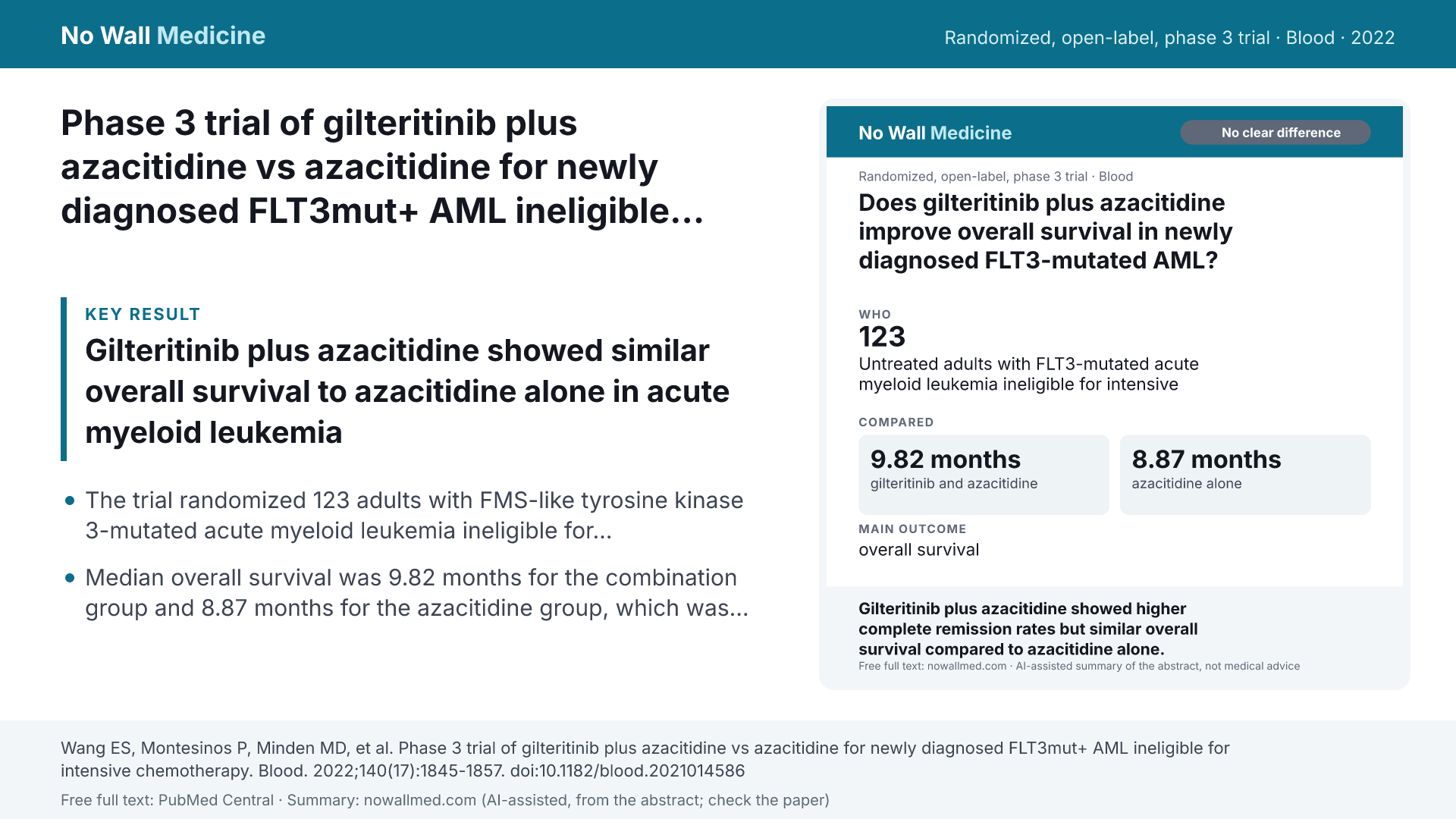
Gilteritinib plus azacitidine showed similar overall survival to azacitidine alone in acute myeloid leukemia
Phase 3 trial of gilteritinib plus azacitidine vs azacitidine for newly diagnosed FLT3mut+ AML ineligible for intensive chemotherapy
Randomized, open-label, phase 3 trialNo clear difference
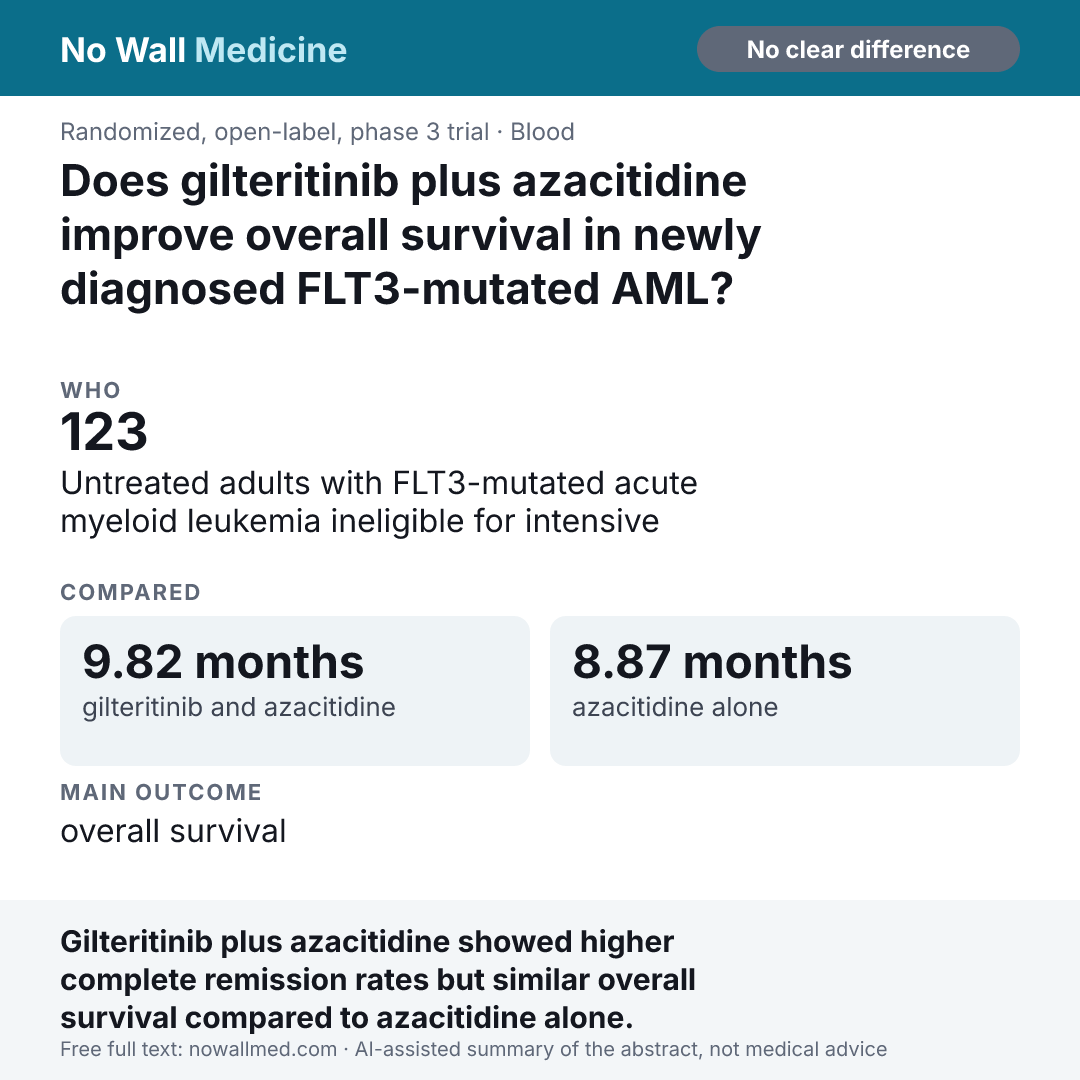
Does gilteritinib plus azacitidine improve overall survival in newly diagnosed FLT3-mutated AML?
Who
123
Untreated adults with FLT3-mutated acute myeloid leukemia ineligible for intensive chemotherapy · Multicenter
Compared
9.82 monthsgilteritinib and azacitidine
8.87 monthsazacitidine alone
Main outcome
overall survival
Result: hazard ratio 0.916 (95% CI 0.529-1.585)
Bottom line: Gilteritinib plus azacitidine showed higher complete remission rates but similar overall survival compared to azacitidine alone.
Blood · 2022-08-03 · Save PNG
Clinical question: Does gilteritinib plus azacitidine improve overall survival in newly diagnosed FLT3-mutated AML?
Why it matters: Treatment results for patients with newly diagnosed FMS-like tyrosine kinase 3-mutated acute myeloid leukemia who cannot receive intensive chemotherapy are disappointing.
Key points
- The trial randomized 123 adults with FMS-like tyrosine kinase 3-mutated acute myeloid leukemia ineligible for intensive chemotherapy to receive gilteritinib plus azacitidine or azacitidine alone.
- Median overall survival was 9.82 months for the combination group and 8.87 months for the azacitidine group, which was not a statistically significant difference.
- The combination group had a higher composite complete remission rate of 58.1% compared to 26.5% for the azacitidine group.
Headline and key points written with AI from the paper’s abstract, with every number checked against it. Read the paper before relying on them.
Was this summary helpful?
Abstract
Treatment results for patients with newly diagnosed FMS-like tyrosine kinase 3 (FLT3)-mutated (FLT3mut+) acute myeloid leukemia (AML) ineligible for intensive chemotherapy are disappointing. This multicenter, open-label, phase 3 trial randomized (2:1) untreated adults with FLT3mut+ AML ineligible for intensive induction chemotherapy to receive gilteritinib (120 mg/d orally) and azacitidine (GIL + AZA) or azacitidine (AZA) alone. The primary end point was overall survival (OS). At the interim analysis (August 26, 2020), a total of 123 patients were randomized to treatment (GIL + AZA, n = 74; AZA, n = 49). Subsequent AML therapy, including FLT3 inhibitors, was received by 20.3% (GIL + AZA) and 44.9% (AZA) of patients. Median OS was 9.82 (GIL + AZA) and 8.87 (AZA) months (hazard ratio, 0.916; 95% CI, 0.529-1.585; P = .753). The study was closed based on the protocol-specified boundary for futility. Median event-free survival was 0.03 month in both arms. Event-free survival defined by using composite complete remission (CRc) was 4.53 months for GIL + AZA and 0.03 month for AZA (hazard ratio, 0.686; 95% CI, 0.433-1.087; P = .156). CRc rates were 58.1% (GIL + AZA) and 26.5% (AZA) (difference, 31.4%; 95% CI, 13.1-49.7; P < .001). Adverse event (AE) rates were similar for GIL + AZA (100%) and AZA (95.7%); grade ≥3 AEs were 95.9% and 89.4%, respectively. Common AEs with GIL + AZA included pyrexia (47.9%) and diarrhea (38.4%). Gilteritinib steady-state trough concentrations did not differ between GIL + AZA and gilteritinib. GIL + AZA resulted in significantly higher CRc rates, although similar OS compared with AZA. Results support the safety/tolerability and clinical activity of upfront therapy with GIL + AZA in older/unfit patients with FLT3mut+ AML. This trial was registered at www.clinicaltrials.gov as #NCT02752035.
Abstract reproduced under the article’s CC BY NC ND licence.
Subject terms
Headline, design, result, key points, caveat and citation as plain text.
Cite this article
Wang ES, Montesinos P, Minden MD, et al. Phase 3 trial of gilteritinib plus azacitidine vs azacitidine for newly diagnosed FLT3mut+ AML ineligible for intensive chemotherapy. Blood. 2022;140(17):1845-1857. doi:10.1182/blood.2021014586
Spotted a mistake? Suggest a correction