Atezolizumab and sipuleucel-T combination showed safety in patients with advanced prostate cancer
Phase Ib study of patients with metastatic castrate-resistant prostate cancer treated with different sequencing regimens of atezolizumab and sipuleucel-T
Randomized phase Ib trialBenefit found
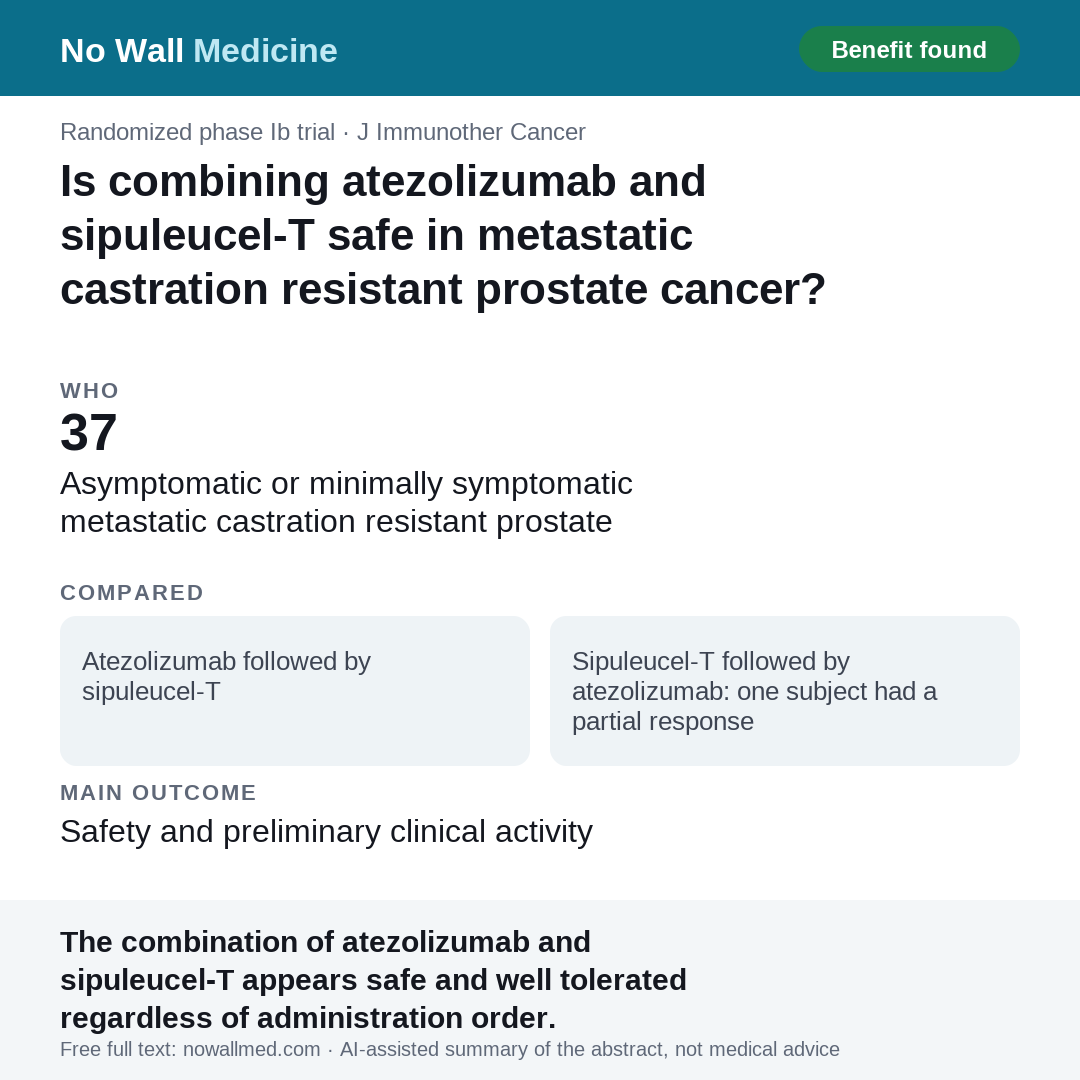
Is combining atezolizumab and sipuleucel-T safe in metastatic castration resistant prostate cancer?
Who
37
Asymptomatic or minimally symptomatic metastatic castration resistant prostate cancer patients
Compared
Atezolizumab followed by sipuleucel-T
Sipuleucel-T followed by atezolizumab: one subject had a partial response
Main outcome
Safety and preliminary clinical activity
Bottom line: The combination of atezolizumab and sipuleucel-T appears safe and well tolerated regardless of administration order.
Limitation: Further studies are needed.
J Immunother Cancer · 2021-08-11Download image
Clinical question: Is combining atezolizumab and sipuleucel-T safe in metastatic castration resistant prostate cancer?
Key points
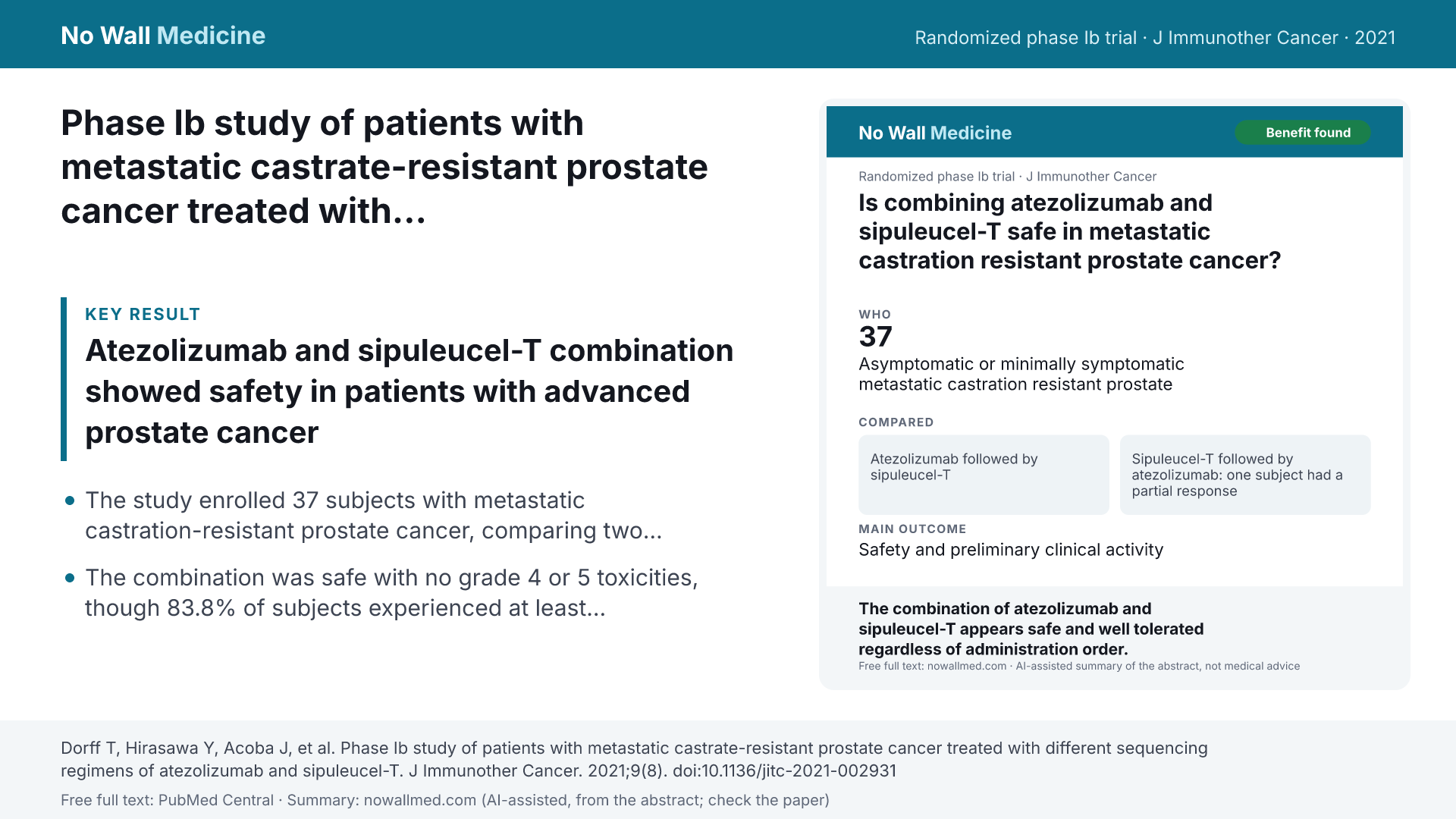
- The study enrolled 37 subjects with metastatic castration-resistant prostate cancer, comparing two different sequences of atezolizumab, an immune checkpoint inhibitor, and sipuleucel-T, a tumor vaccine.
- The combination was safe with no grade 4 or 5 toxicities, though 83.8% of subjects experienced at least one treatment-related adverse event.
- Among 23 subjects with measurable disease, the objective response rate was 4.3% and the disease control rate was 21.7% at 6 months.
Headline and key points written with AI from the paper’s abstract, with every number checked against it. Read the paper before relying on them.
Was this summary helpful?
Abstract
Background
Combining an immune checkpoint inhibitor with a tumor vaccine may modulate the immune system to leverage complementary mechanisms of action that lead to sustained T-cell activation and a potent prolonged immunotherapeutic response in metastatic castration resistant prostate cancer (mCRPC). Methods
Subjects with asymptomatic or minimally symptomatic mCRPC were randomly assigned in a 1:1 ratio to receive either atezolizumab followed by sipuleucel-T (Arm 1) or sipuleucel-T followed by atezolizumab (Arm 2). The primary endpoint was safety, while secondary endpoints included preliminary clinical activity such as objective tumor response and systemic immune responses that could identify key molecular and immunological changes associated with sequential administration of atezolizumab and sipuleucel-T. Results
A total of 37 subjects were enrolled. The median age was 75.0 years, median prostate specific antigen (PSA) was 21.9 ng/mL, and subjects had a median number of three prior treatments. Most subjects (83.8%) had at least one treatment-related adverse event. There were no grade 4 or 5 toxicities attributed to either study drug. Immune-related adverse events and infusion reactions occurred in 13.5% of subjects, and all of which were grade 1 or 2. Of 23 subjects with Response Evaluation Criteria in Solid Tumors measurable disease, only one subject in Arm 2 had a partial response (PR) and four subjects overall had stable disease (SD) at 6 months reflecting an objective response rate of 4.3% and a disease control rate of 21.7%. T-cell receptor diversity was higher in subjects with a response, including SD. Immune response to three novel putative antigens (SIK3, KDM1A/LSD1, and PIK3R6) appeared to increase with treatment. Conclusions
Overall, regardless of the order in which they were administered, the combination of atezolizumab with sipuleucel-T appears to be safe and well tolerated with a comparable safety profile to each agent administered as monotherapy. Correlative immune studies may suggest the combination to be beneficial; however, further studies are needed. Trial registration number
NCT03024216.
Abstract reproduced under the article’s CC BY NC licence.
Subject terms
Cite this article
Dorff T, Hirasawa Y, Acoba J, et al. Phase Ib study of patients with metastatic castrate-resistant prostate cancer treated with different sequencing regimens of atezolizumab and sipuleucel-T. J Immunother Cancer. 2021. doi:10.1136/jitc-2021-002931
Spotted a mistake? Suggest a correction