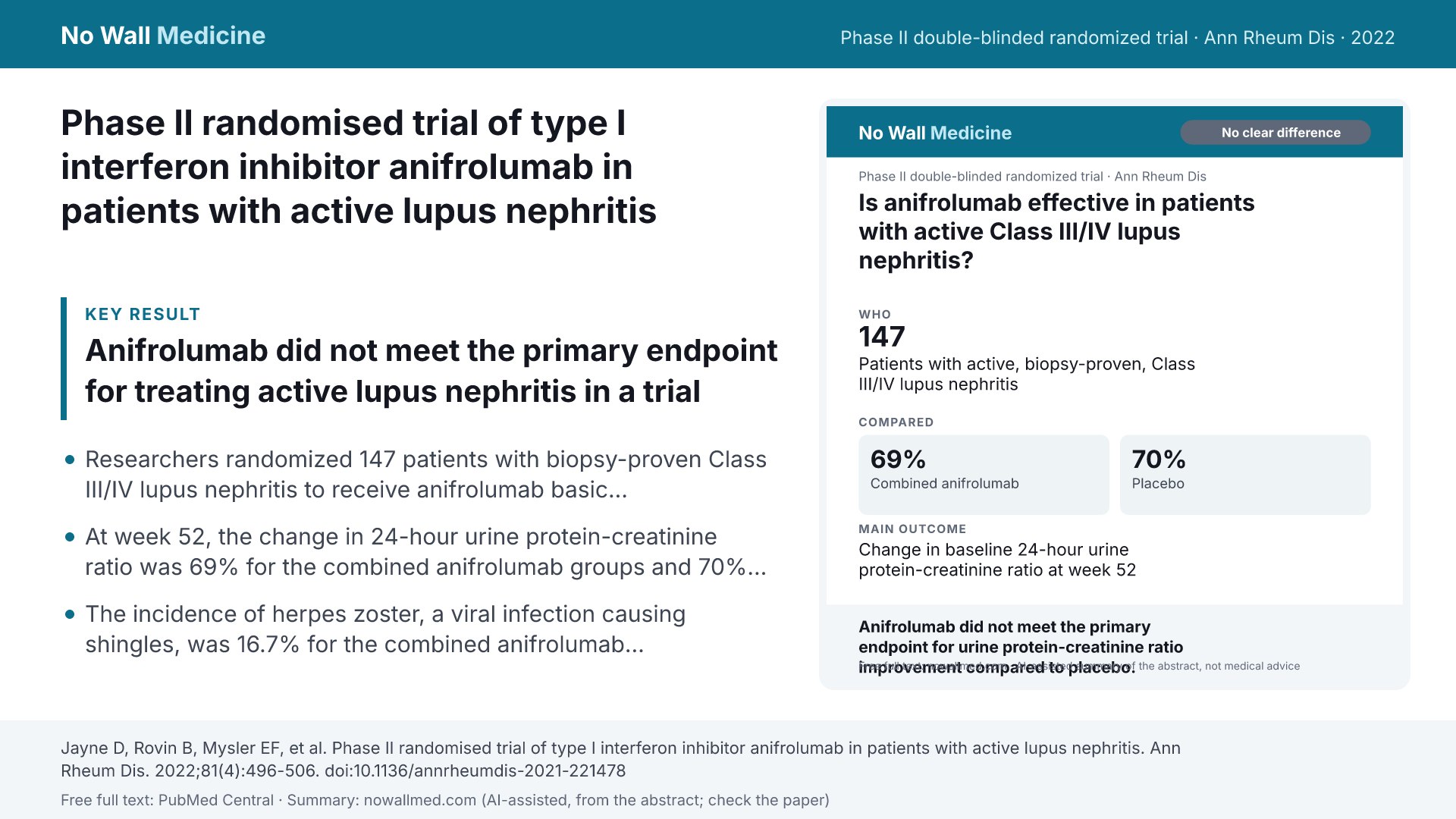
Anifrolumab did not meet the primary endpoint for treating active lupus nephritis in a trial
Phase II randomised trial of type I interferon inhibitor anifrolumab in patients with active lupus nephritis
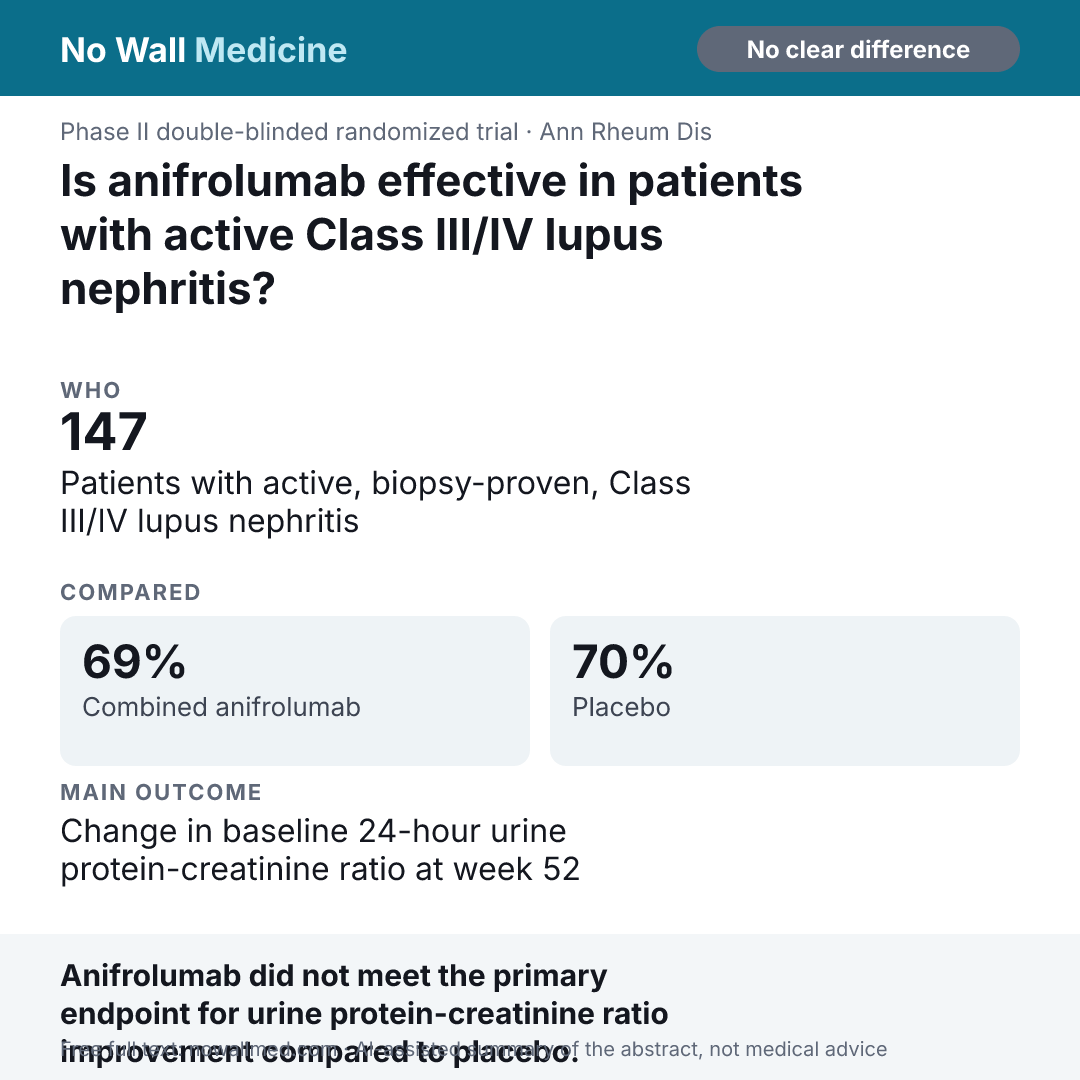
Phase II double-blinded randomized trialNo clear difference
Is anifrolumab effective in patients with active Class III/IV lupus nephritis?
Who
147
Patients with active, biopsy-proven, Class III/IV lupus nephritis
Compared
69%Combined anifrolumab
70%Placebo
Main outcome
Change in baseline 24-hour urine protein-creatinine ratio at week 52
Result: geometric mean ratio=1.03; 95% CI 0.62 to 1.71
Bottom line: Anifrolumab did not meet the primary endpoint for urine protein-creatinine ratio improvement compared to placebo.
Ann Rheum Dis · 2022-02-10 · Save PNG
Same trial (NCT02547922)
Papers we list that report this registered trial, oldest first. Read a secondary analysis alongside the main results.
- Main results No clear difference
This paper Ann Rheum Dis 2022-02 - Related analysis Unclear result
Anifrolumab treatment changes specific metabolites in patients with lupus nephritis in a phase 2 trial RMD Open 2025-10 - Related analysis
Anifrolumab reduced urinary kidney inflammation markers faster than placebo in lupus nephritis Arthritis Rheumatol 2026-03
Clinical question: Is anifrolumab effective in patients with active Class III/IV lupus nephritis?
Key points
- Researchers randomized 147 patients with biopsy-proven Class III/IV lupus nephritis to receive anifrolumab basic regimen, anifrolumab intensified regimen, or a placebo alongside standard therapy.
- At week 52, the change in 24-hour urine protein-creatinine ratio was 69% for the combined anifrolumab groups and 70% for the placebo group (p=0.905).
- The incidence of herpes zoster, a viral infection causing shingles, was 16.7% for the combined anifrolumab groups compared to 8.2% for the placebo group.
Headline and key points written with AI from the paper’s abstract, with every number checked against it. Read the paper before relying on them.
Was this summary helpful?
Abstract
Objective
To assess the efficacy and safety of the type I interferon receptor antibody, anifrolumab, in patients with active, biopsy-proven, Class III/IV lupus nephritis. Methods
This phase II double-blinded study randomised 147 patients (1:1:1) to receive monthly intravenous anifrolumab basic regimen (BR, 300 mg), intensified regimen (IR, 900 mg ×3, 300 mg thereafter) or placebo, alongside standard therapy (oral glucocorticoids, mycophenolate mofetil). The primary endpoint was change in baseline 24-hour urine protein-creatinine ratio (UPCR) at week (W) 52 for combined anifrolumab versus placebo groups. The secondary endpoint was complete renal response (CRR) at W52. Exploratory endpoints included more stringent CRR definitions and sustained glucocorticoid reductions (≤7.5 mg/day, W24-52). Safety was analysed descriptively. Results
Patients received anifrolumab BR (n=45), IR (n=51), or placebo (n=49). At W52, 24-hour UPCR improved by 69% and 70% for combined anifrolumab and placebo groups, respectively (geometric mean ratio=1.03; 95% CI 0.62 to 1.71; p=0.905). Serum concentrations were higher with anifrolumab IR versus anifrolumab BR, which provided suboptimal exposure. Numerically more patients treated with anifrolumab IR vs placebo attained CRR (45.5% vs 31.1%), CRR with UPCR ≤0.5 mg/mg (40.9% vs 26.7%), CRR with inactive urinary sediment (40.9% vs 13.3%) and sustained glucocorticoid reductions (55.6% vs 33.3%). Incidence of herpes zoster was higher with combined anifrolumab vs placebo (16.7% vs 8.2%). Incidence of serious adverse events was similar across groups. Conclusion
Although the primary endpoint was not met, anifrolumab IR was associated with numerical improvements over placebo across endpoints, including CRR, in patients with active lupus nephritis. Trial registration number
NCT02547922.
Abstract reproduced under the article’s CC BY NC licence.
Subject terms
Headline, design, result, key points, caveat and citation as plain text.
Cite this article
Jayne D, Rovin B, Mysler EF, et al. Phase II randomised trial of type I interferon inhibitor anifrolumab in patients with active lupus nephritis. Ann Rheum Dis. 2022;81(4):496-506. doi:10.1136/annrheumdis-2021-221478
Spotted a mistake? Suggest a correction