One year of everolimus added to endocrine therapy did not improve outcomes in high-risk breast cancer
Phase III Randomized, Placebo-Controlled Trial of Endocrine Therapy ± 1 Year of Everolimus in Patients With High-Risk, Hormone Receptor-Positive, Early-Stage Breast Cancer
Randomized, placebo-controlled trialNo clear difference
Does adding everolimus to endocrine therapy improve outcomes in high-risk early-stage breast cancer?
Who
1792
High-risk, hormone receptor-positive, human epidermal growth factor receptor 2-negative breast cancer patients
Compared
Everolimus plus endocrine therapy
Placebo plus endocrine therapy
Main outcome
invasive disease-free survival
Result: hazard ratio 0.94 (95% CI 0.77 to 1.14)
Bottom line: One year of adjuvant everolimus plus endocrine therapy did not improve invasive disease-free survival or overall survival.
J Clin Oncol · 2024-06-04Download image
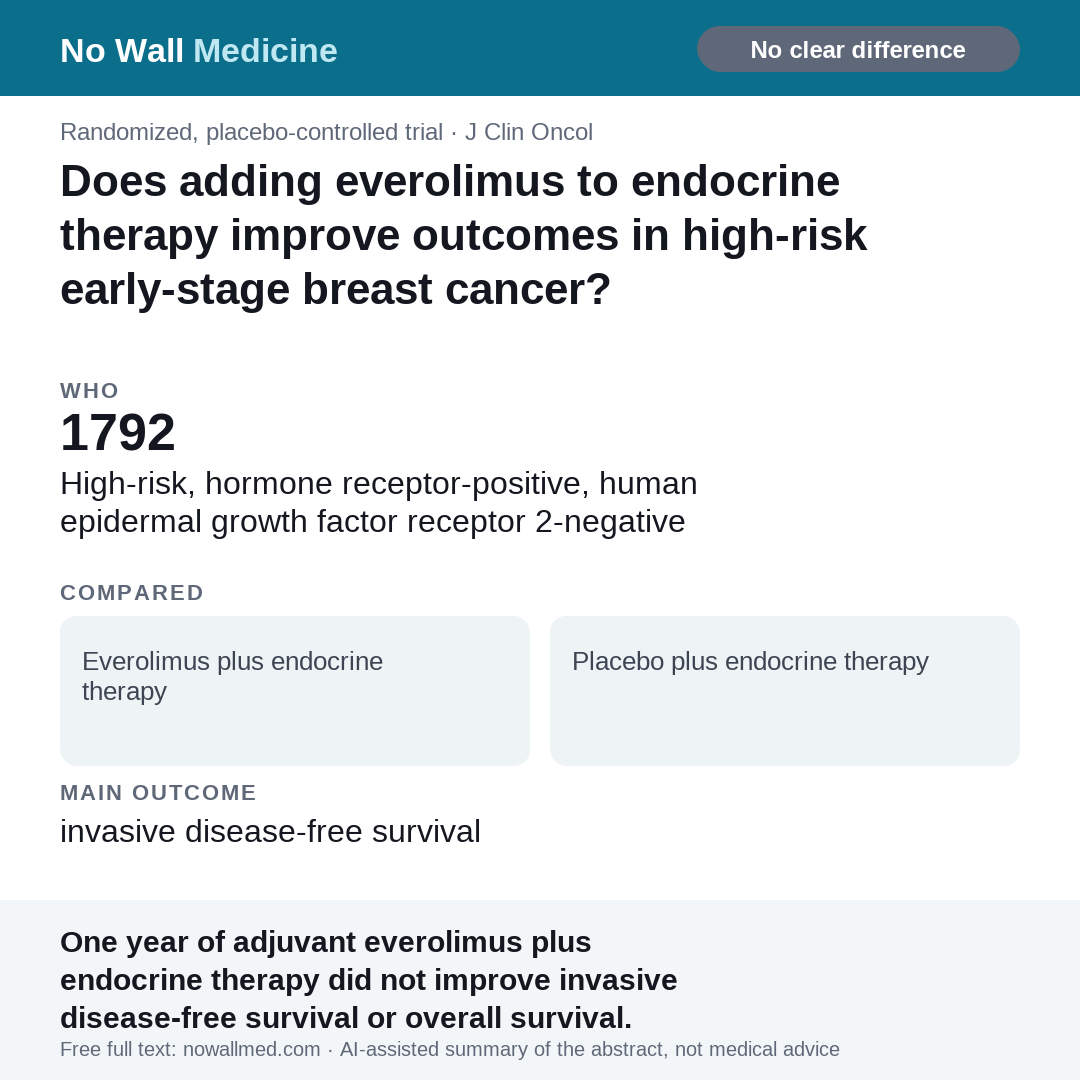
Clinical question: Does adding everolimus to endocrine therapy improve outcomes in high-risk early-stage breast cancer?
Why it matters: It was unknown if adding an mTOR inhibitor to endocrine therapy as adjuvant therapy would improve outcomes for patients with high-risk, early-stage breast cancer.
Key points
- Researchers studied 1,792 patients with high-risk, hormone receptor-positive, human epidermal growth factor receptor 2-negative breast cancer assigned to either endocrine therapy plus everolimus or a placebo.
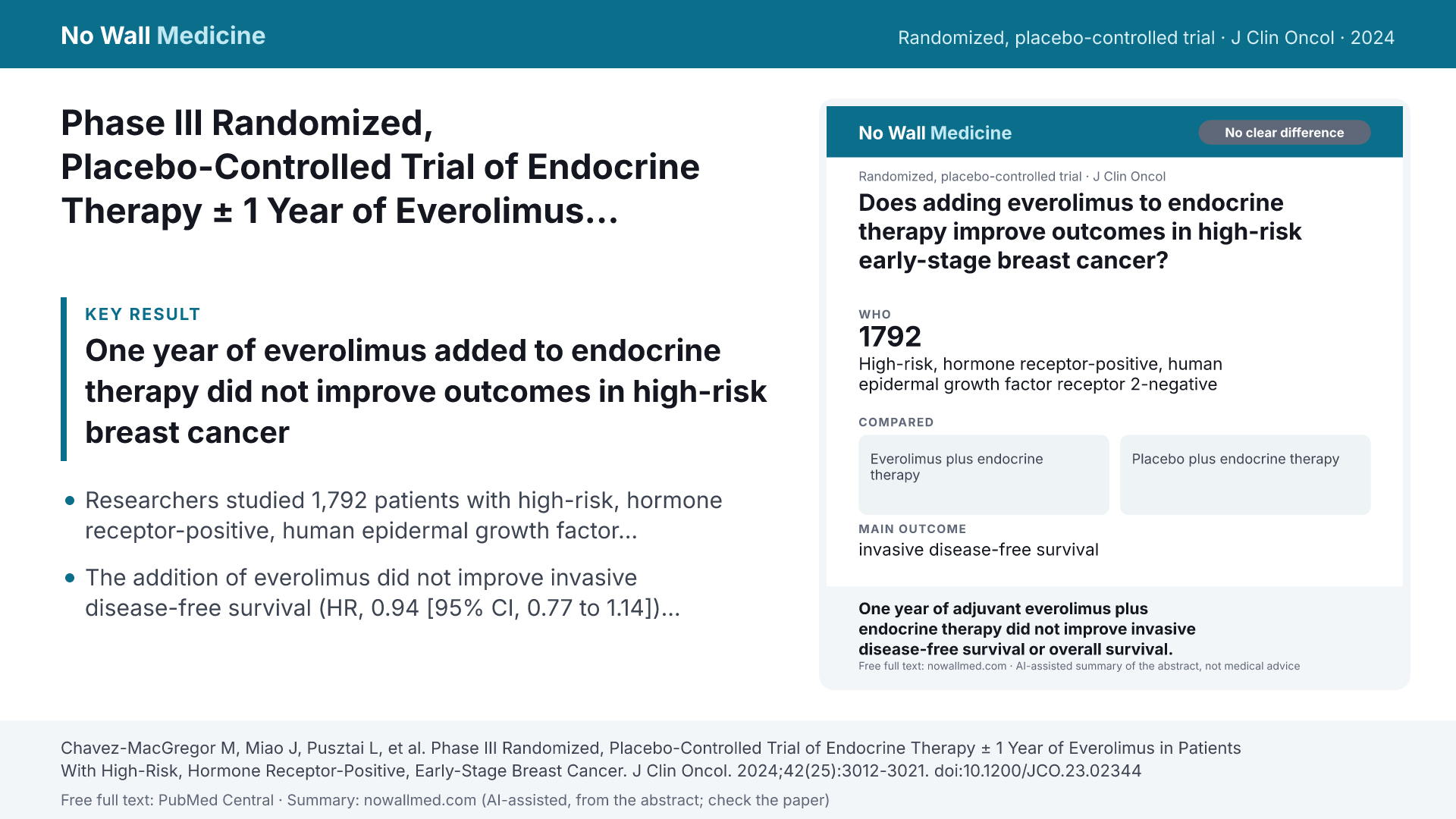
- The addition of everolimus did not improve invasive disease-free survival (HR, 0.94 [95% CI, 0.77 to 1.14]) or overall survival (HR, 0.97 [95% CI, 0.75 to 1.26]).
- Grade 3 and 4 adverse events were higher in the everolimus group at 35% compared to 7% in the placebo group.
Headline and key points written with AI from the paper’s abstract, with every number checked against it. Read the paper before relying on them.
Was this summary helpful?
Subject terms
Cite this article
Chavez-MacGregor M, Miao J, Pusztai L, Goetz MP, Rastogi P, Ganz PA. Phase III Randomized, Placebo-Controlled Trial of Endocrine Therapy ± 1 Year of Everolimus in Patients With High-Risk, Hormone Receptor-Positive, Early-Stage Breast Cancer. J Clin Oncol. 2024. doi:10.1200/JCO.23.02344
Spotted a mistake? Suggest a correction
Top studies every Monday
The week’s key trials and guidelines in your specialties, plus any topics you follow. By email, free.
Get the weekly digest