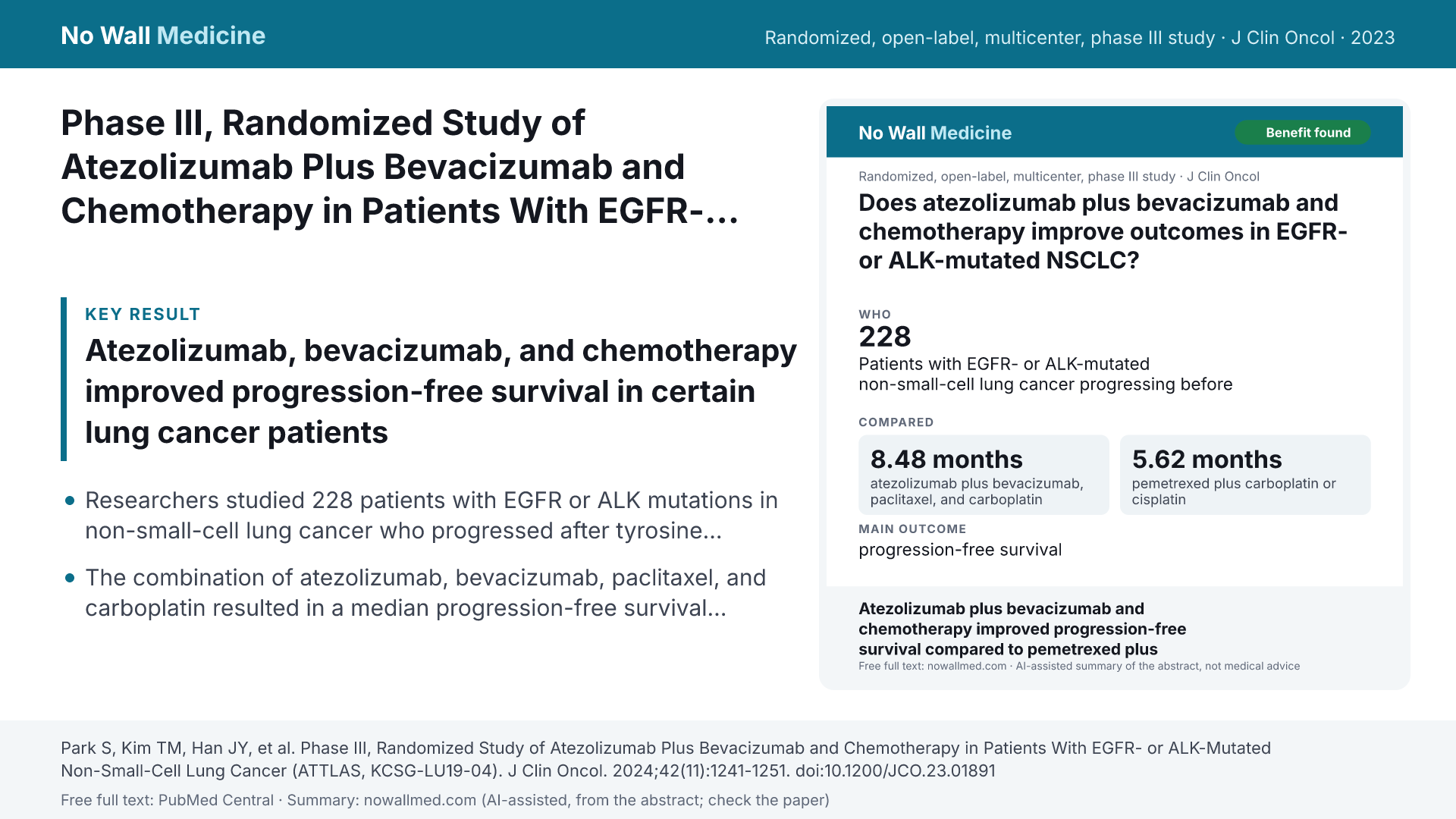
Atezolizumab, bevacizumab, and chemotherapy improved progression-free survival in certain lung cancer patients
Phase III, Randomized Study of Atezolizumab Plus Bevacizumab and Chemotherapy in Patients With EGFR- or ALK-Mutated Non-Small-Cell Lung Cancer (ATTLAS, KCSG-LU19-04)
Randomized, open-label, multicenter, phase III studyBenefit found
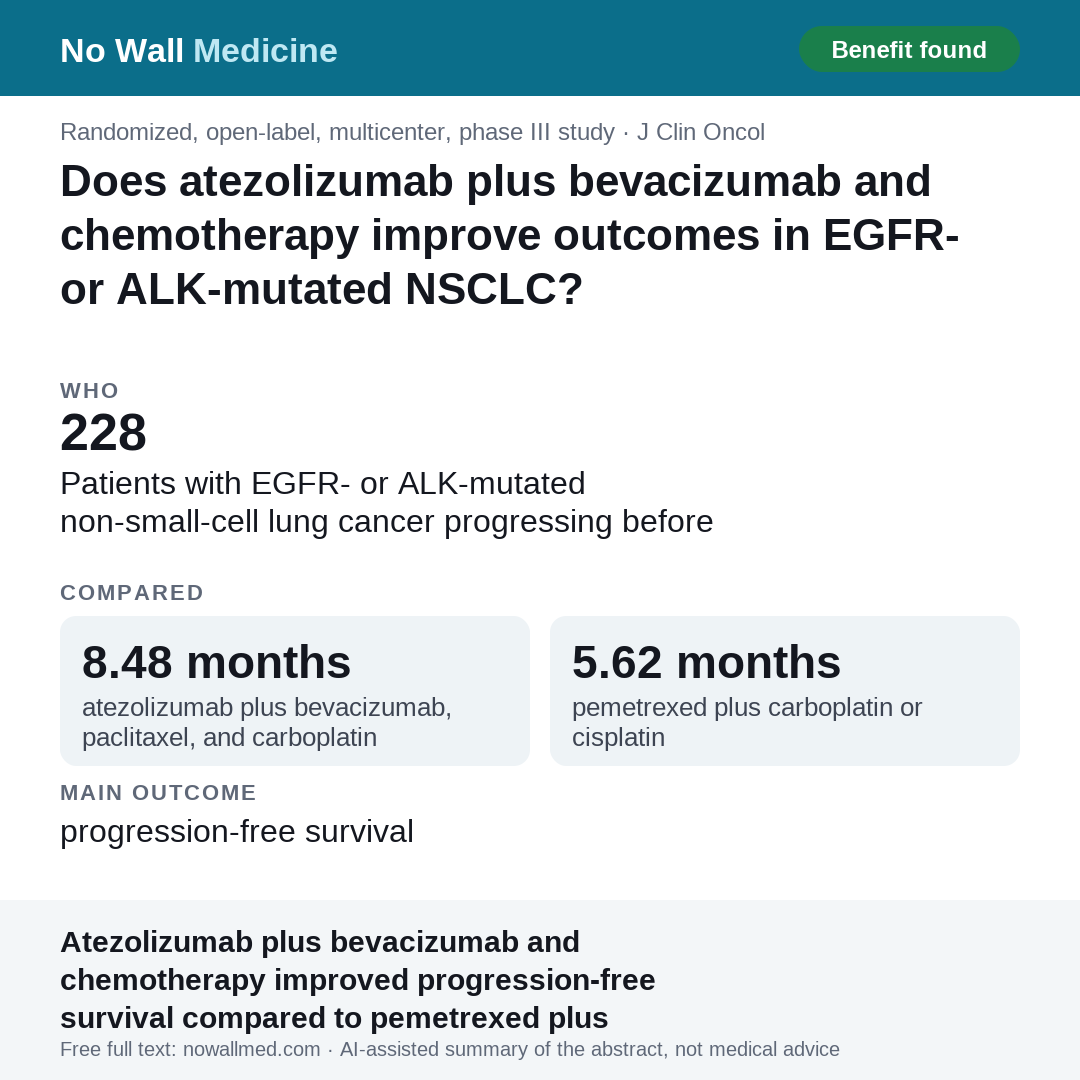
Does atezolizumab plus bevacizumab and chemotherapy improve outcomes in EGFR- or ALK-mutated NSCLC?
Who
228
Patients with EGFR- or ALK-mutated non-small-cell lung cancer progressing before tyrosine kinase inhibitor therapy · 16 sites in the Republic of Korea
Compared
8.48 monthsatezolizumab plus bevacizumab, paclitaxel, and carboplatin
5.62 monthspemetrexed plus carboplatin or cisplatin
Main outcome
progression-free survival
Result: hazard ratio 0.62 (95% CI 0.45 to 0.86)
Bottom line: Atezolizumab plus bevacizumab and chemotherapy improved progression-free survival compared to pemetrexed plus platinum chemotherapy.
J Clin Oncol · 2023-10-20Download image
Clinical question: Does atezolizumab plus bevacizumab and chemotherapy improve outcomes in EGFR- or ALK-mutated NSCLC?
Key points
- Researchers studied 228 patients with EGFR or ALK mutations in non-small-cell lung cancer who progressed after tyrosine kinase inhibitor therapy.
- The combination of atezolizumab, bevacizumab, paclitaxel, and carboplatin resulted in a median progression-free survival of 8.48 months compared to 5.62 months for chemotherapy alone.
- The objective response rate was 69.5% for the combination therapy versus 41.9% for the chemotherapy group, though overall survival was similar at 20.63 versus 20.27 months.
Headline and key points written with AI from the paper’s abstract, with every number checked against it. Read the paper before relying on them.
Was this summary helpful?
Subject terms
Cite this article
Park S, Kim TM, Han JY, et al. Phase III, Randomized Study of Atezolizumab Plus Bevacizumab and Chemotherapy in Patients With EGFR- or ALK-Mutated Non-Small-Cell Lung Cancer (ATTLAS, KCSG-LU19-04). J Clin Oncol. 2023. doi:10.1200/JCO.23.01891
Spotted a mistake? Suggest a correction