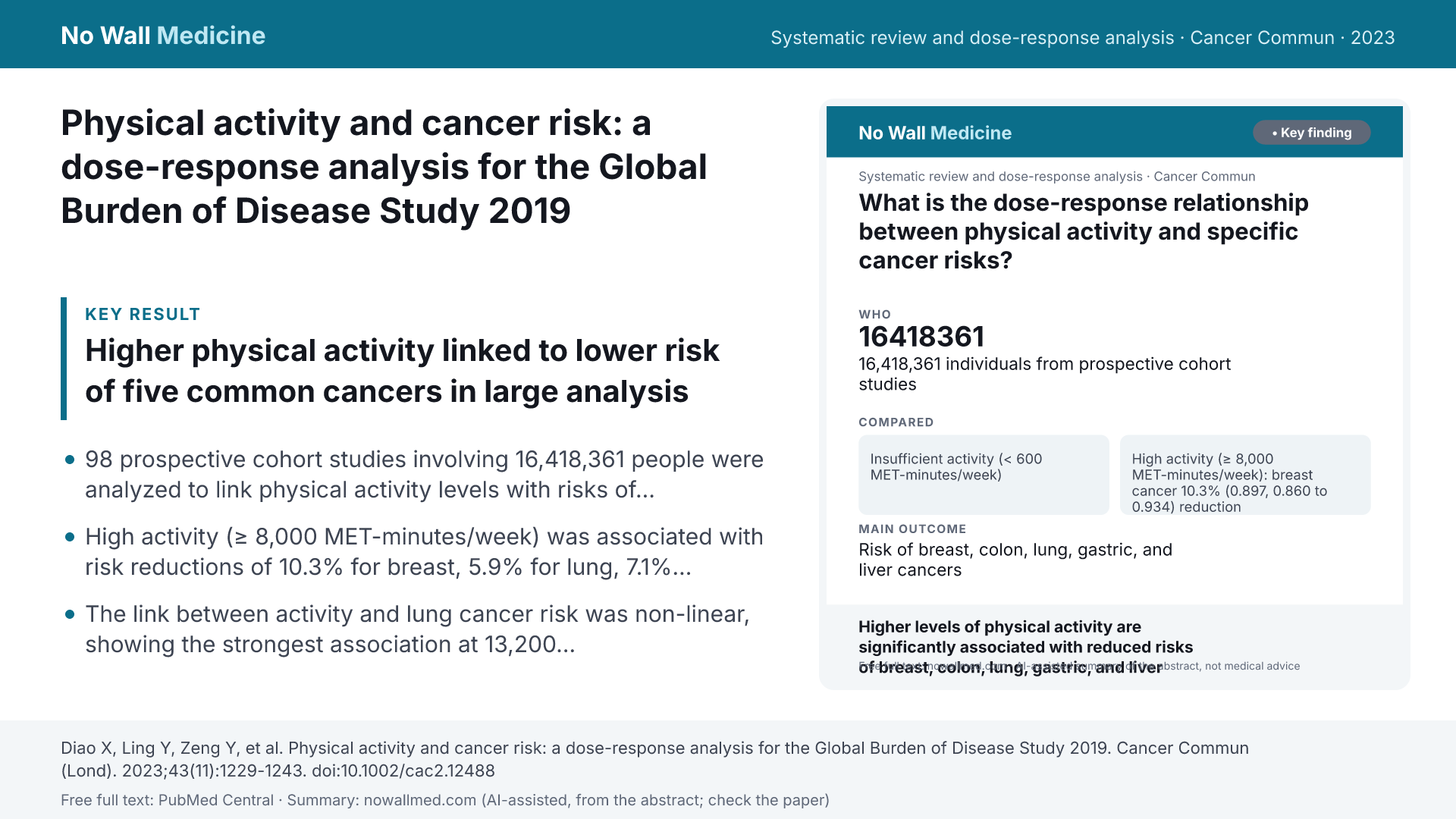
Physical activity and cancer risk: a dose-response analysis for the Global Burden of Disease Study 2019
Key result: Higher physical activity linked to lower risk of five common cancers in large analysis
Systematic review and dose-response analysisKey finding
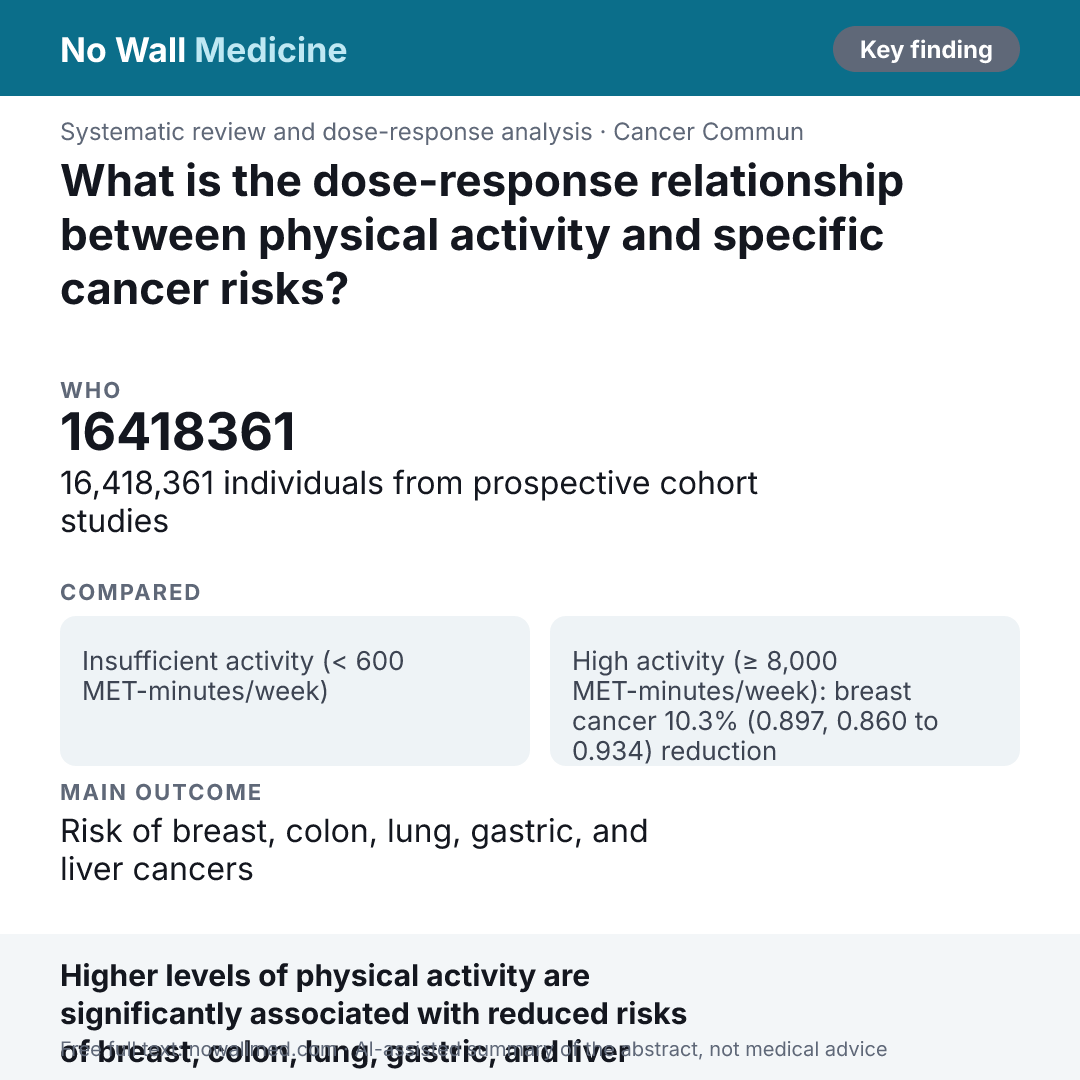
What is the dose-response relationship between physical activity and specific cancer risks?
Who
16418361
16,418,361 individuals from prospective cohort studies
Compared
Insufficient activity (< 600 MET-minutes/week)
High activity (≥ 8,000 MET-minutes/week): breast cancer 10.3% (0.897, 0.860 to 0.934) reduction
Main outcome
Risk of breast, colon, lung, gastric, and liver cancers
Result: lung cancer risk reduction 14.7% (relative risk 0.853, uncertainty interval 0.798 to 0.912)
Bottom line: Higher levels of physical activity are significantly associated with reduced risks of breast, colon, lung, gastric, and liver cancers.
Cancer Commun · 2023-09-24 · Save PNG
Key points
- 98 prospective cohort studies involving 16,418,361 people were analyzed to link physical activity levels with risks of breast, lung, colon, gastric, and liver cancers.
- High activity (≥ 8,000 MET-minutes/week) was associated with risk reductions of 10.3% for breast, 5.9% for lung, 7.1% for colon, 5.1% for gastric, and 17.1% for liver cancer.
- The link between activity and lung cancer risk was non-linear, showing the strongest association at 13,200 MET-minutes/week, while other cancers showed linear trends.
Why it matters: Previous evidence on how much physical activity is needed to lower cancer risk for specific cancer types was not quantitatively established.
Discussion prompts
- Would these patients look like yours? Who was left out?
- Is the main outcome one that matters to patients?
- Is the difference large enough to change what you do?
Cite: Diao X, Ling Y, Zeng Y, et al. Physical activity and cancer risk: a dose-response analysis for the Global Burden of Disease Study 2019. Cancer Commun (Lond). 2023;43(11):1229-1243. doi:10.1002/cac2.12488
Free full text: PubMed Central · Summary and visual abstract: nowallmed.com/a/physical-activity-and-cancer-risk-a-dose-response-analysis-for-the-1wyxirw/ (AI-assisted from the abstract; check the paper before relying on it).