Physical activity and diet just-in-time adaptive intervention to reduce blood pressure: a randomized controlled trial
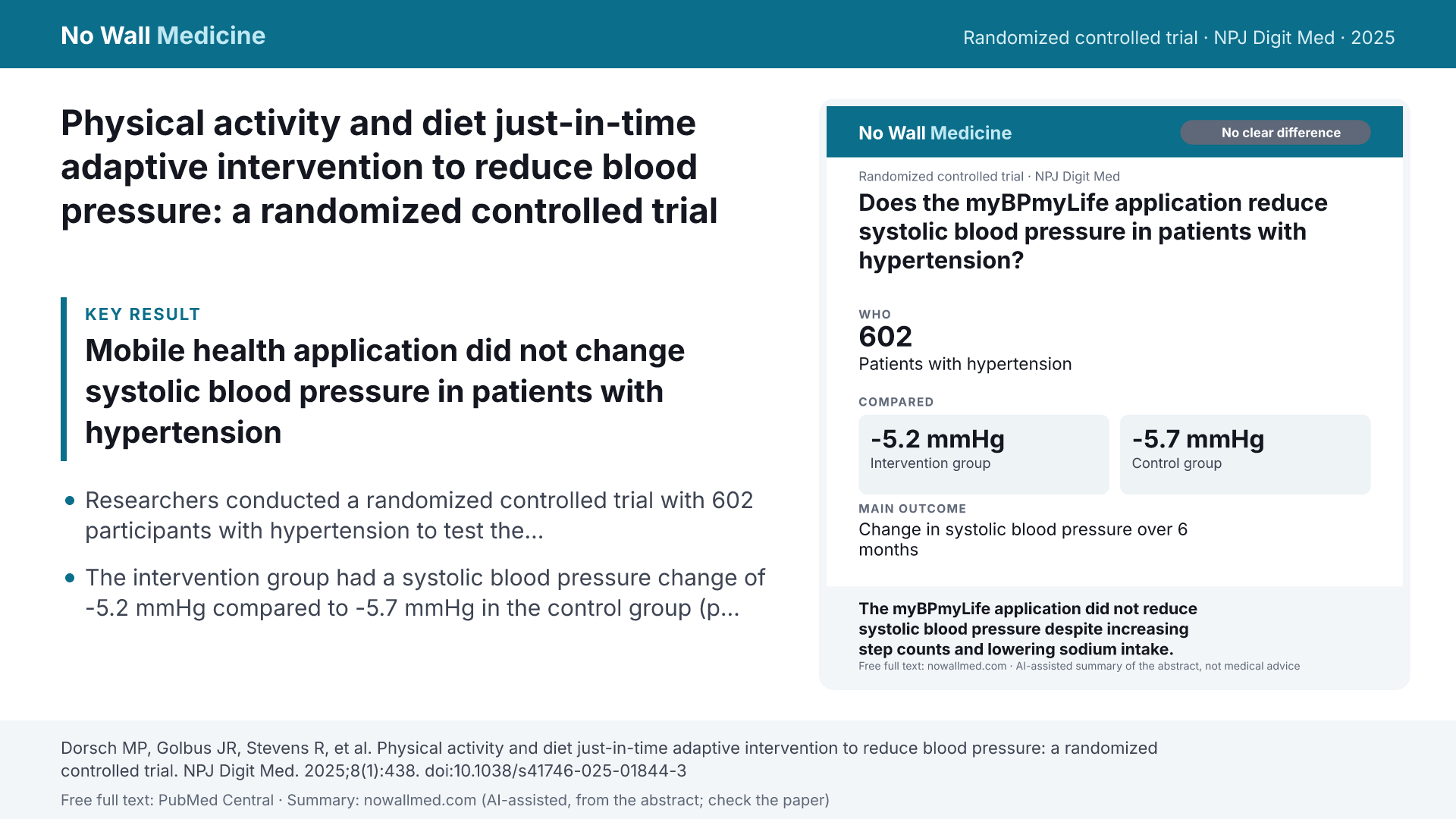
Key result: Mobile health application did not change systolic blood pressure in patients with hypertension
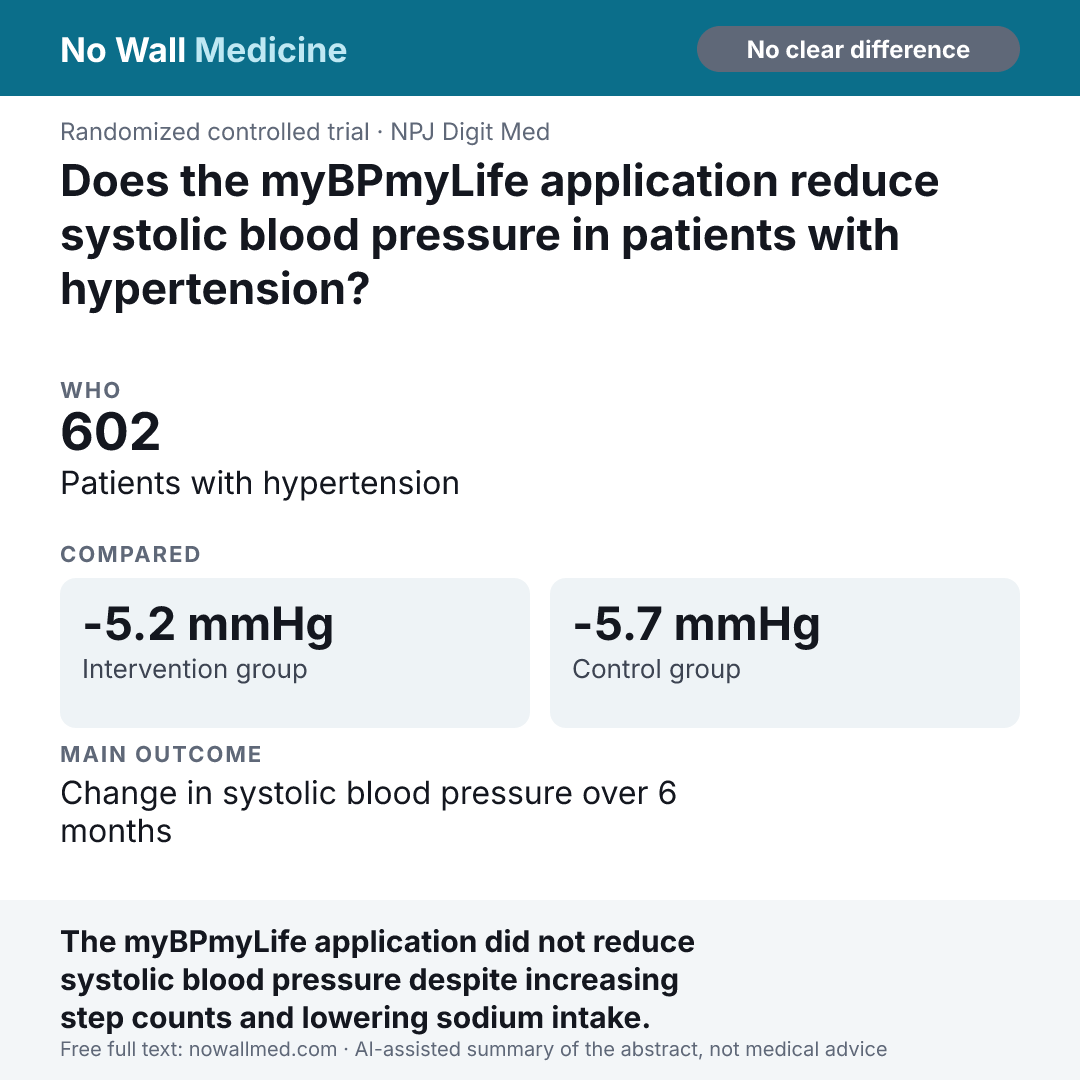
Randomized controlled trialNo clear difference
Does the myBPmyLife application reduce systolic blood pressure in patients with hypertension?
Who
602
Patients with hypertension
Compared
-5.2 mmHgIntervention group
-5.7 mmHgControl group
Main outcome
Change in systolic blood pressure over 6 months
Bottom line: The myBPmyLife application did not reduce systolic blood pressure despite increasing step counts and lowering sodium intake.
NPJ Digit Med · 2025-07-14 · Save PNG
Key points
- Researchers conducted a randomized controlled trial with 602 participants with hypertension to test the myBPmyLife application for physical activity and low-sodium food habits.
- The intervention group had a systolic blood pressure change of -5.2 mmHg compared to -5.7 mmHg in the control group (p = 0.76).
- The application group increased daily steps by 170 steps while the control group decreased by 319 steps (p = 0.040).
Why it matters: Large-scale studies are required to ensure that mobile health interventions for behavioral change provide clinical benefits for patients with hypertension.
Discussion prompts
- Would these patients look like yours? Who was left out?
- Is the main outcome one that matters to patients?
- Is the difference large enough to change what you do?
Cite: Dorsch MP, Golbus JR, Stevens R, et al. Physical activity and diet just-in-time adaptive intervention to reduce blood pressure: a randomized controlled trial. NPJ Digit Med. 2025;8(1):438. doi:10.1038/s41746-025-01844-3
Free full text: PubMed Central · Summary and visual abstract: nowallmed.com/a/physical-activity-and-diet-just-in-time-adaptive-intervention-to-1xg3gao/ (AI-assisted from the abstract; check the paper before relying on it).