Wearable devices show physical activity levels in rheumatic disease patients often fall below recommended thresholds
Physical activity assessment with wearable devices in rheumatic diseases: a systematic review and meta-analysis
Systematic review and meta-analysisHarm found
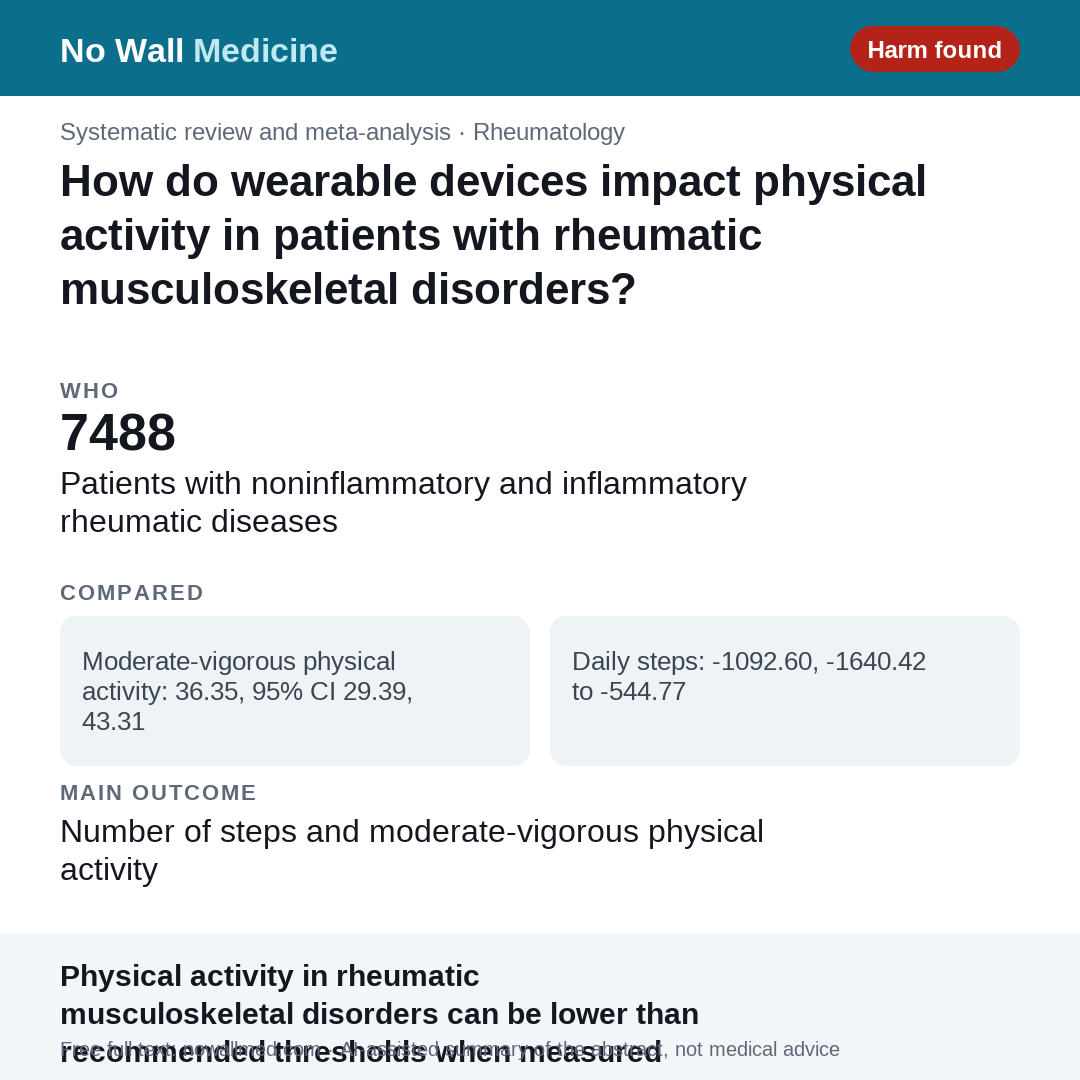
How do wearable devices impact physical activity in patients with rheumatic musculoskeletal disorders?
Who
7488
Patients with noninflammatory and inflammatory rheumatic diseases
Compared
Moderate-vigorous physical activity: 36.35, 95% CI 29.39, 43.31
Daily steps: -1092.60, -1640.42 to -544.77
Main outcome
Number of steps and moderate-vigorous physical activity
Bottom line: Physical activity in rheumatic musculoskeletal disorders can be lower than recommended thresholds when measured objectively with wearable devices.
Rheumatology · 2022-08-26Download image
Clinical question: How do wearable devices impact physical activity in patients with rheumatic musculoskeletal disorders?
Why it matters: It was unknown how much physical activity patients with noninflammatory and inflammatory rheumatic diseases actually perform when measured objectively with wearable devices.
Key points
- Researchers analyzed 51 studies involving 7488 participants to evaluate physical activity measured by wearable devices in patients with rheumatic musculoskeletal disorders.
- The meta-analysis found that the recommended threshold was reached for moderate-to-vigorous physical activity (36.35, 95% CI 29.39, 43.31) but not for daily steps (-1092.60, -1640.42 to -544.77).
- Patients with fibromyalgia reported a higher number of daily steps (6290, 5198.65-7381.62) compared to other rheumatic musculoskeletal disorders.
Headline and key points written with AI from the paper’s abstract, with every number checked against it. Read the paper before relying on them.
Was this summary helpful?
Subject terms
Cite this article
Ocagli H, Agarinis R, Azzolina D, Zabotti A, Treppo E, Francavilla A. Physical activity assessment with wearable devices in rheumatic diseases: a systematic review and meta-analysis. Rheumatology. 2022. doi:10.1093/rheumatology/keac476
Spotted a mistake? Suggest a correction
Top studies every Monday
The week’s key trials and guidelines in your specialties, plus any topics you follow. By email, free.
Get the weekly digest