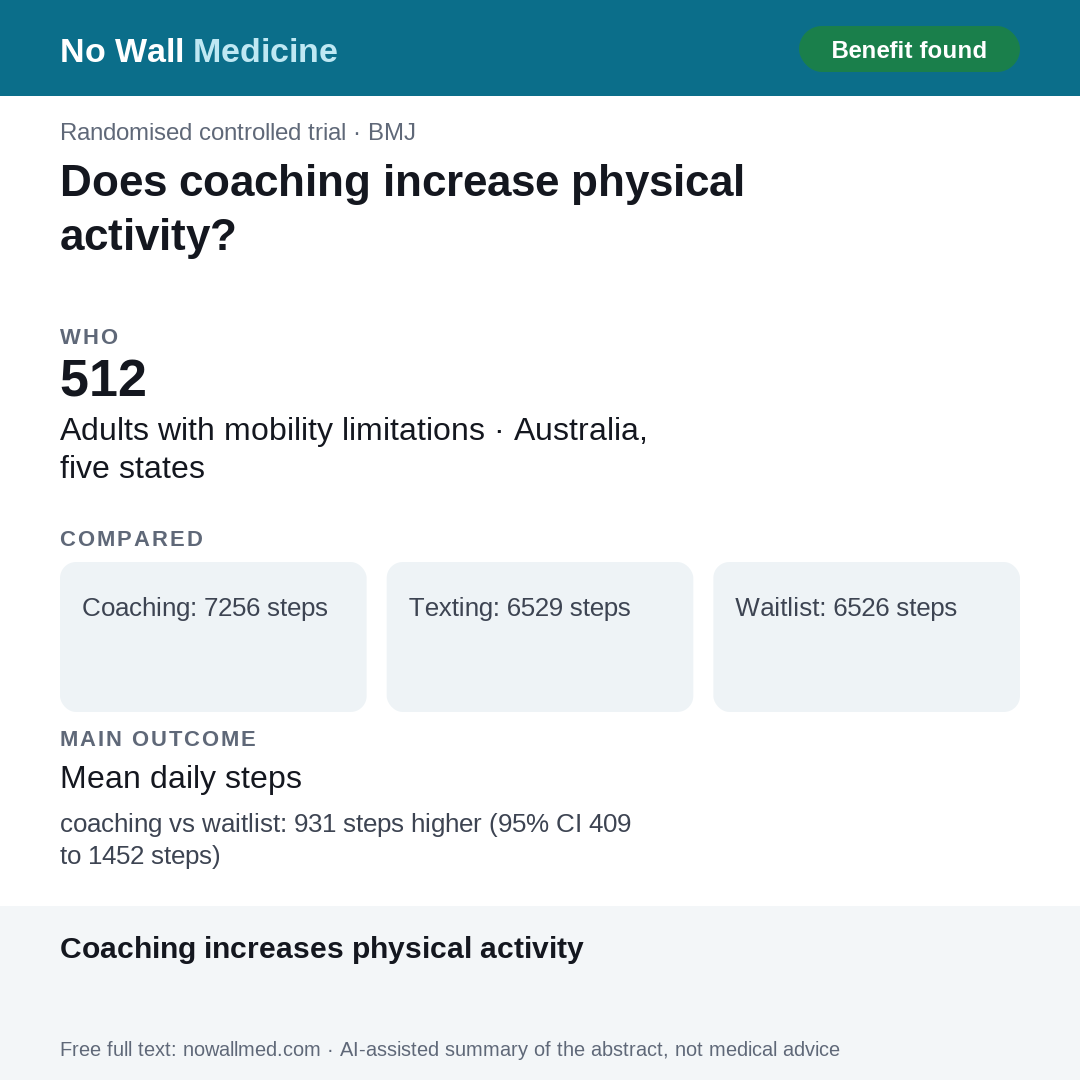
Coaching increased daily steps by 931 compared to no intervention in adults with mobility limitations
Physical activity coaching and text messaging for adults with mobility limitations (ComeBACK): hybrid type 1 effectiveness implementation randomised controlled trial
Pearce LMN, Sherrington C, Tiedemann A, Hinman RS, Crotty M, Taylor NF, et al
Objective
To evaluate the effectiveness of a physical activity coaching intervention compared with text messaging intervention and waitlist control in adults with mobility limitations. Design
Three arm, pragmatic, superiority, hybrid type 1 effectiveness implementation randomised controlled trial. Setting
Health services and general communities across five Australian states, 19 December 2018 to 7 March 2023. Participants
512 community dwelling adults (≥18 years) who self-reported mobility limitations (difficulty or inability to walk 800 m, with or without a walking aid) but were still able to leave home without physical assistance from another person. Interventions
Participants were randomly assigned in a 1:1:1 allocation ratio to: a six month, multicomponent intervention including fortnightly physiotherapist delivered telephone coaching (coaching group, n=172); a six month, multicomponent intervention including regular unidirectional text messages (texting group, n=171); and no intervention for six months, followed by the six month text messaging intervention (waitlist control group, n=169). Participants and physiotherapists were unmasked to group allocation. Main outcome measure
The primary outcome was device measured mean daily steps at six months, analysed according to treatment allocation using all available data. Outcome assessors and data analysts were masked to group allocation. Results
Participants' mean age was 69 years (standard deviation (SD) 10 years) and 76% (n=388/511) were women. More than half (n=263/508, 51%) of participants reported multiple long term conditions as the main reason for their mobility limitation. At six months, mean daily steps were 931 higher (95% confidence interval 409 to 1452 steps; P=0.001) in the coaching group (mean 7256 (SD 3736) steps) compared with waitlist group (6526 (3003) steps); and 571 steps higher (58 to 1084, P=0.03) compared with the texting group (6529 (3029) steps). Mean daily steps in the texting group were 359 higher (-91 to 810, P=0.12) compared with the waitlist group, but this was not statistically significant. The number of adverse events was similar between groups (11/172 (6%) in the coaching group, 7/171 (4%) in the texting group, and 13/169 (8%) in the waitlist group) and none were serious. Conclusion
A person centred coaching intervention produced modest increases in physical activity and was more effective than a less intensive texting intervention or no intervention among adults with mobility limitations. Trial registration
Australian New Zealand Clinical Trials Registry ACTRN12618001983291.
Abstract reproduced under the article’s CC BY licence.