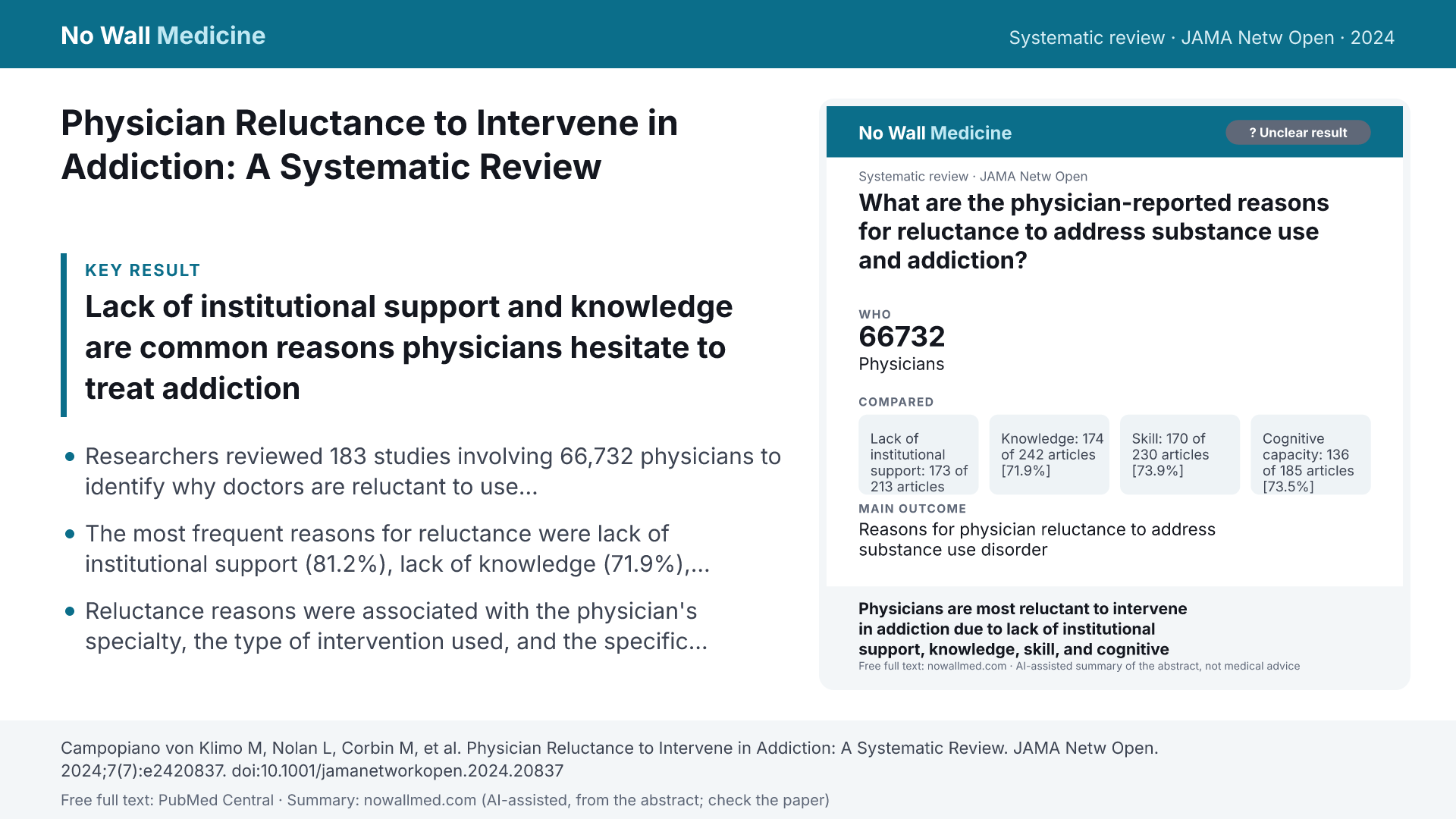
Lack of institutional support and knowledge are common reasons physicians hesitate to treat addiction
Physician Reluctance to Intervene in Addiction: A Systematic Review
Systematic reviewUnclear result
What are the physician-reported reasons for reluctance to address substance use and addiction?
Who
66732
Physicians
Compared
Lack of institutional support: 173 of 213 articles [81.2%]
Knowledge: 174 of 242 articles [71.9%]
Skill: 170 of 230 articles [73.9%]
Cognitive capacity: 136 of 185 articles [73.5%]
Main outcome
Reasons for physician reluctance to address substance use disorder
Bottom line: Physicians are most reluctant to intervene in addiction due to lack of institutional support, knowledge, skill, and cognitive capacity.
JAMA Netw Open · 2024-07-01 · Save PNG
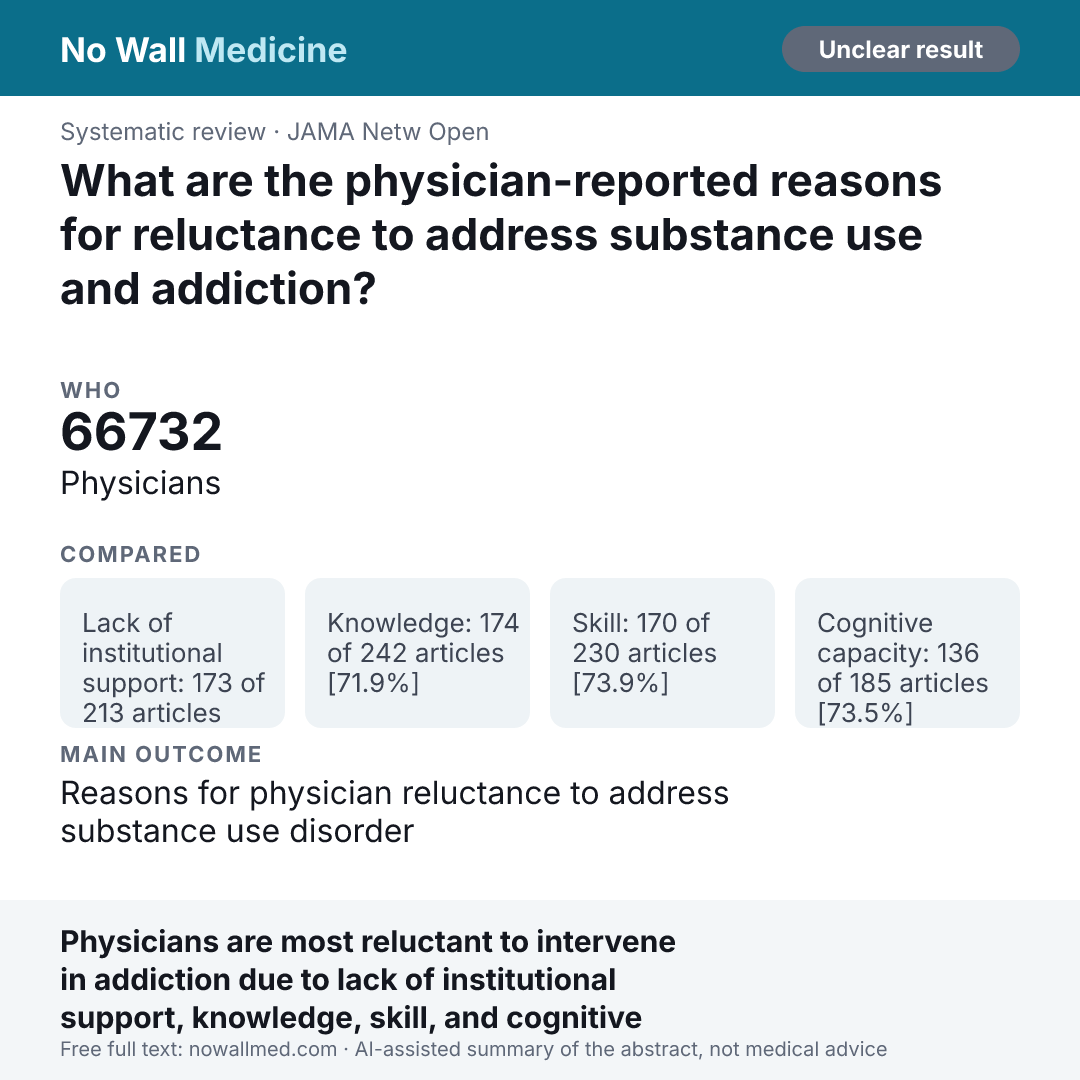
Clinical question: What are the physician-reported reasons for reluctance to address substance use and addiction?
Why it matters: Physicians have shown low adoption rates of evidence-based practices for substance use disorders despite widespread training and support efforts.
Key points
- Researchers reviewed 183 studies involving 66,732 physicians to identify why doctors are reluctant to use evidence-based practices for substance use disorders.
- The most frequent reasons for reluctance were lack of institutional support (81.2%), lack of knowledge (71.9%), lack of skill (73.9%), and cognitive capacity (73.5%).
- Reluctance reasons were associated with the physician's specialty, the type of intervention used, and the specific drug involved.
Headline and key points written with AI from the paper’s abstract, with every number checked against it. Read the paper before relying on them.
Was this summary helpful?
Subject terms
Headline, design, result, key points, caveat and citation as plain text.
Cite this article
Campopiano von Klimo M, Nolan L, Corbin M, et al. Physician Reluctance to Intervene in Addiction: A Systematic Review. JAMA Netw Open. 2024;7(7):e2420837. doi:10.1001/jamanetworkopen.2024.20837
Spotted a mistake? Suggest a correction