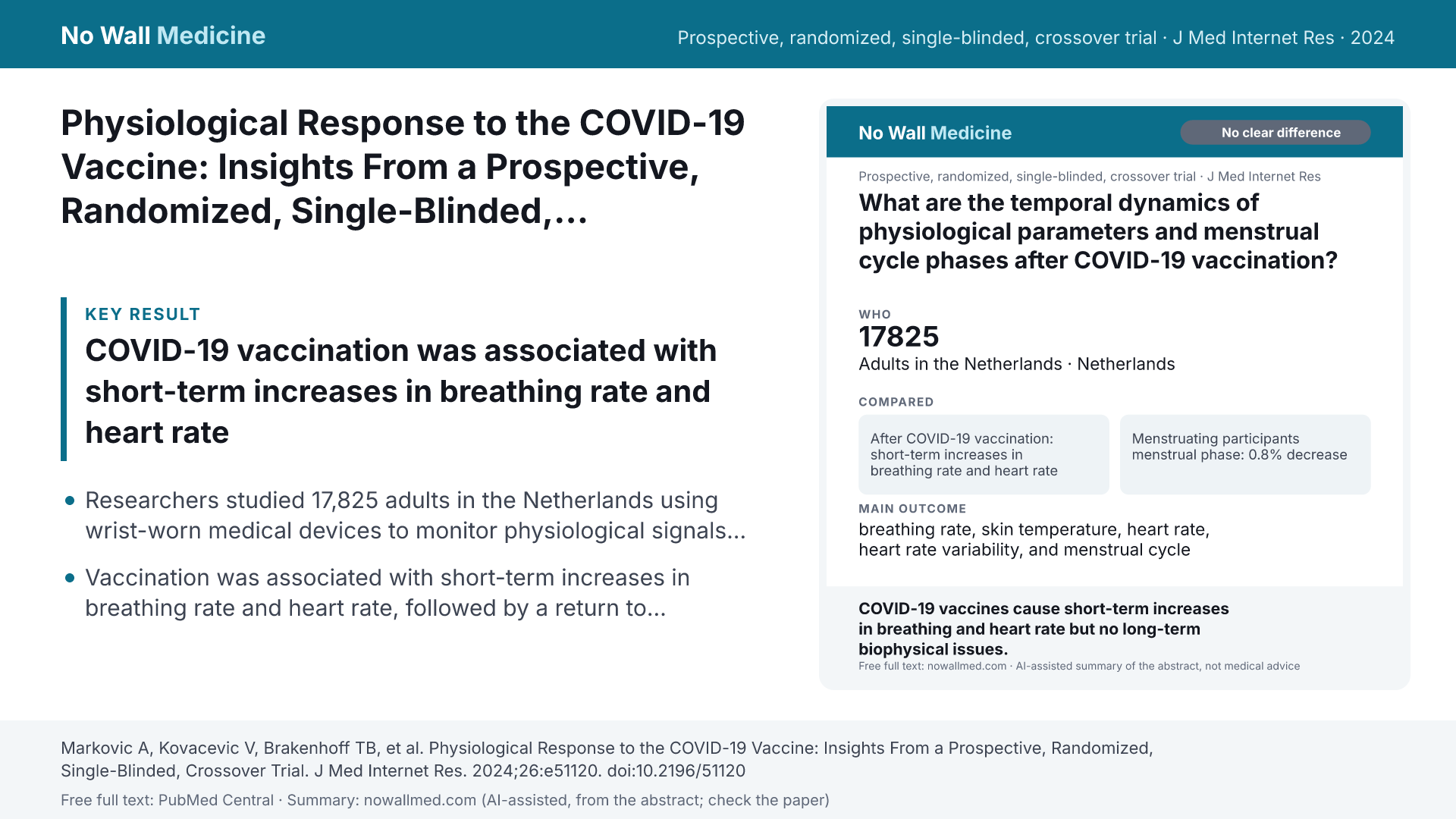
COVID-19 vaccination was associated with short-term increases in breathing rate and heart rate
Physiological Response to the COVID-19 Vaccine: Insights From a Prospective, Randomized, Single-Blinded, Crossover Trial
Prospective, randomized, single-blinded, crossover trialNo clear difference
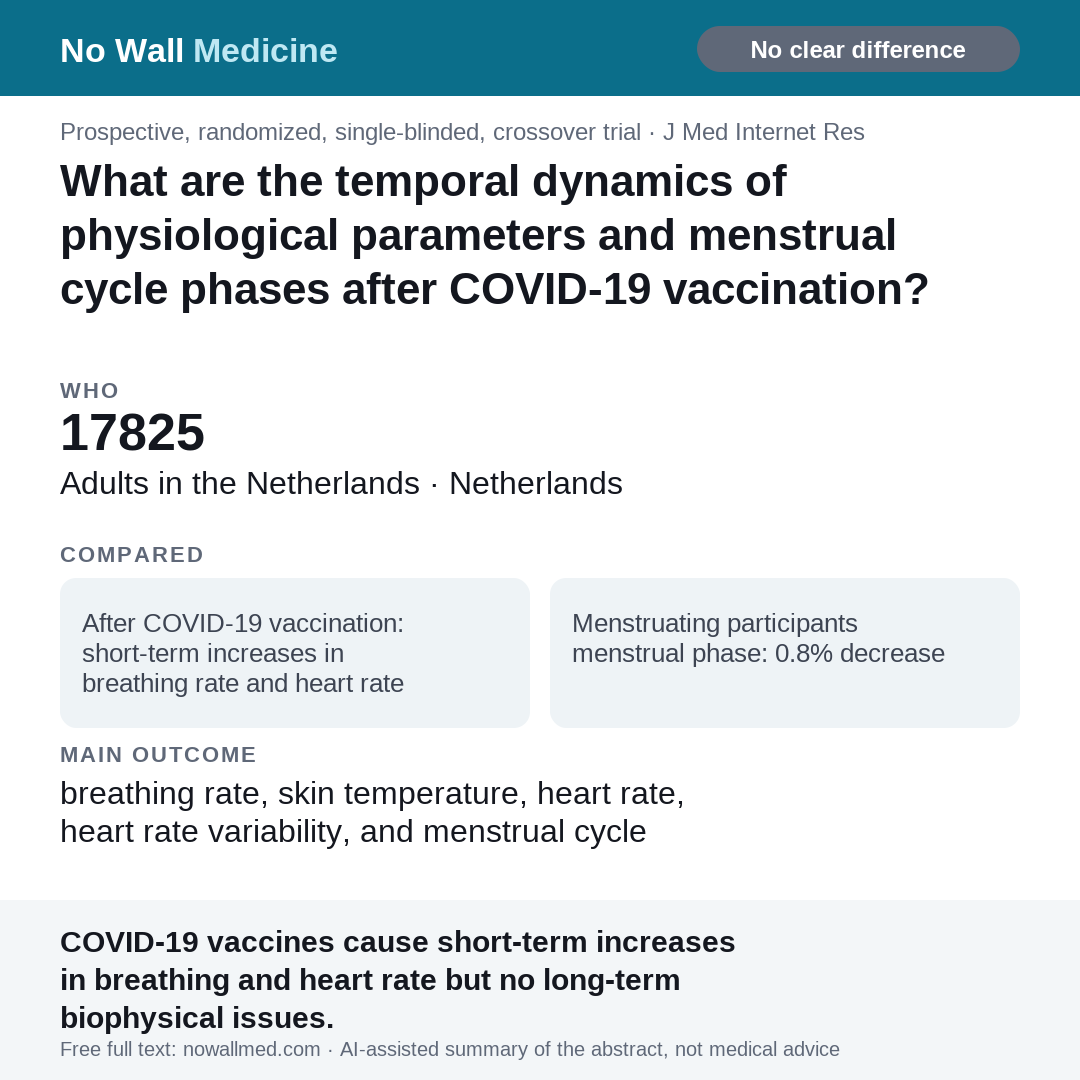
What are the temporal dynamics of physiological parameters and menstrual cycle phases after COVID-19 vaccination?
Who
17825
Adults in the Netherlands · Netherlands
Compared
After COVID-19 vaccination: short-term increases in breathing rate and heart rate
Menstruating participants menstrual phase: 0.8% decrease
Main outcome
breathing rate, skin temperature, heart rate, heart rate variability, and menstrual cycle phases
Bottom line: COVID-19 vaccines cause short-term increases in breathing and heart rate but no long-term biophysical issues.
J Med Internet Res · 2024-07-31Download image
Clinical question: What are the temporal dynamics of physiological parameters and menstrual cycle phases after COVID-19 vaccination?
Key points
- Researchers studied 17,825 adults in the Netherlands using wrist-worn medical devices to monitor physiological signals and menstrual cycles.
- Vaccination was associated with short-term increases in breathing rate and heart rate, followed by a return to baseline levels.
- In menstruating participants, vaccination was associated with a 0.8% decrease in the duration of the menstrual phase.
Headline and key points written with AI from the paper’s abstract, with every number checked against it. Read the paper before relying on them.
Was this summary helpful?
Subject terms
Headline, design, result, key points, caveat and citation as plain text.
Cite this article
Markovic A, Kovacevic V, Brakenhoff TB, et al. Physiological Response to the COVID-19 Vaccine: Insights From a Prospective, Randomized, Single-Blinded, Crossover Trial. J Med Internet Res. 2024. doi:10.2196/51120
Spotted a mistake? Suggest a correction