Meta-analysis shows low prevalence of double vision and sunken eye after orbital fracture reconstruction
Pilot Study: Facial Trauma Reconstruction Outcomes: Systematic Review and Meta-analysis
Systematic review and meta-analysisNo clear difference
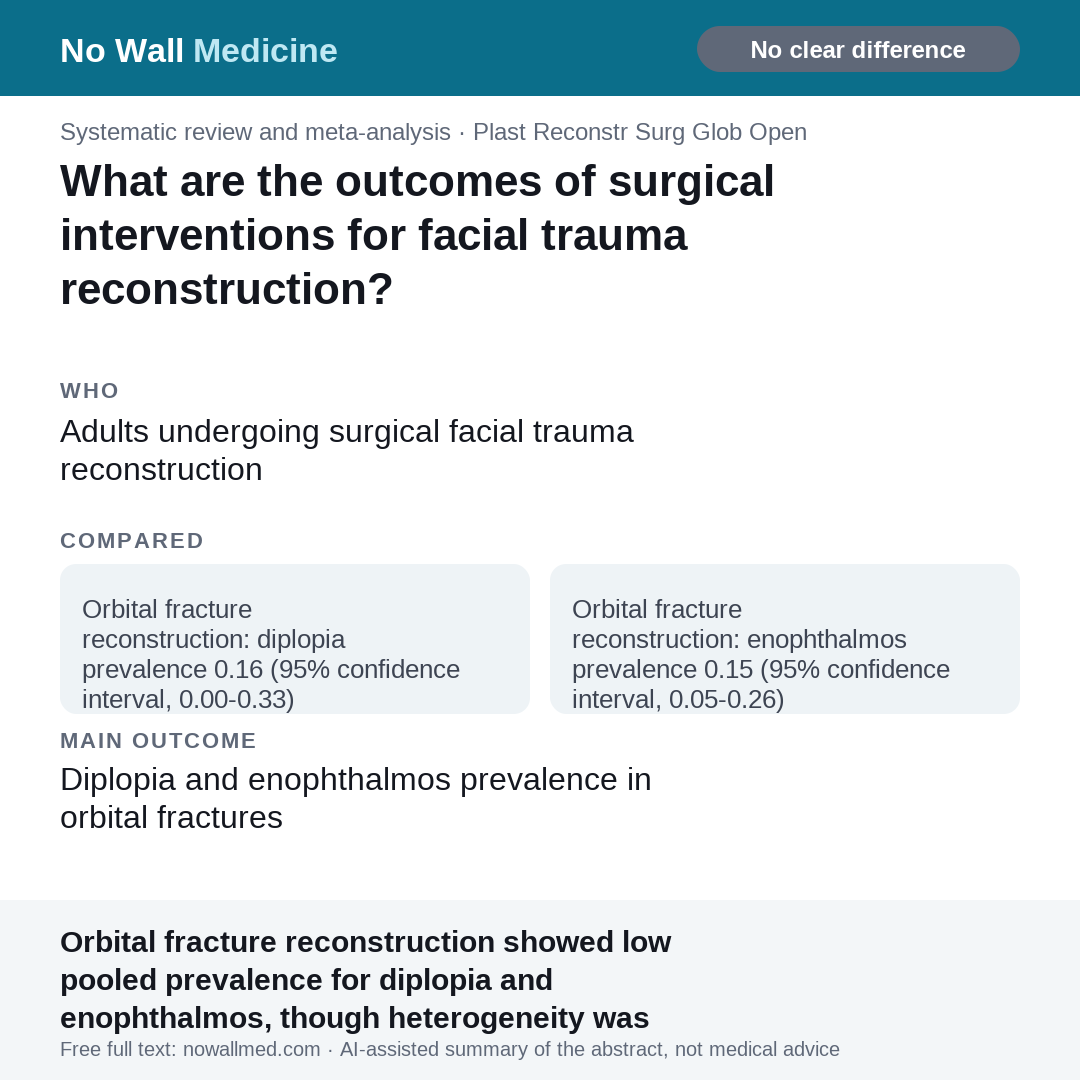
What are the outcomes of surgical interventions for facial trauma reconstruction?
Who
Adults undergoing surgical facial trauma reconstruction
Compared
Orbital fracture reconstruction: diplopia prevalence 0.16 (95% confidence interval, 0.00-0.33)
Orbital fracture reconstruction: enophthalmos prevalence 0.15 (95% confidence interval, 0.05-0.26)
Main outcome
Diplopia and enophthalmos prevalence in orbital fractures
Result: diplopia 0.16 (95% confidence interval, 0.00-0.33); enophthalmos 0.15 (95% confidence interval, 0.05-0.26)
Bottom line: Orbital fracture reconstruction showed low pooled prevalence for diplopia and enophthalmos, though heterogeneity was substantial for diplopia.
Plast Reconstr Surg Glob Open · 2026-08-03Download image
Clinical question: What are the outcomes of surgical interventions for facial trauma reconstruction?
Why it matters: Clinicians need to understand the prevalence of complications and the efficacy of different surgical interventions for facial trauma reconstruction.
Key points
- Researchers reviewed 9 studies involving adult patients undergoing surgical reconstruction for facial injuries.
- The pooled prevalence of diplopia, or double vision, was 0.16 and enophthalmos, or a sunken eye, was 0.15.
- Complications in non-orbital facial fractures, such as infection and wound separation, showed wide variability across the studies.
Headline and key points written with AI from the paper’s abstract, with every number checked against it. Read the paper before relying on them.
Spotted a mistake? Suggest a correction
More in Plastic & Reconstructive Surgery
Releasable plating systems had higher complication rates than continuous systems
Continuous Versus Releasable Plating Systems for Sternal Closure: A Systematic Review of Outcomes
Saphenous nerve terminated near navicular cuneiform joint in 45% of specimens
Evaluating Saphenous Nerve Variations With Classification System in the Lower Limb, an Anatomical Study With Surgical Relevance
Evaluation of an Animated Patient Information Video: Improving Consent and Decision-making for Deep Inferior Epigastric Perforator Flap Breast Reconstruction
Most plastic surgery residents satisfied with elective rotation experience
Optimizing the Chief Resident Elective Rotation: Insights From Alumni Feedback in Plastic Surgery Training