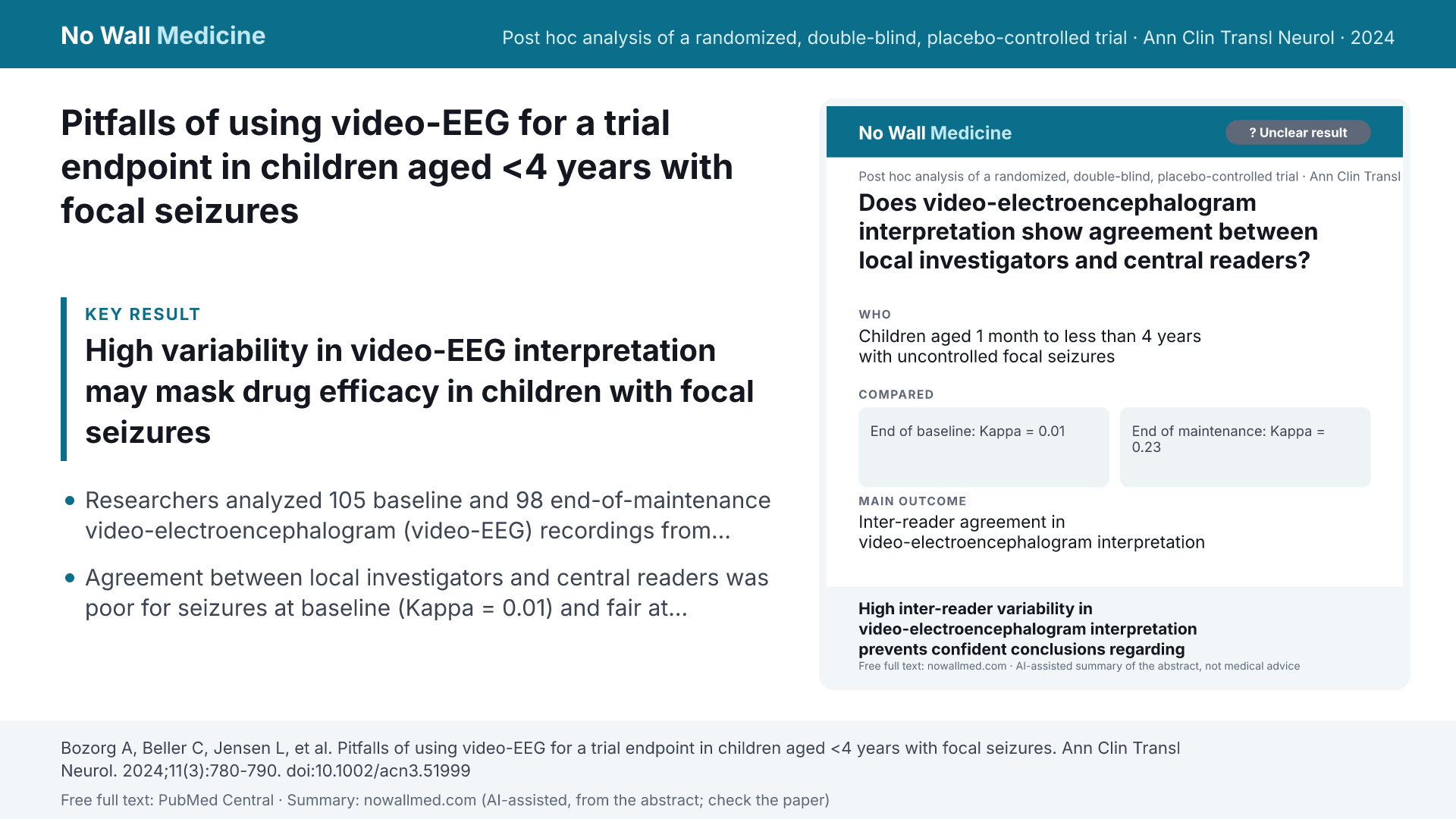
High variability in video-EEG interpretation may mask drug efficacy in children with focal seizures
Pitfalls of using video-EEG for a trial endpoint in children aged <4 years with focal seizures
Post hoc analysis of a randomized, double-blind, placebo-controlled trialUnclear result
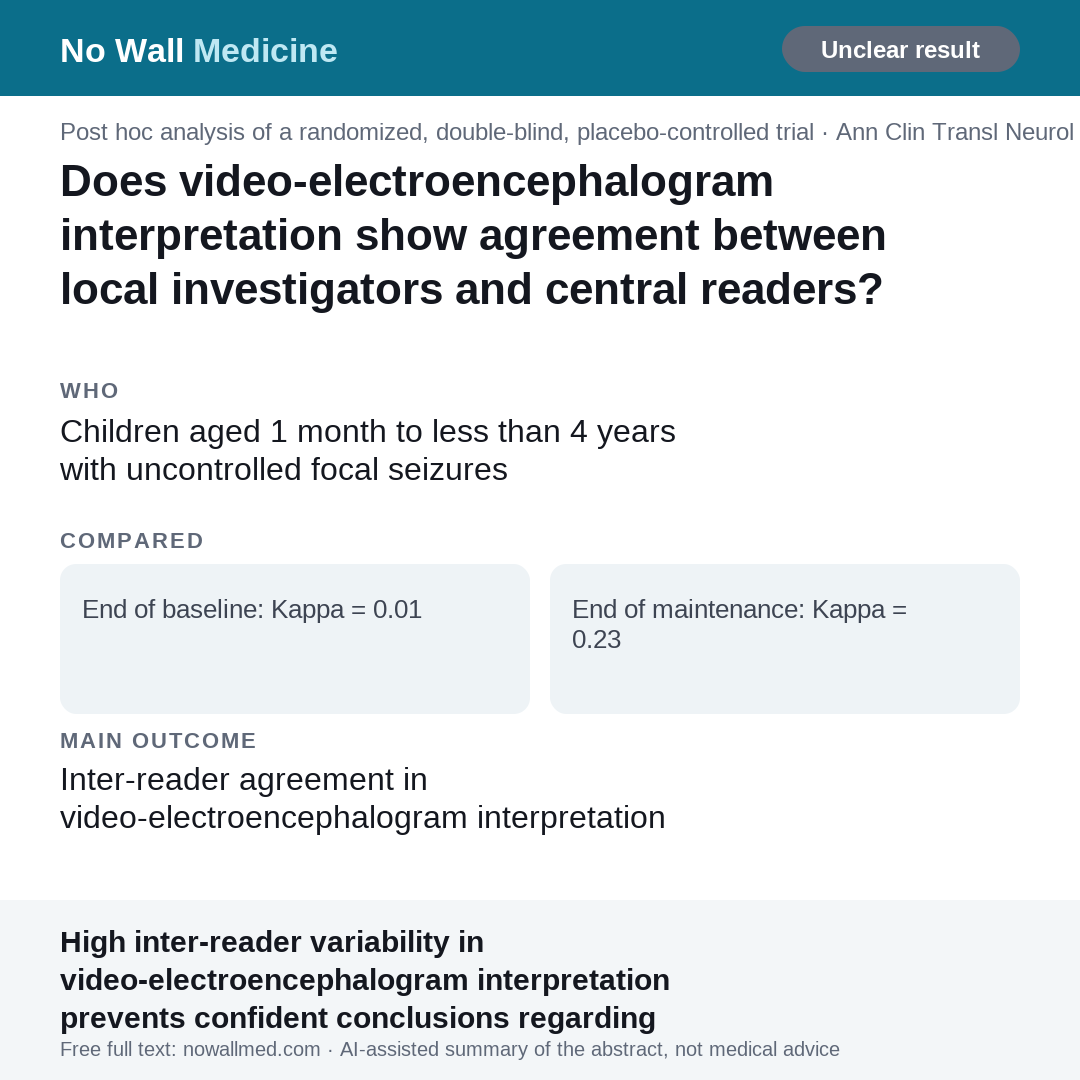
Does video-electroencephalogram interpretation show agreement between local investigators and central readers?
Who
Children aged 1 month to less than 4 years with uncontrolled focal seizures
Compared
End of baseline: Kappa = 0.01
End of maintenance: Kappa = 0.23
Main outcome
Inter-reader agreement in video-electroencephalogram interpretation
Bottom line: High inter-reader variability in video-electroencephalogram interpretation prevents confident conclusions regarding lacosamide efficacy in very young children.
Limitation: High inter-reader variability and low reliability of seizure type and count interpretations.
Ann Clin Transl Neurol · 2024-02-06Download image
Clinical question: Does video-electroencephalogram interpretation show agreement between local investigators and central readers?
Why it matters: It is unknown if video-electroencephalogram (video-EEG) provides reliable data for measuring seizure frequency in very young children compared to seizure diaries.
Key points
- Researchers analyzed 105 baseline and 98 end-of-maintenance video-electroencephalogram (video-EEG) recordings from a randomized trial of children aged 1 month to under 4 years.
- Agreement between local investigators and central readers was poor for seizures at baseline (Kappa = 0.01) and fair at the end of maintenance (Kappa = 0.23).
- Substantial variations in seizure counts and types between readers prevent a confident conclusion regarding the lack of efficacy of lacosamide in this population.
Headline and key points written with AI from the paper’s abstract, with every number checked against it. Read the paper before relying on them.
Was this summary helpful?
Subject terms
Cite this article
Bozorg A, Beller C, Jensen L, et al. Pitfalls of using video-EEG for a trial endpoint in children aged <4 years with focal seizures. Ann Clin Transl Neurol. 2024. doi:10.1002/acn3.51999
Spotted a mistake? Suggest a correction