Unblinded trials of surgical procedures show larger effects than blinded placebo-controlled trials for certain outcomes
Placebo Control and Blinding in Randomized Trials of Procedural Interventions: A Systematic Review and Meta-Regression
Systematic review and meta-regressionMixed results
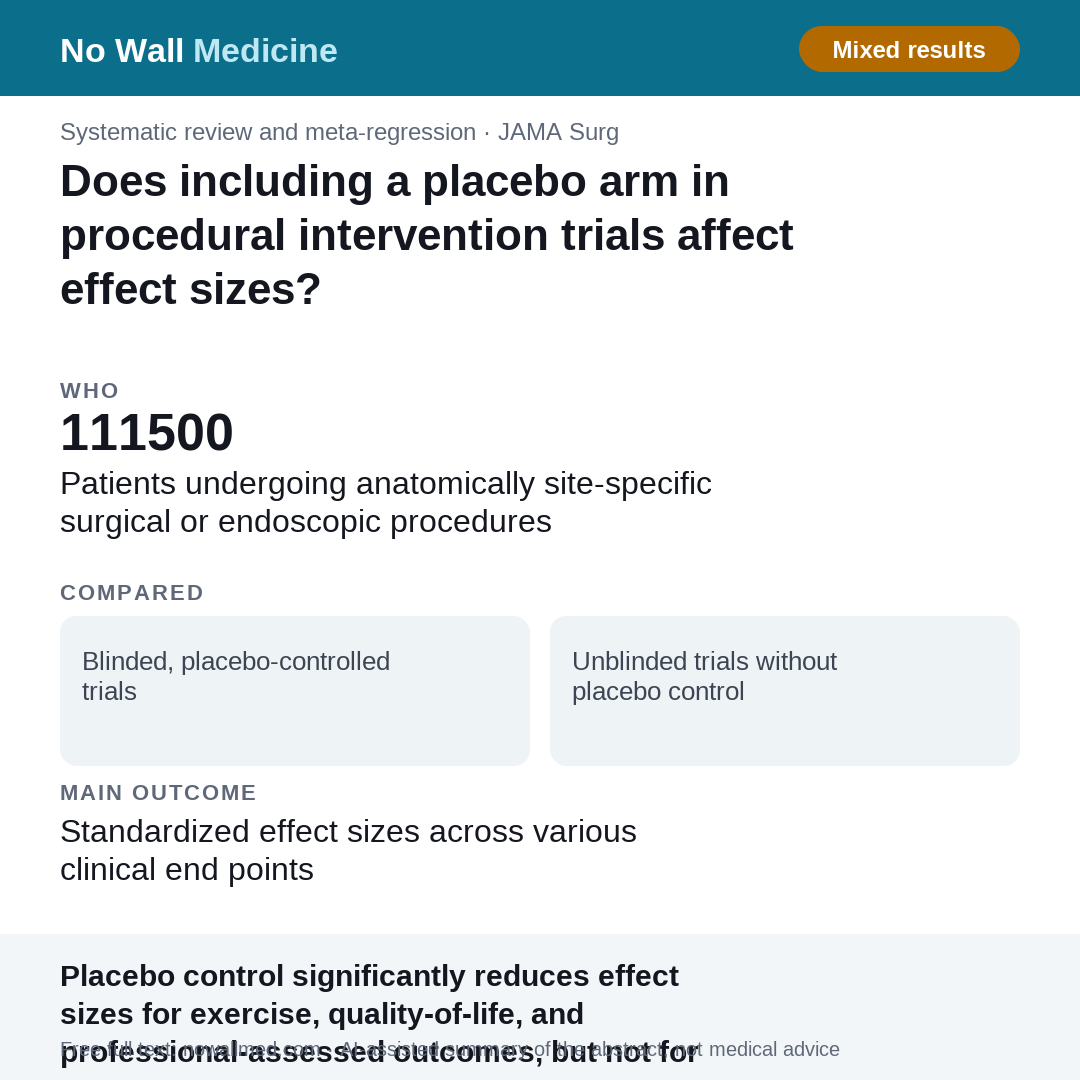
Does including a placebo arm in procedural intervention trials affect effect sizes?
Who
111500
Patients undergoing anatomically site-specific surgical or endoscopic procedures
Compared
Blinded, placebo-controlled trials
Unblinded trials without placebo control
Main outcome
Standardized effect sizes across various clinical end points
Result: SMD 0.59 (95% CI, 0.29 to 0.89) for exercise-related outcomes in unblinded trials
Bottom line: Placebo control significantly reduces effect sizes for exercise, quality-of-life, and professional-assessed outcomes, but not for mortality or pain.
JAMA Surg · 2024-04-17Download image
Clinical question: Does including a placebo arm in procedural intervention trials affect effect sizes?
Why it matters: It is unknown if the absence of a placebo arm in surgical and interventional procedure trials leads to overestimating how well these procedures work.
Key points
- Researchers compared 72 blinded, placebo-controlled trials with 55 unblinded trials involving 111,500 individual patient end points.
- Unblinded trials were associated with larger effect sizes for exercise-related outcomes, quality of life, and health care professional-assessed outcomes.
- No significant difference was found between unblinded and blinded trials for pain, blood pressure, mortality, recurrent bleeding, or patient-reported outcomes.
Headline and key points written with AI from the paper’s abstract, with every number checked against it. Read the paper before relying on them.
Was this summary helpful?
Subject terms
Cite this article
Rajkumar CA, Thomas KE, Foley M, Ganesananthan S, Evans H, Simader F. Placebo Control and Blinding in Randomized Trials of Procedural Interventions: A Systematic Review and Meta-Regression. JAMA Surg. 2024. doi:10.1001/jamasurg.2024.0718
Spotted a mistake? Suggest a correction
Top studies every Monday
The week’s key trials and guidelines in your specialties, plus any topics you follow. By email, free.
Get the weekly digest