Triangular titanium implants reduced pelvic fixation failure in multilevel spinal fusion surgery patients
Placement of Triangular Titanium Implants Suprajacent to Pelvic Fixation Screws Reduces Pelvic Fixation Failure in Multilevel Spinal Fusion: Results of a Randomized Controlled Trial
Partially blinded randomized clinical trialBenefit found
Does triangular titanium implant placement reduce pelvic fixation failure in multilevel spinal fusion?
Who
222
Patients scheduled for multilevel spinal fusion surgery with S2-alar-iliac pelvic fixation · Multicenter, international
Compared
11.0%S2-alar-iliac screws plus triangular titanium implants
20.4%S2-alar-iliac screws alone
Main outcome
Primary composite radiographic end point of pelvic fixation failure
Bottom line: Placing triangular titanium implants suprajacent to S2-alar-iliac screws reduces pelvic fixation failure rates.
J Bone Joint Surg Am · 2026-07-16Download image
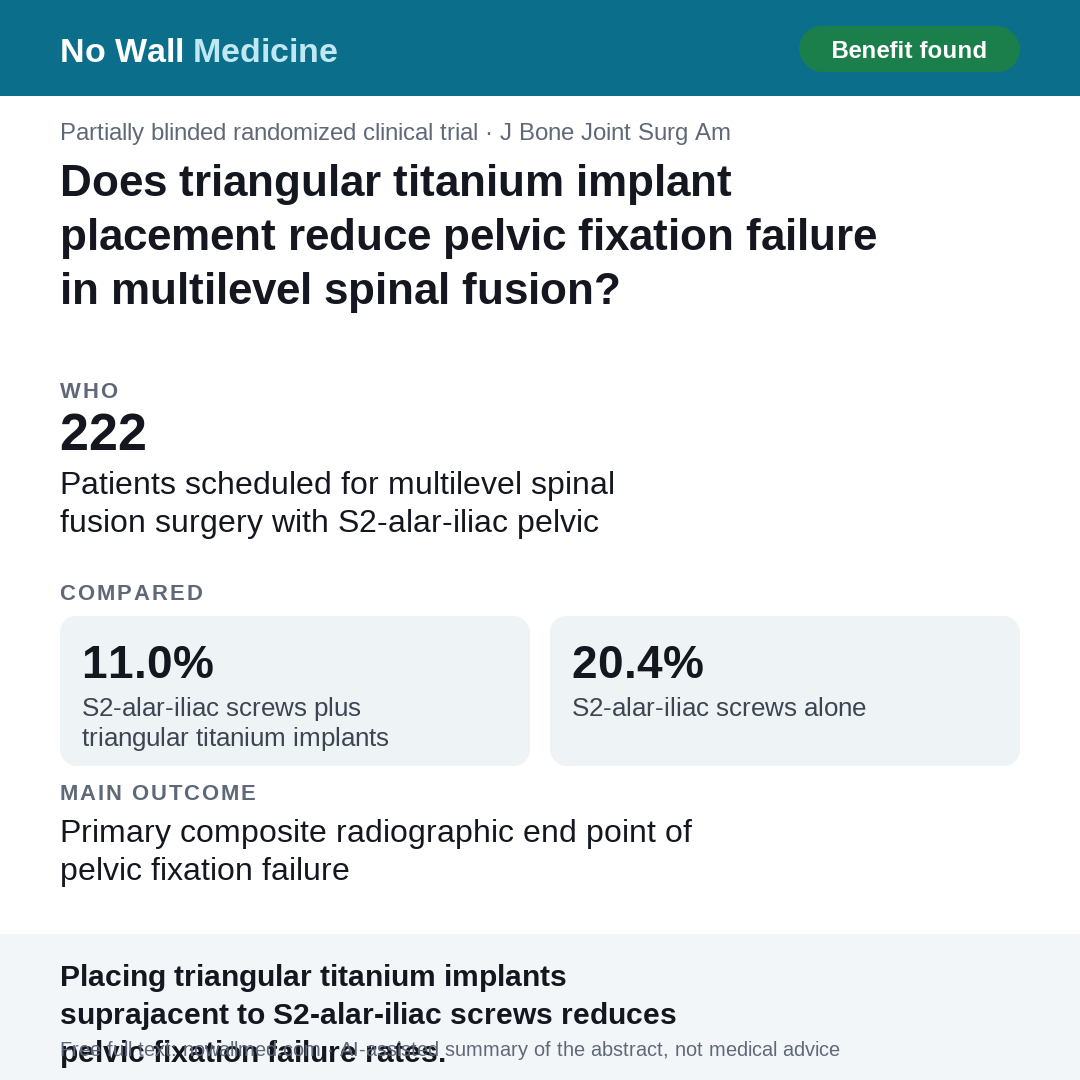
Clinical question: Does triangular titanium implant placement reduce pelvic fixation failure in multilevel spinal fusion?
Why it matters: Doctors needed to determine if adding triangular titanium implants above pelvic fixation screws could reduce failures during multilevel spinal fusion surgery.
Key points
- Researchers conducted a randomized trial with 222 patients undergoing multilevel spinal fusion surgery to compare S2-alar-iliac screws alone against screws plus triangular titanium implants.
- The primary composite failure rate was 11.0% in the triangular titanium implant group compared to 20.4% in the group receiving screws alone.
- The rate of spinal rod fractures was 9.2% in the triangular titanium implant group and 5.3% in the screw-only group, though this difference was not statistically significant.
Headline and key points written with AI from the paper’s abstract, with every number checked against it. Read the paper before relying on them.
Topics
Spotted a mistake? Suggest a correction
More in Orthopedics & Sports Medicine
Higher pre-treatment expectations associated with less pain and better function after physiotherapy
Higher pre-treatment expectations are associated with less pain and better physical function and quality of life after physiotherapy for knee osteoarthritis
Patellofemoral osteochondritis dissecans patients have distinct knee anatomy
Is There an Association Between Abnormal Patellofemoral Morphology and Patellofemoral Osteochondritis Dissecans in Pediatric Patients?
Newly Diagnosed Dyslipidemia Linked to Higher Risk of Osteoarthritis
Association Between Newly Diagnosed Dyslipidemia and Joint-Specific Incident Osteoarthritis: A Nationwide Propensity-Score-Matched Cohort Study