Planned delivery for late preterm pre-eclampsia showed no significant difference in maternal mortality or morbidity
Planned delivery or expectant management for late preterm pre-eclampsia in low-income and middle-income countries (CRADLE-4): a multicentre, open-label, randomised controlled trial
Multicentre, open-label, randomised controlled trialNo clear difference
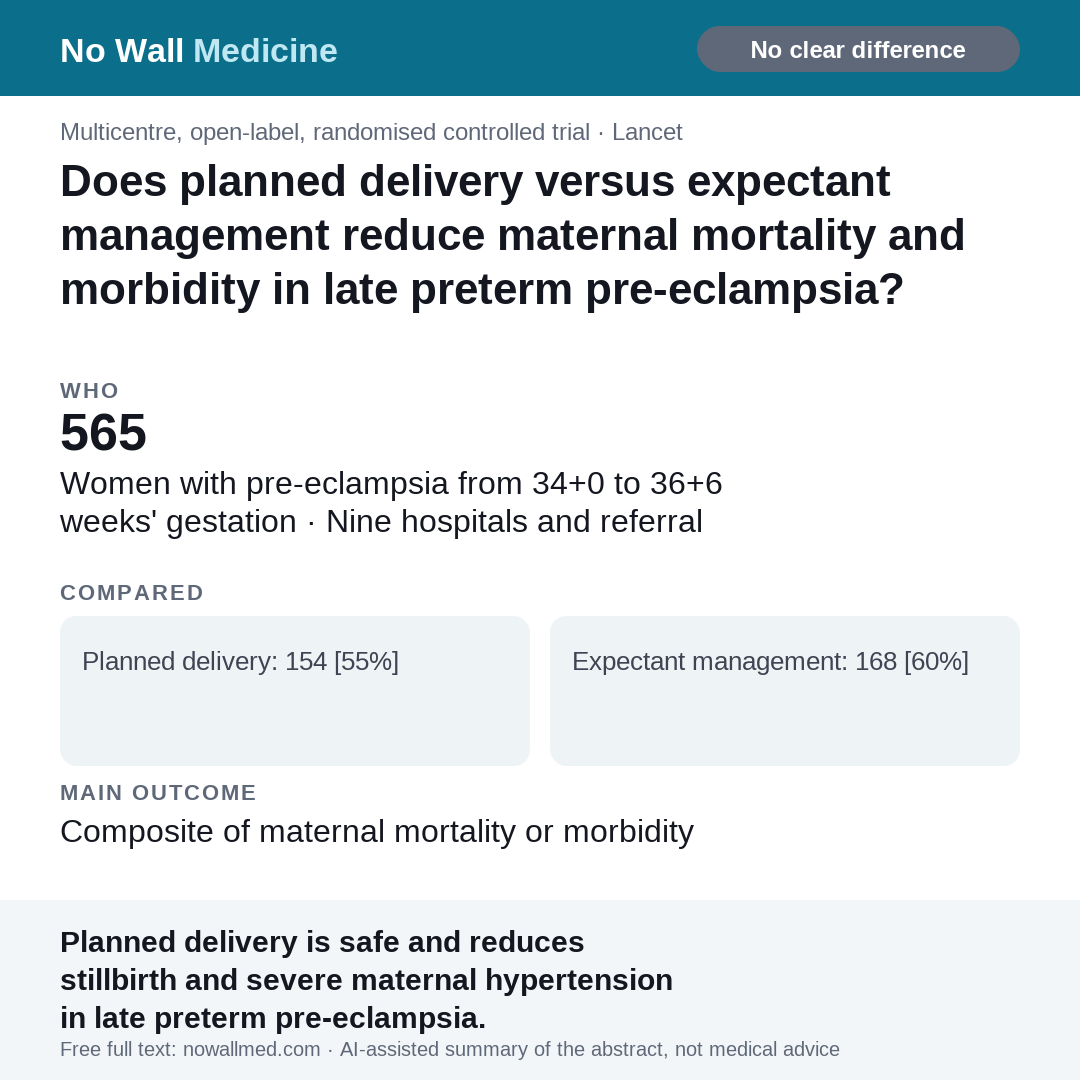
Does planned delivery versus expectant management reduce maternal mortality and morbidity in late preterm pre-eclampsia?
Who
565
Women with pre-eclampsia from 34+0 to 36+6 weeks' gestation · Nine hospitals and referral facilities in India and Zambia
Compared
Planned delivery: 154 [55%]
Expectant management: 168 [60%]
Main outcome
Composite of maternal mortality or morbidity
Result: adjusted risk ratio 0·91, 95% CI 0·79 to 1·05
Bottom line: Planned delivery is safe and reduces stillbirth and severe maternal hypertension in late preterm pre-eclampsia.
Funded by: UK Medical Research Council and Indian Department of Biotechnology
Lancet · 2023-06-29Download image
Clinical question: Does planned delivery versus expectant management reduce maternal mortality and morbidity in late preterm pre-eclampsia?
Why it matters: Evidence is scarce regarding whether planned delivery between 34+0 and 36+6 weeks of gestation reduces maternal mortality and morbidity without increasing perinatal complications in low-income or middle-income settings.
Key points
- Researchers studied 565 women in India and Zambia with pre-eclampsia between 34+0 and 36+6 weeks of pregnancy, comparing planned delivery to expectant management.
- The primary maternal outcome was not significantly different between planned delivery (55%) and expectant management (60%), while perinatal outcomes were non-inferior in the planned delivery group (19% vs 22%).
- Planned delivery was associated with a reduction in severe maternal hypertension and stillbirth.
Headline and key points written with AI from the paper’s abstract, with every number checked against it. Read the paper before relying on them.
Abstract
Background
Pre-eclampsia is a leading cause of maternal and perinatal mortality. Evidence regarding interventions in a low-income or middle-income setting is scarce. We aimed to evaluate whether planned delivery between 34+ 0 and 36+ 6 weeks' gestation can reduce maternal mortality and morbidity without increasing perinatal complications in India and Zambia. Methods
In this parallel-group, multicentre, open-label, randomised controlled trial, we compared planned delivery versus expectant management in women with pre-eclampsia from 34+ 0 to 36+ 6 weeks' gestation. Participants were recruited from nine hospitals and referral facilities in India and Zambia and randomly assigned to planned delivery or expectant management in a 1:1 ratio by a secure web-based randomisation facility hosted by MedSciNet. Randomisation was stratified by centre and minimised by parity, single-fetus pregnancy or multi-fetal pregnancy, and gestational age. The primary maternal outcome was a composite of maternal mortality or morbidity with a superiority hypothesis. The primary perinatal outcome was a composite of one or more of: stillbirth, neonatal death, or neonatal unit admission of more than 48 h with a non-inferiority hypothesis (margin of 10% difference). Analyses were by intention to treat, with an additional per-protocol analysis for the perinatal outcome. The trial was prospectively registered with ISRCTN, 10672137. The trial is closed to recruitment and all follow-up has been completed. Findings
Between Dec 19, 2019, and March 31, 2022, 565 women were enrolled. 284 women (282 women and 301 babies analysed) were allocated to planned delivery and 281 women (280 women and 300 babies analysed) were allocated to expectant management. The incidence of the primary maternal outcome was not significantly different in the planned delivery group (154 [55%]) compared with the expectant management group (168 [60%]; adjusted risk ratio [RR] 0·91, 95% CI 0·79 to 1·05). The incidence of the primary perinatal outcome by intention to treat was non-inferior in the planned delivery group (58 [19%]) compared with the expectant management group (67 [22%]; adjusted risk difference -3·39%, 90% CI -8·67 to 1·90; non-inferiority p<0·0001). The results from the per-protocol analysis were similar. There was a significant reduction in severe maternal hypertension (adjusted RR 0·83, 95% CI 0·70 to 0·99) and stillbirth (0·25, 0·07 to 0·87) associated with planned delivery. There were 12 serious adverse events in the planned delivery group and 21 in the expectant management group. Interpretation
Clinicians can safely offer planned delivery to women with late preterm pre-eclampsia, in a low-income or middle-income country. Planned delivery reduces stillbirth, with no increase in neonatal unit admissions or neonatal morbidity and reduces the risk of severe maternal hypertension. Planned delivery from 34 weeks' gestation should therefore be considered as an intervention to reduce pre-eclampsia associated mortality and morbidity in these settings. Funding
UK Medical Research Council and Indian Department of Biotechnology.
Abstract reproduced under the article’s CC BY licence.
Topics
Cite this article
Beardmore-Gray A, Vousden N, Seed PT, Vwalika B, Chinkoyo S, Sichone V. Planned delivery or expectant management for late preterm pre-eclampsia in low-income and middle-income countries (CRADLE-4): a multicentre, open-label, randomised controlled trial. Lancet. 2023. doi:10.1016/S0140-6736(23)00688-8
Spotted a mistake? Suggest a correction