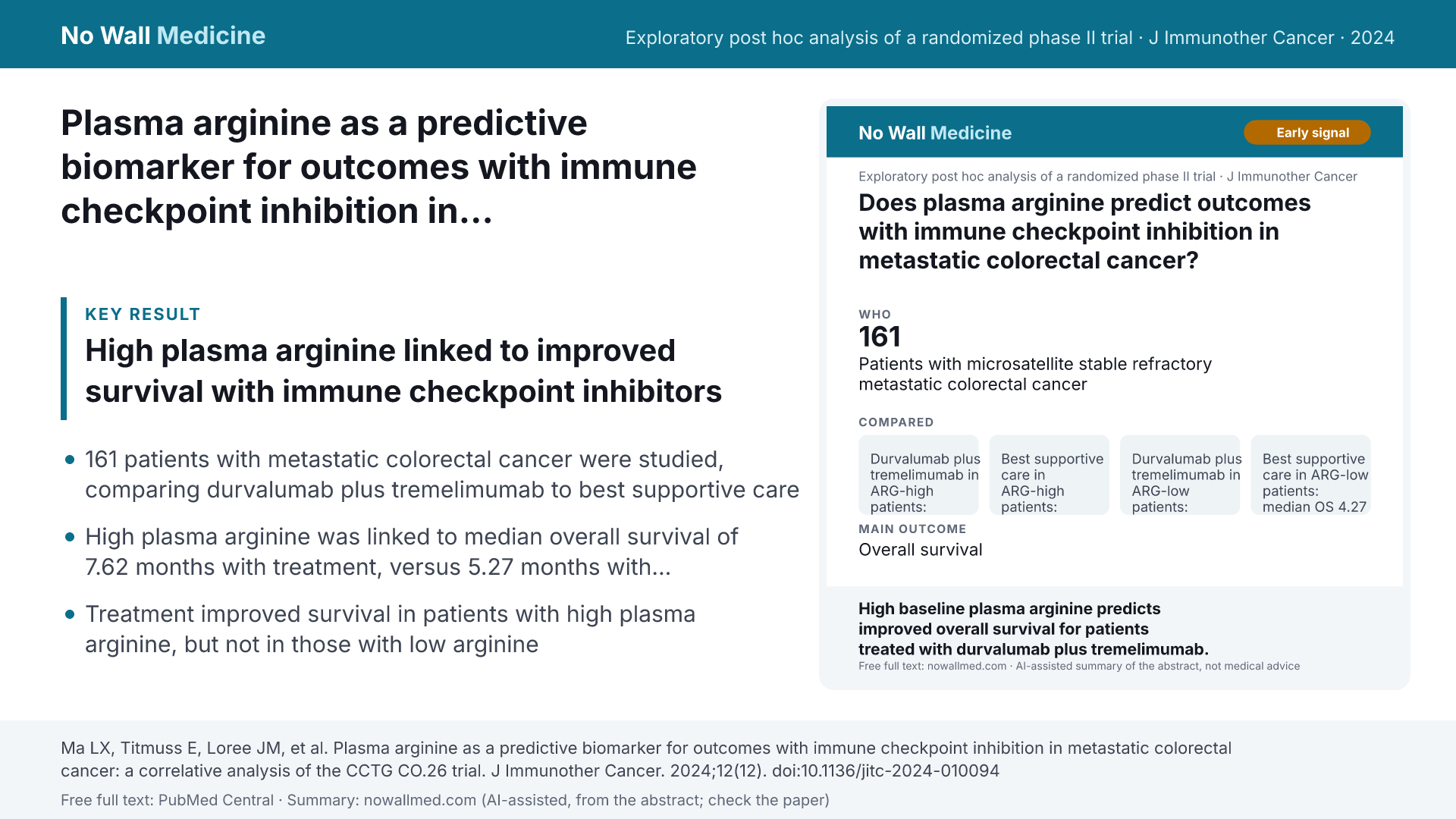
High plasma arginine linked to improved survival with immune checkpoint inhibitors
Plasma arginine as a predictive biomarker for outcomes with immune checkpoint inhibition in metastatic colorectal cancer: a correlative analysis of the CCTG CO.26 trial
Exploratory post hoc analysis of a randomized phase II trialBenefit found
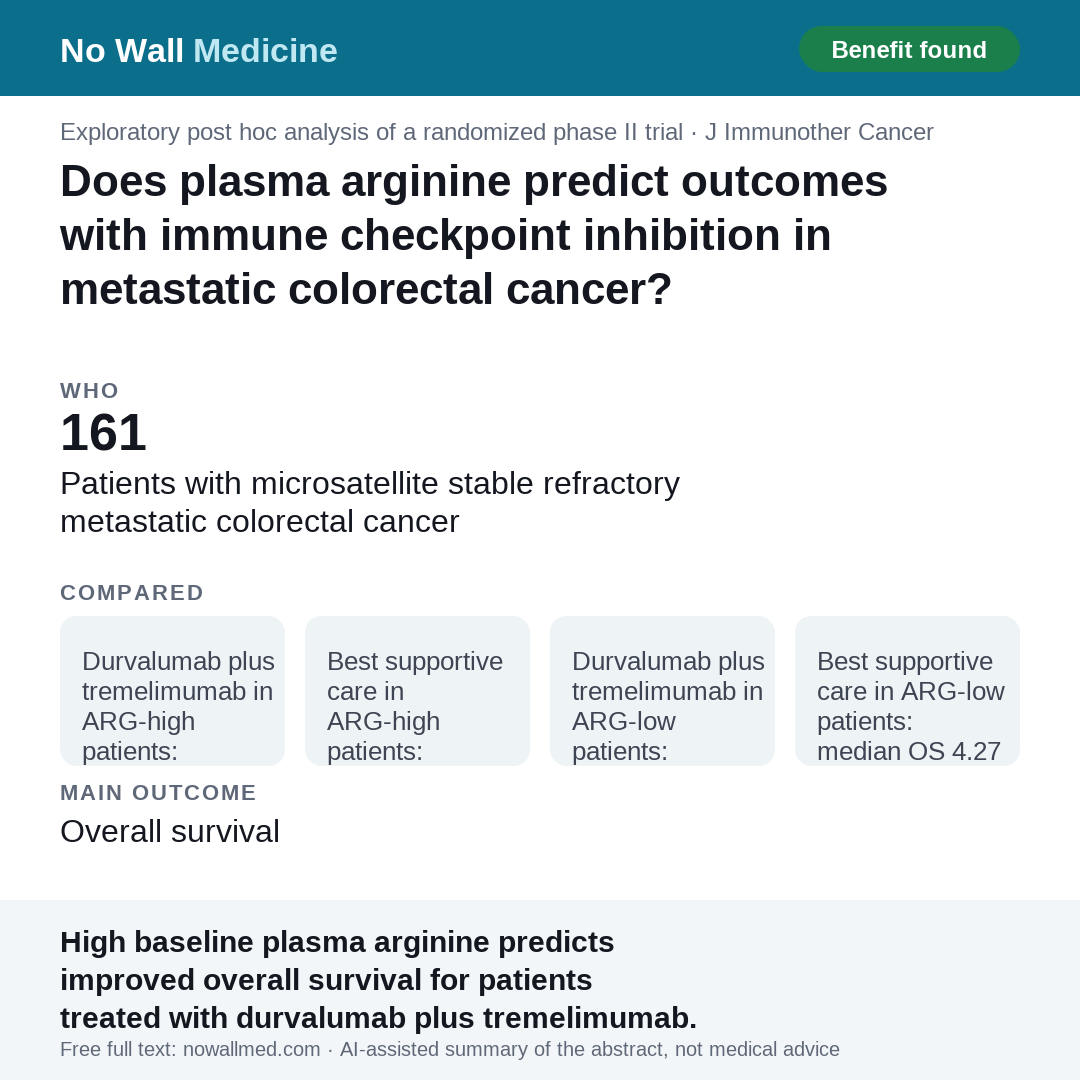
Does plasma arginine predict outcomes with immune checkpoint inhibition in metastatic colorectal cancer?
Who
161
Patients with microsatellite stable refractory metastatic colorectal cancer
Compared
Durvalumab plus tremelimumab in ARG-high patients: median OS 7.62 months
Best supportive care in ARG-high patients: median OS 3.09 months
Durvalumab plus tremelimumab in ARG-low patients: median OS 5.27 months
Best supportive care in ARG-low patients: median OS 4.27 months
Main outcome
Overall survival
Result: HR 0.61 (0.37-0.99)
Bottom line: High baseline plasma arginine predicts improved overall survival for patients treated with durvalumab plus tremelimumab.
J Immunother Cancer · 2024-12-04Download image
Clinical question: Does plasma arginine predict outcomes with immune checkpoint inhibition in metastatic colorectal cancer?
Why it matters: The role of plasma arginine in predicting response to immune checkpoint inhibitors in metastatic colorectal cancer was unknown
Key points
- 161 patients with metastatic colorectal cancer were studied, comparing durvalumab plus tremelimumab to best supportive care.
- High plasma arginine was linked to median overall survival of 7.62 months with treatment, versus 5.27 months with low arginine.
- Treatment improved survival in patients with high plasma arginine, but not in those with low arginine.
Headline and key points written with AI from the paper’s abstract, with every number checked against it. Read the paper before relying on them.
Was this summary helpful?
Abstract
Background
Nutritional stress is a mechanism that allows tumor cells to evade the immune system. Arginine (ARG), an amino acid involved in immunomodulation, aids in regulating T-lymphocyte cell activity and the antitumor response. ARG deficiency in the tumor microenvironment can impair T-cell response while ARG supplementation may promote antitumor immune activity. In this exploratory post hoc analysis of the randomized phase II CO.26 trial, we investigated the role of plasma ARG in predicting response to immune checkpoint inhibitors (ICI) in patients with microsatellite stable refractory metastatic colorectal cancer (mCRC). Methods
CO.26 randomized patients with refractory mCRC to durvalumab plus tremelimumab (D+T) versus best supportive care (BSC). Plasma ARG concentrations were determined from pretreatment blood samples using high-performance liquid chromatography-tandem mass spectrometry. The median plasma ARG value was used as a cut-off stratifying patients into ARG-high (≥10 700 ng/mL) versus ARG-low (<10 700 ng/mL) groups. Overall survival (OS) was estimated using the Kaplan-Meier method and compared using the log-rank test. Cox proportional hazard models were used to analyze the prognostic and predictive impacts of ARG on OS. Results
Of 180 patients enrolled in CO.26, 161 (N=114 treated with D+T and 47 BSC) had pretreatment blood samples for ARG analysis. There were no significant differences in baseline characteristics between patients included in this analysis and the total study patients, or between ARG-high and ARG-low patients. In the BSC arm, the median OS was 3.09 months for ARG-high versus 4.27 months for ARG-low patients (univariable HR 0.89 (0.49-1.65), p=0.72). In the D+T arm, the median OS was 7.62 months for ARG-high versus 5.27 months for ARG-low patients (univariable HR 0.68, (0.48-1.0], p=0.048). In ARG-high patients, D+T significantly improved OS (median OS 7.62 months with D+T vs 3.09 months BSC; HR 0.61 (0.37-0.99), p=0.047; adjusted p=0.042 for interaction). In ARG-low patients there was no OS benefit with D+T (median OS 5.27 months D+T vs 4.27 months BSC; HR 0.87 (0.52-1.46), p=0.61). Conclusion
High baseline plasma ARG was predictive of improved OS in patients with mCRC treated with D+T. Further investigations are needed to validate ARG as a biomarker. Therapeutic approaches targeting the ARG pathway may augment ICI activity. Trial registration number
NCT02870920.
Abstract reproduced under the article’s CC BY NC licence.
Subject terms
Cite this article
Ma LX, Titmuss E, Loree JM, Jonker DJ, Kennecke HF, Berry S. Plasma arginine as a predictive biomarker for outcomes with immune checkpoint inhibition in metastatic colorectal cancer: a correlative analysis of the CCTG CO.26 trial. J Immunother Cancer. 2024. doi:10.1136/jitc-2024-010094
Spotted a mistake? Suggest a correction
Top studies every Monday
The week’s key trials and guidelines in your specialties, plus any topics you follow. By email, free.
Get the weekly digest