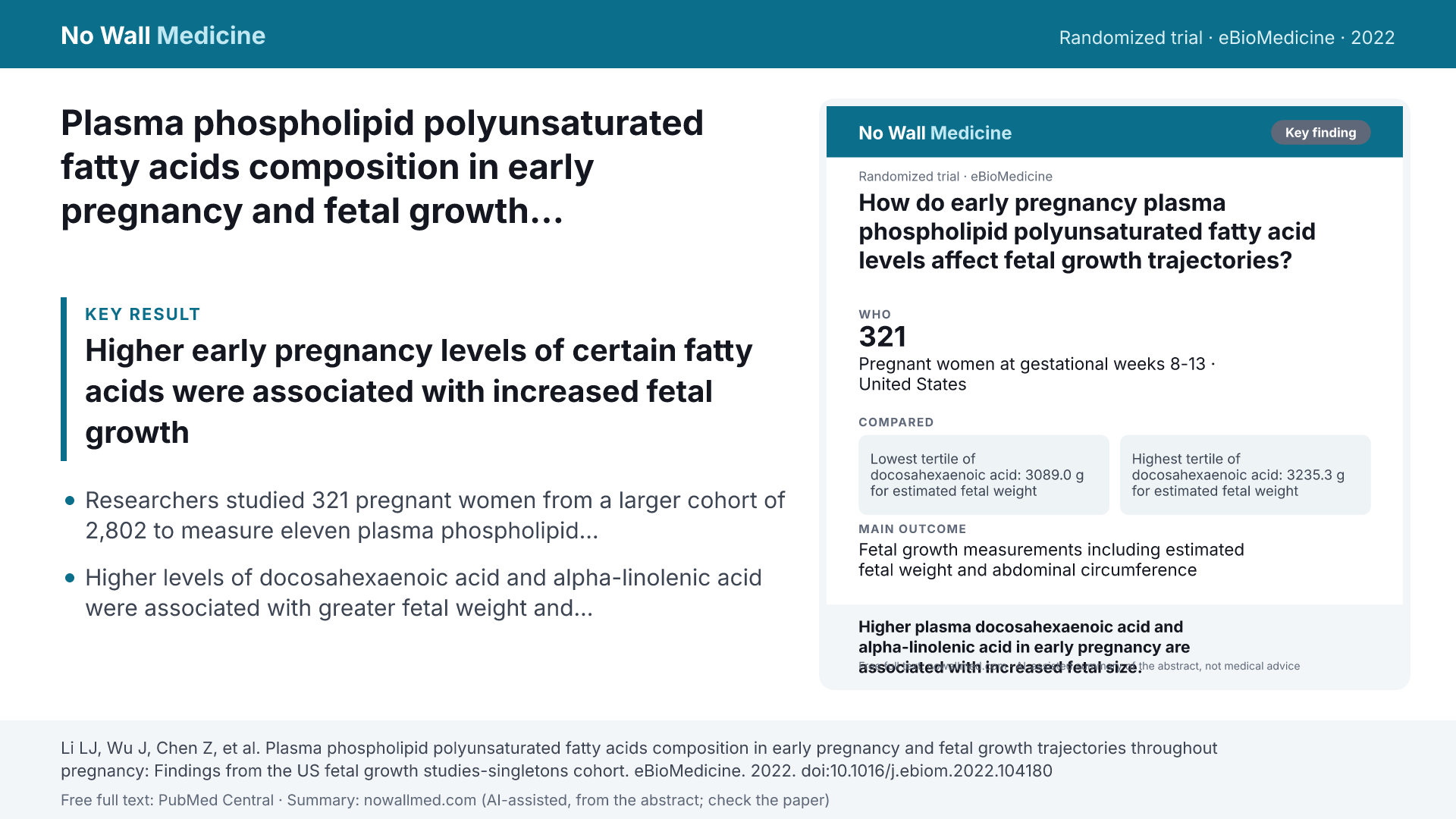
Higher early pregnancy levels of certain fatty acids were associated with increased fetal growth
Plasma phospholipid polyunsaturated fatty acids composition in early pregnancy and fetal growth trajectories throughout pregnancy: Findings from the US fetal growth studies-singletons cohort
Randomized trialKey finding
How do early pregnancy plasma phospholipid polyunsaturated fatty acid levels affect fetal growth trajectories?
Who
321
Pregnant women at gestational weeks 8-13 · United States
Compared
Lowest tertile of docosahexaenoic acid: 3089.0 g for estimated fetal weight
Highest tertile of docosahexaenoic acid: 3235.3 g for estimated fetal weight
Main outcome
Fetal growth measurements including estimated fetal weight and abdominal circumference
Bottom line: Higher plasma docosahexaenoic acid and alpha-linolenic acid in early pregnancy are associated with increased fetal size.
Limitation: Measurements were performed using a subsample of the total cohort.
Funded by: National Institute of Child Health and Human Development
eBioMedicine · 2022-07-16Download image
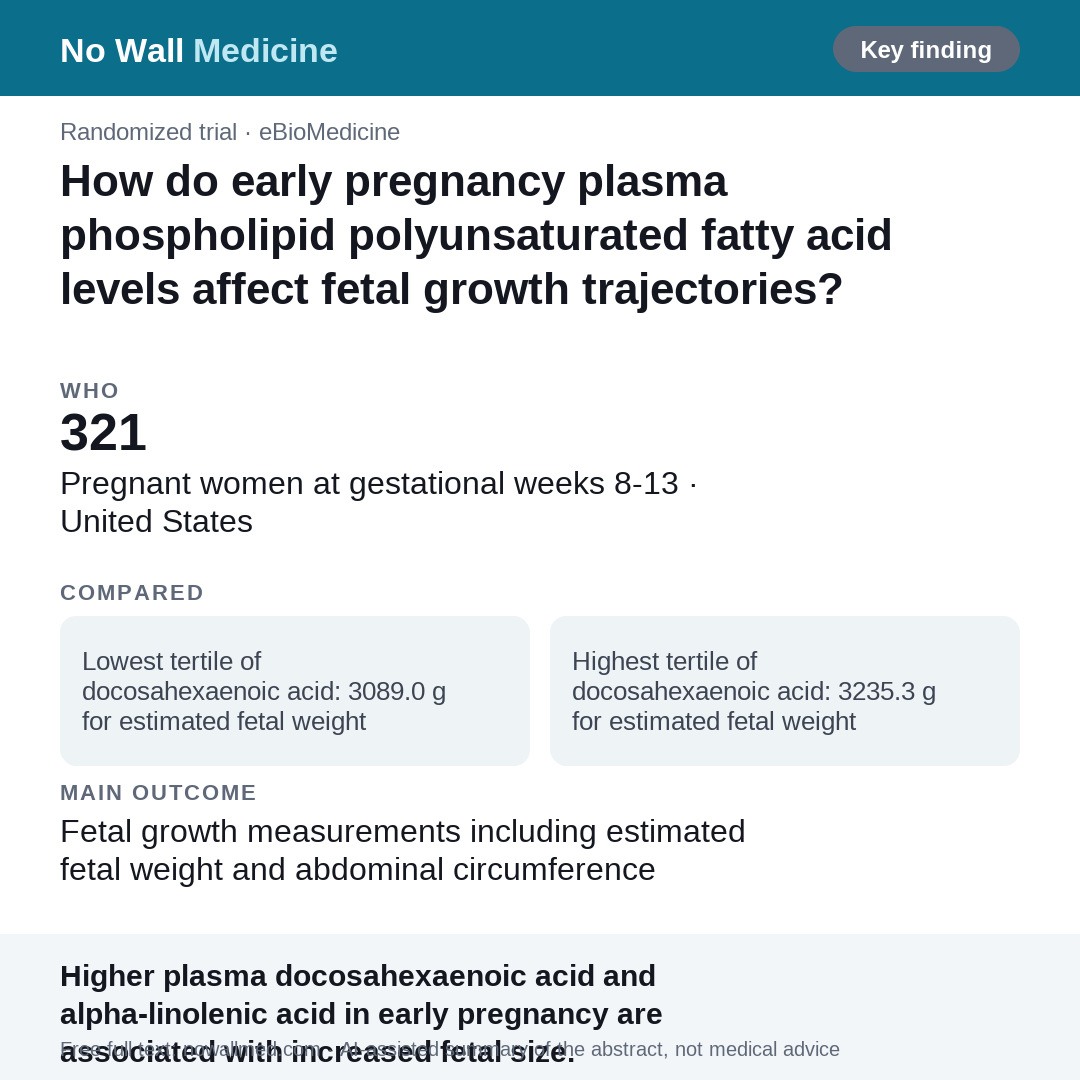
Clinical question: How do early pregnancy plasma phospholipid polyunsaturated fatty acid levels affect fetal growth trajectories?
Key points
- Researchers studied 321 pregnant women from a larger cohort of 2,802 to measure eleven plasma phospholipid polyunsaturated fatty acids, which are types of fats, during early pregnancy.
- Higher levels of docosahexaenoic acid and alpha-linolenic acid were associated with greater fetal weight and abdominal circumference throughout pregnancy.
- At 38 weeks of gestation, the highest group of docosahexaenoic acid had an estimated fetal weight of 3235.3 g compared to 3089.0 g in the lowest group.
Headline and key points written with AI from the paper’s abstract, with every number checked against it. Read the paper before relying on them.
Was this summary helpful?
Subject terms
Cite this article
Li LJ, Wu J, Chen Z, et al. Plasma phospholipid polyunsaturated fatty acids composition in early pregnancy and fetal growth trajectories throughout pregnancy: Findings from the US fetal growth studies-singletons cohort. eBioMedicine. 2022. doi:10.1016/j.ebiom.2022.104180
Spotted a mistake? Suggest a correction