Higher levels of certain polyamines were linked to different outcomes after an ischemic stroke
Plasma Polyamines and Short-Term Adverse Outcomes Among Patients With Ischemic Stroke: A Prospective Cohort Study
Prospective cohort studyMixed results
Are elevated plasma polyamine levels associated with adverse outcomes in ischemic stroke patients?
Who
3570
Patients with acute ischemic stroke
Compared
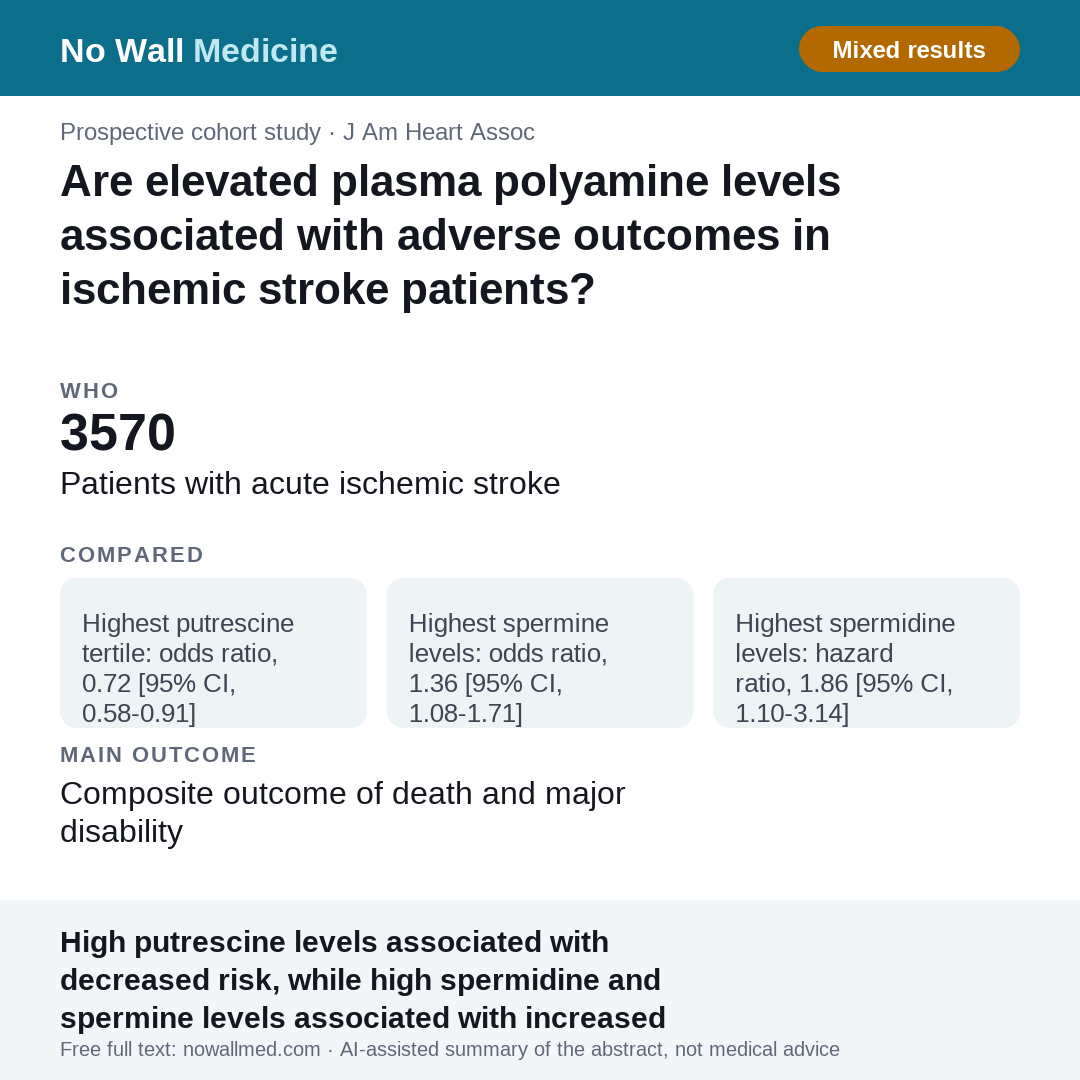
Highest putrescine tertile: odds ratio, 0.72 [95% CI, 0.58-0.91]
Highest spermine levels: odds ratio, 1.36 [95% CI, 1.08-1.71]
Highest spermidine levels: hazard ratio, 1.86 [95% CI, 1.10-3.14]
Main outcome
Composite outcome of death and major disability
Bottom line: High putrescine levels associated with decreased risk, while high spermidine and spermine levels associated with increased adverse outcomes.
J Am Heart Assoc · 2024-07-31Download image
Clinical question: Are elevated plasma polyamine levels associated with adverse outcomes in ischemic stroke patients?
Why it matters: The associations between polyamine levels and the prognosis of patients following an ischemic stroke remain unclear.
Key points
- Researchers studied 3570 patients with acute ischemic stroke to measure plasma polyamine levels and assess clinical outcomes at 3 months.
- Increased putrescine levels were associated with a decreased risk of death or major disability, while increased spermidine and spermine levels were associated with higher risks.
- During the 3-month follow-up, 25.1% of the 3570 participants experienced the primary outcome of death or major disability.
Headline and key points written with AI from the paper’s abstract, with every number checked against it. Read the paper before relying on them.
Was this summary helpful?
Subject terms
Cite this article
Yang P, Shi M, Jia Y, Zhong C, Peng H, Sun L. Plasma Polyamines and Short-Term Adverse Outcomes Among Patients With Ischemic Stroke: A Prospective Cohort Study. J Am Heart Assoc. 2024. doi:10.1161/JAHA.124.035837
Spotted a mistake? Suggest a correction
Top studies every Monday
The week’s key trials and guidelines in your specialties, plus any topics you follow. By email, free.
Get the weekly digest