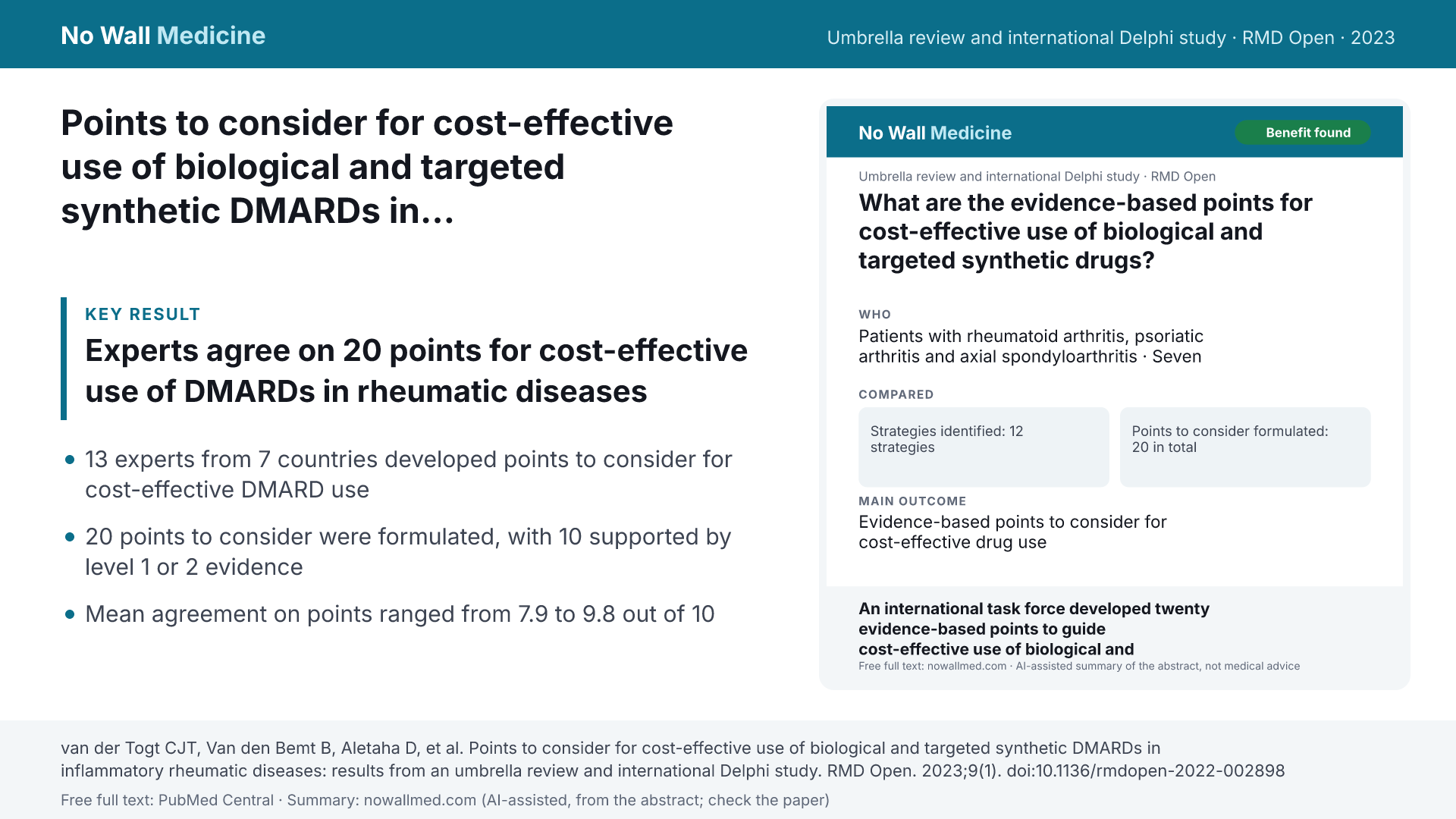
Experts agree on 20 points for cost-effective use of DMARDs in rheumatic diseases
Points to consider for cost-effective use of biological and targeted synthetic DMARDs in inflammatory rheumatic diseases: results from an umbrella review and international Delphi study
Umbrella review and international Delphi studyBenefit found
What are the evidence-based points for cost-effective use of biological and targeted synthetic drugs?
Who
Patients with rheumatoid arthritis, psoriatic arthritis and axial spondyloarthritis · Seven European countries
Compared
Strategies identified: 12 strategies
Points to consider formulated: 20 in total
Main outcome
Evidence-based points to consider for cost-effective drug use
Bottom line: An international task force developed twenty evidence-based points to guide cost-effective use of biological and targeted synthetic drugs.
RMD Open · 2023-03-02 · Save PNG
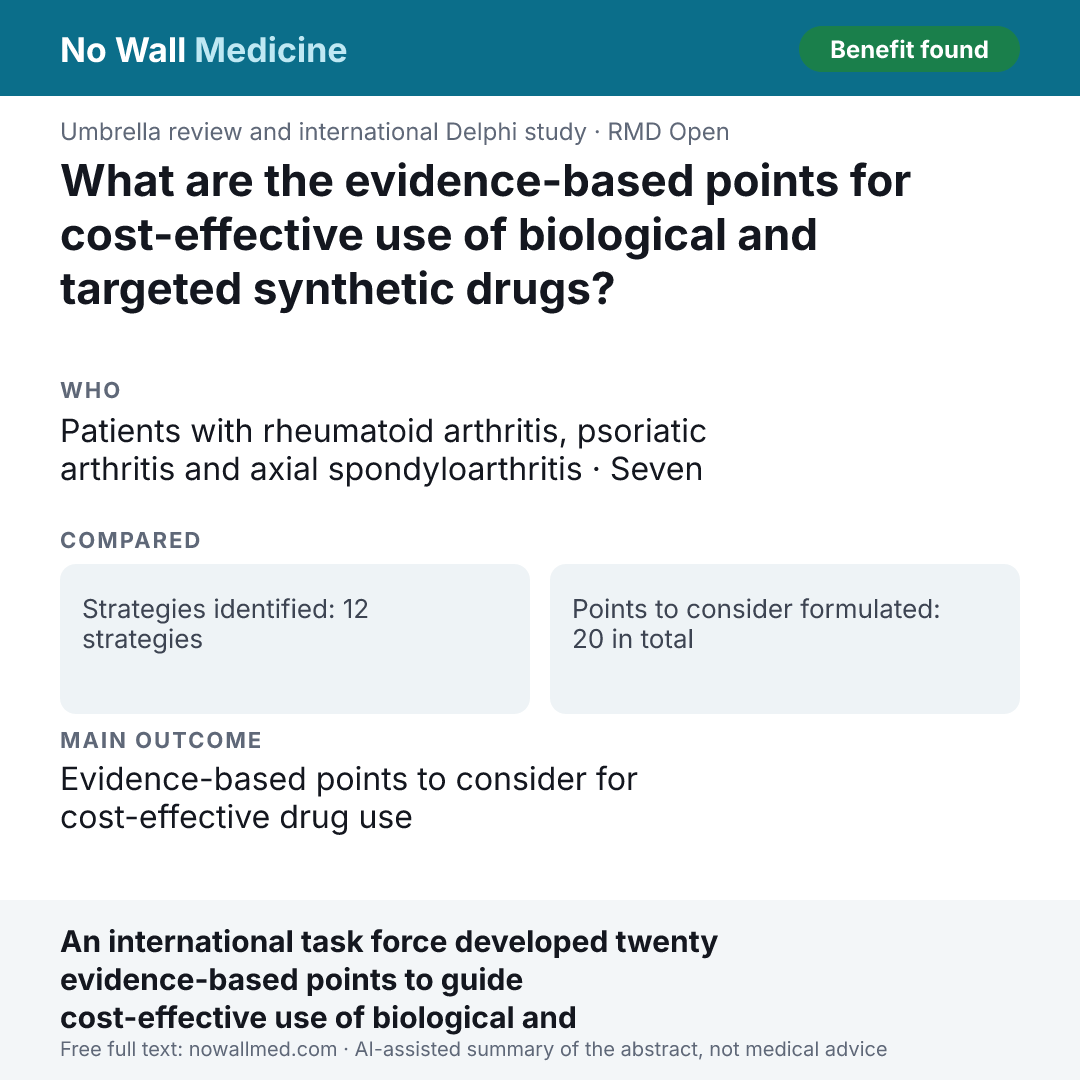
Clinical question: What are the evidence-based points for cost-effective use of biological and targeted synthetic drugs?
Why it matters: Guidelines lack clear advice on cost-effective use of biological and targeted synthetic DMARDs
Key points
- 13 experts from 7 countries developed points to consider for cost-effective DMARD use.
- 20 points to consider were formulated, with 10 supported by level 1 or 2 evidence.
- Mean agreement on points ranged from 7.9 to 9.8 out of 10.
Headline and key points written with AI from the paper’s abstract, with every number checked against it. Read the paper before relying on them.
Was this summary helpful?
Abstract
Objectives
To develop evidence-based points to consider for cost-effective use of biological and targeted synthetic disease-modifying antirheumatic drugs (b/tsDMARDs) in the treatment of inflammatory rheumatic diseases, specifically rheumatoid arthritis, psoriatic arthritis and axial spondyloarthritis. Methods
Following EULAR procedures, an international task force was formed, consisting of 13 experts in rheumatology, epidemiology and pharmacology from seven European countries. Twelve strategies for cost-effective use of b/tsDMARDs were identified through individual and group discussion. For each strategy, PubMed and Embase were systematically searched for relevant English-language systematic reviews and, for six strategies, additionally for randomised controlled trials (RCTs). Thirty systematic reviews and 21 RCTs were included. Based on the evidence, a set of overarching principles and points to consider was formulated by the task force using a Delphi procedure. Level of evidence (1a-5) and grade (A-D) were determined for each point to consider. Individual voting on the level of agreement (LoA; between 0 (completely disagree) and 10 (completely agree)) was performed anonymously. Results
The task force agreed on five overarching principles. For 10 of 12 strategies, the evidence was sufficient to formulate one or more points to consider, leading to 20 in total, regarding response prediction, drug formulary use, biosimilars, loading doses, low-dose initial therapy, concomitant conventional synthetic DMARD use, route of administration, medication adherence, disease activity-guided dose optimisation and non-medical drug switching. Ten points to consider (50%) were supported by level 1 or 2 evidence. The mean LoA (SD) varied between 7.9 (1.2) and 9.8 (0.4). Conclusion
These points to consider can be used in rheumatology practices and complement inflammatory rheumatic disease treatment guidelines to incorporate cost-effectiveness in b/tsDMARD treatment.
Abstract reproduced under the article’s CC BY NC licence.
Subject terms
Headline, design, result, key points, caveat and citation as plain text.
Cite this article
van der Togt CJT, Van den Bemt B, Aletaha D, et al. Points to consider for cost-effective use of biological and targeted synthetic DMARDs in inflammatory rheumatic diseases: results from an umbrella review and international Delphi study. RMD Open. 2023;9(1). doi:10.1136/rmdopen-2022-002898
Spotted a mistake? Suggest a correction