School entry requirements and federal funding programs were associated with higher adolescent HPV vaccination coverage
Policy Approaches for Increasing Adolescent HPV Vaccination Coverage: A Systematic Review
Systematic reviewMixed results
Which governmental policies effectively increase adolescent human papillomavirus vaccination coverage?
Who
36
Adolescents ages 9 to 18 · United States
Compared
School-entry requirements: positive associations (8 of 14)
Federally-funded policies: consistently associated with higher coverage (7 of 9)
Educational requirements: relatively few studies found associations (2 of 8)
Main outcome
human papillomavirus vaccination coverage
Bottom line: School-entry requirements and federally-funded policies show promise for increasing adolescent human papillomavirus vaccination coverage.
Limitation: Studies used limited vaccination data sources and non- or quasi-experimental designs.
Pediatrics · 2024-04-16Download image
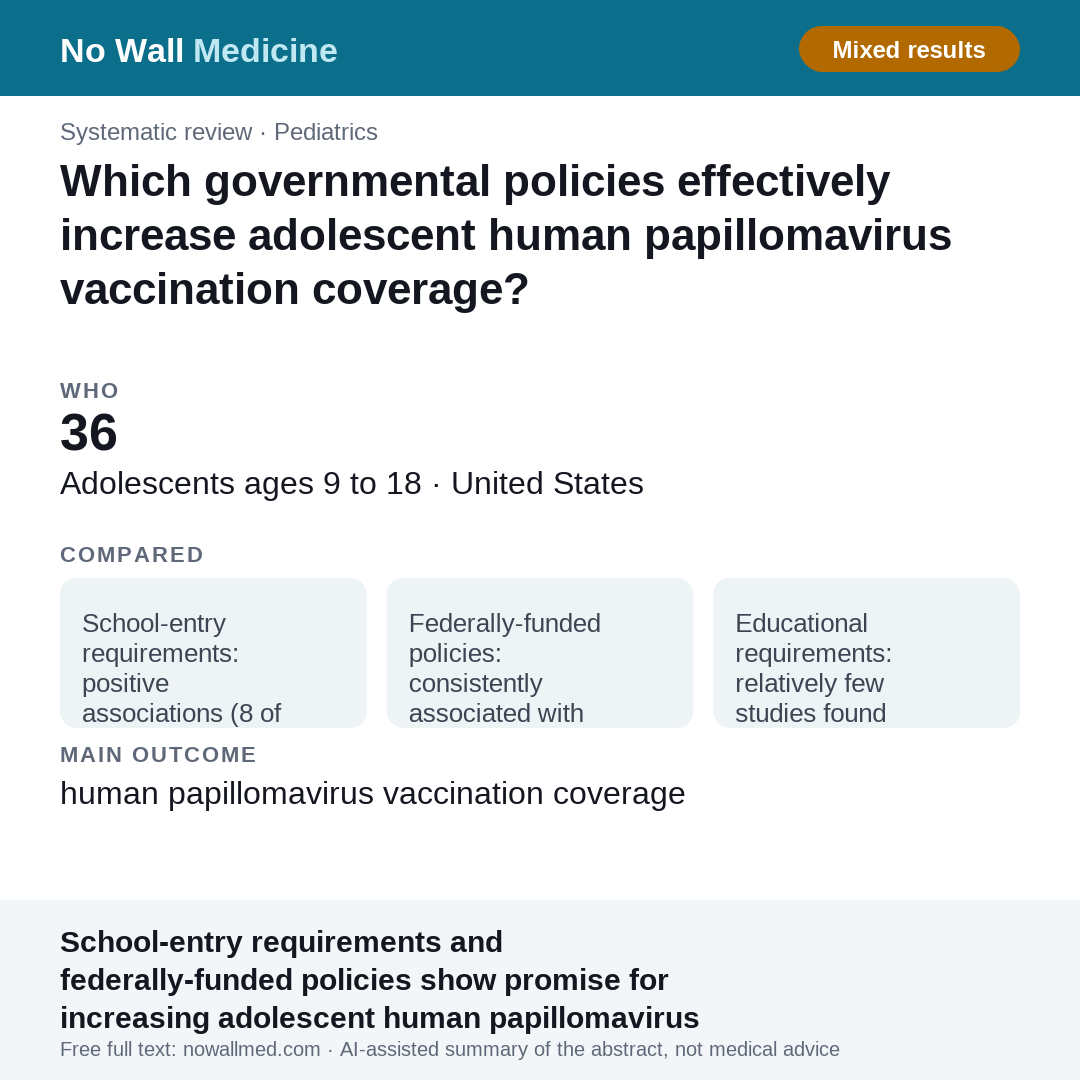
Clinical question: Which governmental policies effectively increase adolescent human papillomavirus vaccination coverage?
Why it matters: It is unclear which specific government policies are effective at increasing human papillomavirus vaccination coverage among adolescents.
Key points
- Researchers reviewed 36 studies published between 2009 and 2022 to evaluate how different government policies affect human papillomavirus vaccination in adolescents aged 9 to 18.
- School entry requirements were associated with higher coverage in 8 of 14 studies, while federally-funded policies related to Medicaid and the Vaccines for Children program were associated with higher coverage in 7 of 9 studies.
- All 7 studies evaluating school entry requirements for other adolescent vaccines showed positive spillover effects for human papillomavirus vaccination.
Limitation the authors note: The included studies used limited vaccination data sources and non-experimental or quasi-experimental designs, with some lacking well-matched comparison groups.
Headline and key points written with AI from the paper’s abstract, with every number checked against it. Read the paper before relying on them.
Topics
Cite this article
McKeithen MC, Gilkey MB, Kong WY, Oh NL, Heisler-MacKinnon J, Carlson R. Policy Approaches for Increasing Adolescent HPV Vaccination Coverage: A Systematic Review. Pediatrics. 2024. doi:10.1542/peds.2023-064692
Spotted a mistake? Suggest a correction
Top studies every Monday
The week’s key trials and guidelines in your specialties, plus any topics you follow. By email, free.
Get the weekly digest