Poly (ADP-ribose) polymerase inhibitors and platinum chemotherapy showed similar efficacy in BRCA-positive prostate cancer
Poly (ADP-ribose) Polymerase Inhibitors Have Comparable Efficacy with Platinum Chemotherapy in Patients with BRCA-positive Metastatic Castration-resistant Prostate Cancer. A Systematic Review and Meta-analysis
Systematic review and meta-analysisNo clear difference
Are poly (ADP-ribose) polymerase inhibitors comparable to platinum chemotherapy in BRCA-positive metastatic castration-resistant prostate cancer?
Who
901
Patients with BRCA-positive metastatic castration-resistant prostate cancer
Compared
69%Poly (ADP-ribose) polymerase inhibitors (CI: 53-82%)
74%Platinum (CI: 49-90%)
Main outcome
Prostate-specific antigen response rate and overall survival
Result: hazard ratio 0.86 (95% CI 0.49-1.52)
Bottom line: Poly (ADP-ribose) polymerase inhibitors and platinum therapy show comparable efficacy in BRCA-positive metastatic castration-resistant prostate cancer.
Limitation: Prospective interventional studies comparing these agents are essential to provide a higher level of evidence.
Eur Urol Oncol · 2023-09-16Download image
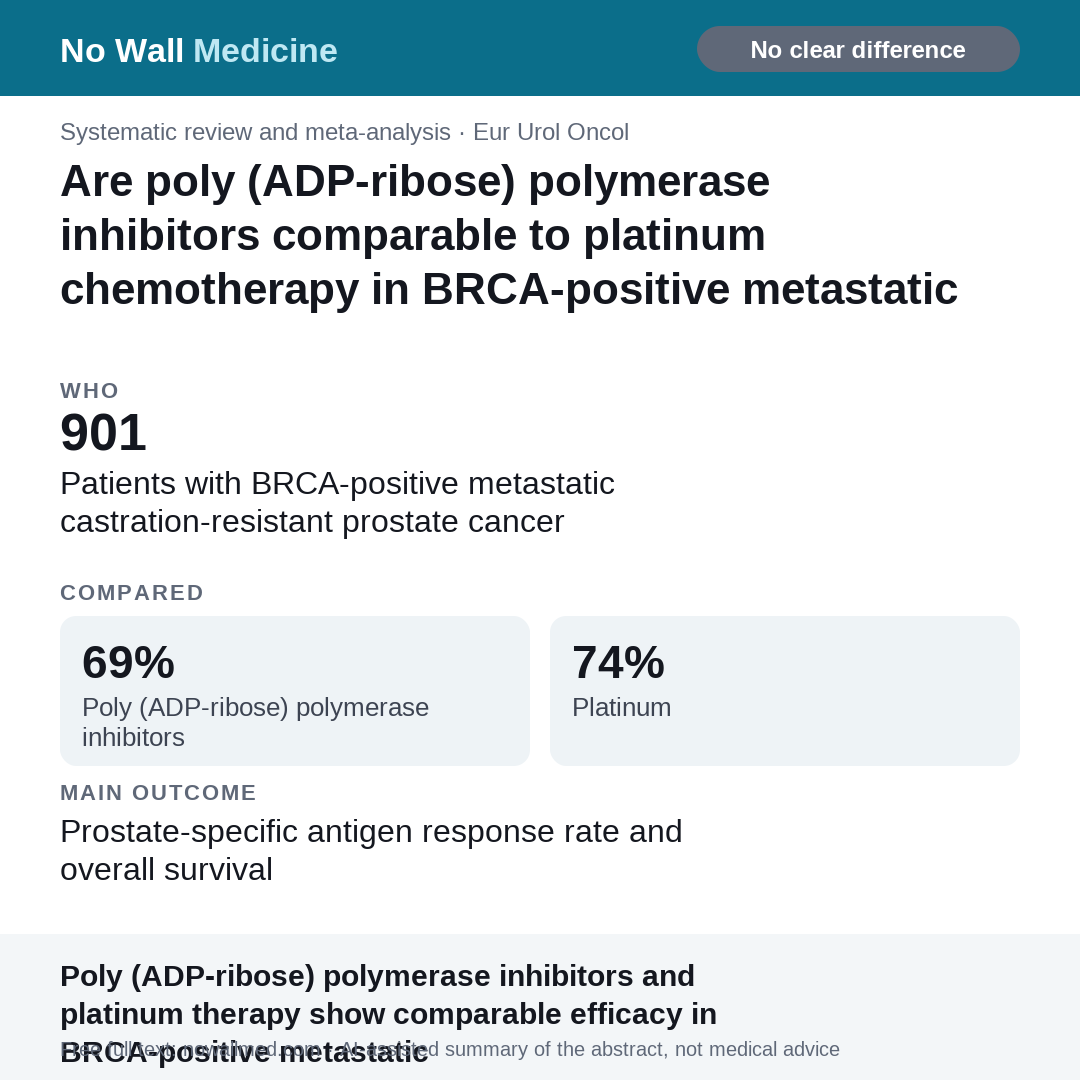
Clinical question: Are poly (ADP-ribose) polymerase inhibitors comparable to platinum chemotherapy in BRCA-positive metastatic castration-resistant prostate cancer?
Why it matters: It was unknown how BRCA mutations impact sensitivity to cabazitaxel and prostate-specific membrane antigen-ligand therapy in metastatic castration-resistant prostate cancer.
Key points
- Researchers analyzed 23 studies involving 901 patients with metastatic castration-resistant prostate cancer harboring BRCA mutations.
- The prostate-specific antigen response rate was 69% for poly (ADP-ribose) polymerase inhibitors and 74% for platinum treatments.
- Overall survival showed no difference between poly (ADP-ribose) polymerase inhibitors and platinum treatments with a hazard ratio of 0.86.
Headline and key points written with AI from the paper’s abstract, with every number checked against it. Read the paper before relying on them.
Abstract
Context
Testing for mutations in Breast Cancer Gene 1/2 (BRCA) has emerged as a novel decision-making tool for clinicians. Patients with metastatic castration-resistant prostate cancer (mCRPC) harboring pathogenic BRCA mutations can benefit from poly (ADP-ribose) polymerase inhibitor (PARPi) and platinum treatments, whereas the impact of the mutation on sensitivity to cabazitaxel and prostate-specific membrane antigen (PSMA)-ligand therapy is currently unknown.Objective
To assess the efficacy of PARPi, platinum, cabazitaxel, and PSMA-ligand therapies in BRCA-positive mCRPC.Evidence acquisition
Databases were queried in February 2022. We performed data synthesis by using both proportional and individual patient data. For prostate-specific antigen (PSA) response rate (≥50% decrease from baseline [PSA50]) evaluation, we pooled event rates with 95% confidence intervals (CIs). Progression-free (PFS) and overall (OS) survival analyses with individual patient data were performed with the mixed-effect Cox proportional hazard model and single-arm random-effect analysis, providing pooled medians.Evidence synthesis
We included 23 eligible studies with 901 BRCA-positive mCRPC patients. PSA50 response rates for PARPi and platinum were 69% (CI: 53-82%), and 74% (CI: 49-90%), respectively. Analyses of OS data showed no difference between PARPi and platinum treatments (hazard ratio: 0.86; CI: 0.49-1.52; p = 0.6). The single-arm OS and PFS analyses revealed similarities among different PARPis; pooled PFS and OS medians were 9.7 mo (CI: 8.1-12.5) and 17.4 mo (CI: 12.7-20.1), respectively.Conclusions
Our data revealed that different PARPis were similarly effective in terms of PFS and OS. Moreover, we found that PARPi and platinum therapy were comparable in terms of PSA50 response rate and OS, highlighting that platinum is a valid treatment option for BRCA-positive mCRPC patients. However, prospective interventional studies comparing these agents are essential to provide a higher level of evidence.Patient summary
In this report, we found that different poly (ADP-ribose) polymerase inhibitors had similar efficacy, and platinum was a valid treatment option in BRCA-positive metastatic castration-resistant prostate cancer patients.
Abstract reproduced under the article’s CC BY licence.
Topics
Cite this article
Fazekas T, Széles ÁD, Teutsch B, Csizmarik A, Vékony B, Kói T. Poly (ADP-ribose) Polymerase Inhibitors Have Comparable Efficacy with Platinum Chemotherapy in Patients with BRCA-positive Metastatic Castration-resistant Prostate Cancer. A Systematic Review and Meta-analysis. Eur Urol Oncol. 2023. doi:10.1016/j.euo.2023.09.001
Spotted a mistake? Suggest a correction
Top studies every Monday
The week’s key trials and guidelines in your specialties, plus any topics you follow. By email, free.
Get the weekly digest