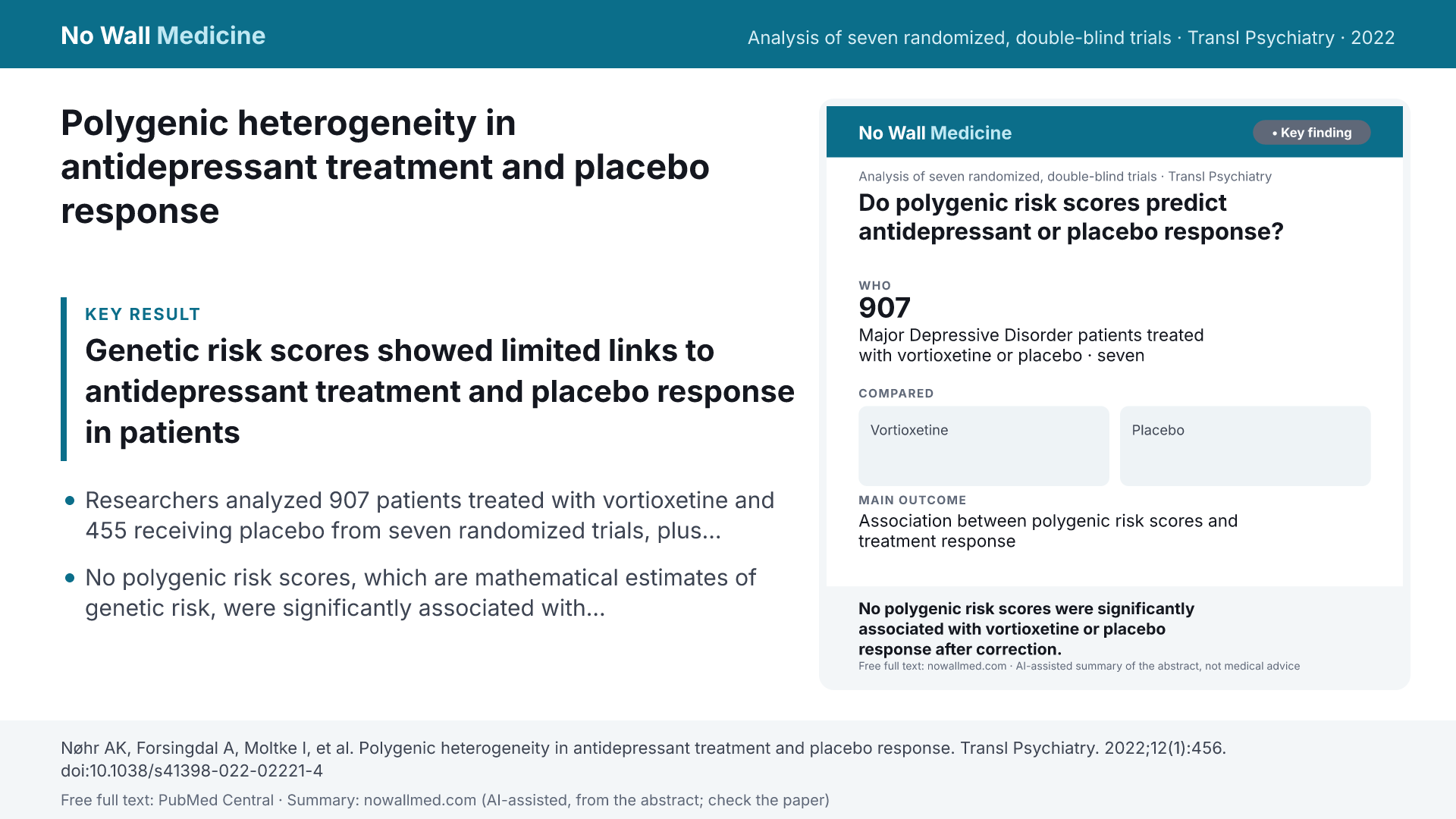
Genetic risk scores showed limited links to antidepressant treatment and placebo response in patients
Polygenic heterogeneity in antidepressant treatment and placebo response
Key points
- Researchers analyzed 907 patients treated with vortioxetine and 455 receiving placebo from seven randomized trials, plus 642 patients in an observational web-based study.
- No polygenic risk scores, which are mathematical estimates of genetic risk, were significantly associated with treatment response after correcting for multiple comparisons.
- In the self-reported sample, a higher polygenic risk score for schizophrenia was significantly associated with poorer self-reported response (P = 0.0001).
Limitation the authors note: The identified polygenic risk scores explain a low proportion of the variance (1.2-5.3%) in placebo and treatment response.
Headline and key points written with AI from the paper’s abstract, with every number checked against it. Read the paper before relying on them.
Was this summary helpful?
Subject terms
Headline, design, result, key points, caveat and citation as plain text.
Cite this article
Nøhr AK, Forsingdal A, Moltke I, et al. Polygenic heterogeneity in antidepressant treatment and placebo response. Transl Psychiatry. 2022. doi:10.1038/s41398-022-02221-4
Spotted a mistake? Suggest a correction