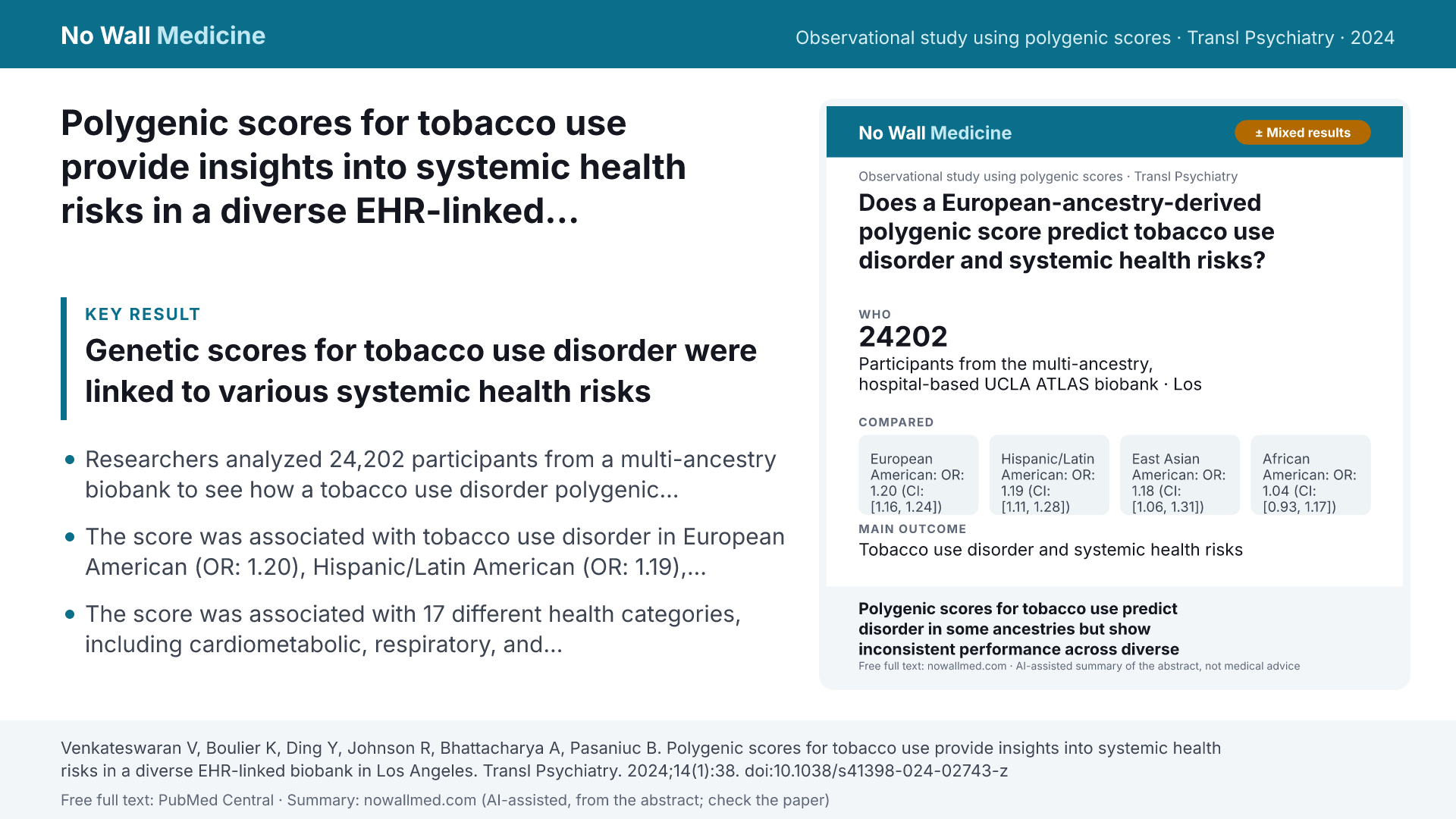
Genetic scores for tobacco use disorder were linked to various systemic health risks
Polygenic scores for tobacco use provide insights into systemic health risks in a diverse EHR-linked biobank in Los Angeles
Observational study using polygenic scoresMixed results
Does a European-ancestry-derived polygenic score predict tobacco use disorder and systemic health risks?
Who
24202
Participants from the multi-ancestry, hospital-based UCLA ATLAS biobank · Los Angeles
Compared
European American: OR: 1.20 (CI: [1.16, 1.24])
Hispanic/Latin American: OR: 1.19 (CI: [1.11, 1.28])
East Asian American: OR: 1.18 (CI: [1.06, 1.31])
African American: OR: 1.04 (CI: [0.93, 1.17])
Main outcome
Tobacco use disorder and systemic health risks
Bottom line: Polygenic scores for tobacco use predict disorder in some ancestries but show inconsistent performance across diverse populations.
Transl Psychiatry · 2024-01-18Download image
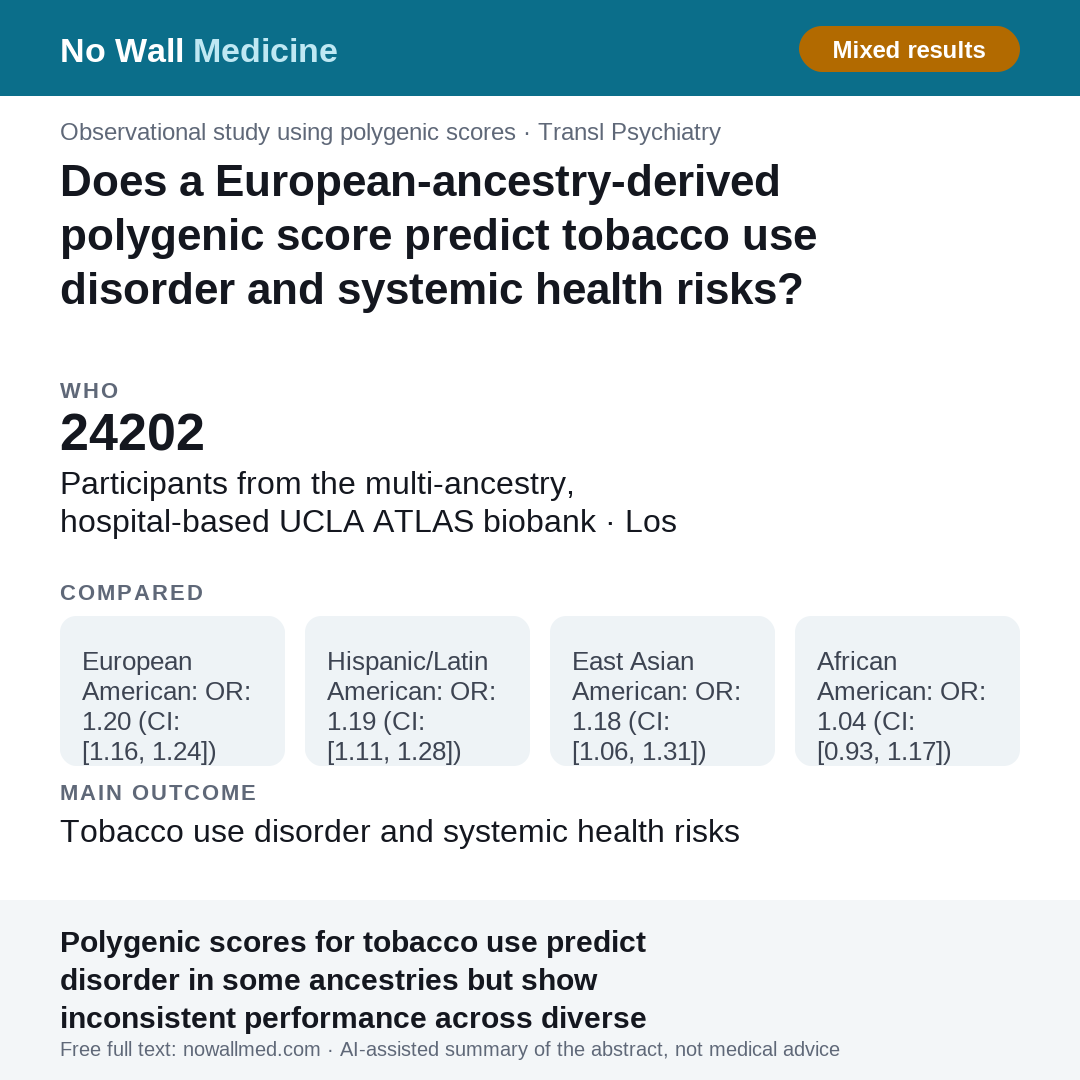
Clinical question: Does a European-ancestry-derived polygenic score predict tobacco use disorder and systemic health risks?
Why it matters: It is unknown how well genetic risk scores for tobacco use disorder predict health outcomes and tobacco use across diverse ancestral populations.
Key points
- Researchers analyzed 24,202 participants from a multi-ancestry biobank to see how a tobacco use disorder polygenic score—a tool using many genetic variants to predict risk—performed across different ancestries.
- The score was associated with tobacco use disorder in European American (OR: 1.20), Hispanic/Latin American (OR: 1.19), and East Asian American (OR: 1.18) groups, but not in African American (OR: 1.04) groups.
- The score was associated with 17 different health categories, including cardiometabolic, respiratory, and psychiatric conditions, and was linked to obesity and alcohol-related disorders in people without a smoking history.
Headline and key points written with AI from the paper’s abstract, with every number checked against it. Read the paper before relying on them.
Was this summary helpful?
Subject terms
Cite this article
Venkateswaran V, Boulier K, Ding Y, Johnson R, Bhattacharya A, Pasaniuc B. Polygenic scores for tobacco use provide insights into systemic health risks in a diverse EHR-linked biobank in Los Angeles. Transl Psychiatry. 2024. doi:10.1038/s41398-024-02743-z
Spotted a mistake? Suggest a correction