Polymyxin B haemoadsorption was associated with a high probability of lower mortality in endotoxic septic shock
Polymyxin B haemoadsorption in endotoxic septic shock (Tigris): a multicentre, open-label, Bayesian, randomised, controlled, phase 3 trial
Randomised, open-label, phase 3 trialBenefit found
Does polymyxin B haemoadsorption reduce mortality in endotoxic septic shock?
Who
157
Adults with endotoxic septic shock and multiple organ dysfunction · 19 US hospitals
Compared
39%polymyxin B plus standard of care
45%standard of care alone
Main outcome
28-day mortality
Result: APACHE-II adjusted odds ratio 0.67 (95% credible interval 0.39-1.08)
Bottom line: Polymyxin B haemoadsorption was associated with a high probability of lower mortality at 28 days and 90 days.
Funded by: Spectral Medical
Lancet Respir Med · 2026-03-23Download image
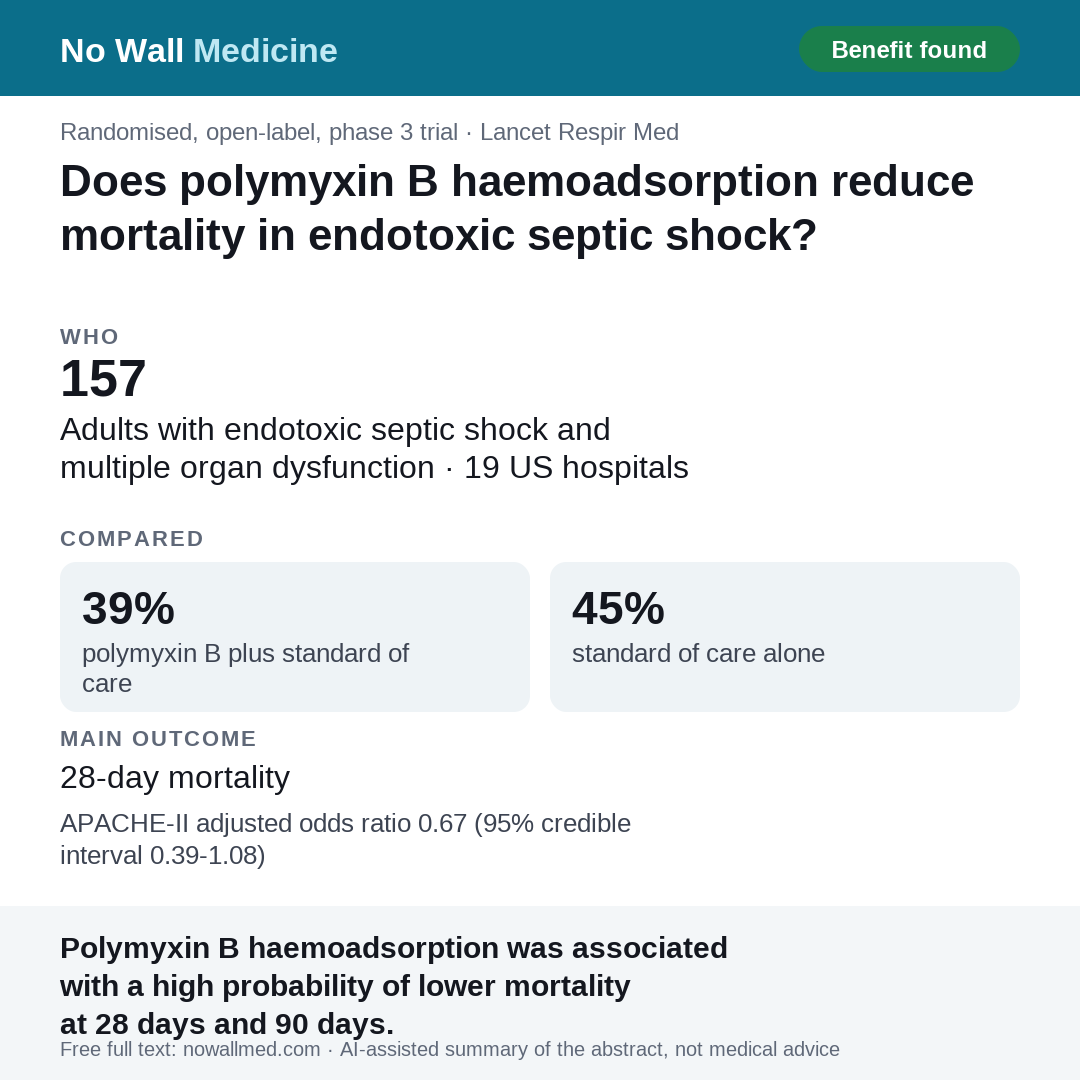
Clinical question: Does polymyxin B haemoadsorption reduce mortality in endotoxic septic shock?
Why it matters: Endotoxic septic shock is a subset of septic shock with high endotoxin activity and multiorgan failure that carries a high risk of death.
Key points
- Researchers studied 157 adults with endotoxic septic shock across 19 hospitals, comparing polymyxin B haemoadsorption to standard care alone.
- At 28 days, 39% of the polymyxin B group died compared to 45% in the control group, showing a 95.3% posterior probability of benefit.
- The 90-day mortality analysis showed a 99.4% posterior probability of benefit for the polymyxin B treatment group.
Headline and key points written with AI from the paper’s abstract, with every number checked against it. Read the paper before relying on them.
Abstract
Background
Endotoxic septic shock, a subset of septic shock with high endotoxin activity and multiorgan failure, is associated with high risk of death. We sought to identify the effect of endotoxin removal from the blood with polymyxin B haemoadsorption on mortality. Methods
We conducted an open-label, randomised, controlled, phase 3 trial at 19 US hospitals, enrolling adults (aged ≥18 years) with septic shock requiring vasopressors, with multiple organ dysfunction, and with endotoxin activity between 0·60 and 0·89 units. Patients were randomly assigned (2:1) to receive two sessions of polymyxin B plus standard of care or standard of care alone (control), with block randomisation stratified by site. Study personnel were masked to treatment allocation. Polymyxin B haemoadsorption was given via haemodialysis at a blood flow rate of 80-120 mL/min for 90-120 min per session, 22 h apart. The primary outcome was 28-day mortality in the intention-to-treat cohort. The safety cohort included all participants exposed to any amount of study treatment. Design and analysis followed a Bayesian framework, using a prior for the treatment effect based on a subgroup of the earlier EUPHRATES trial. 90-day mortality was the key secondary outcome. The trial was registered at ClinicalTrials.gov and is completed (NCT03901807). Findings
Between Sept 30, 2019, and April 10, 2025, we screened 14 890 patients, of whom 157 were enrolled (106 assigned to polymyxin B and 51 to control; 66 [42%] women and 91 [58%] men). At 28 days, 41 (39%) patients in the polymyxin B group and 23 (45%) in the control group had died, yielding a posterior probability of benefit of 95·3% (APACHE-II adjusted odds ratio 0·67 [95% credible interval 0·39-1·08]). At 90 days, the posterior probability of benefit was 99·4% (0·54 [0·32-0·87]). Of 100 patients in the polymyxin B group assessed for safety, 30 (30%) had a serious adverse event compared with 11 (22%) of 51 patients in the control group (difference -8 percentage points [95% CI -22 to 6]). Two (2%) serious adverse events in the polymyxin B group were treatment-related, one related to polymyxin B and one to catheter placement. Interpretation
In patients with endotoxic septic shock defined by high endotoxin activity and multiorgan failure, polymyxin B haemoadsorption was associated with a high probability of lower mortality at 28 days and 90 days. Funding
Spectral Medical.
Abstract reproduced under the article’s CC BY licence.
Topics
Spotted a mistake? Suggest a correction