Risk factors for aortic dilations vary depending on which part of the aorta is affected
Population-Based Risk Factors for Ascending, Arch, Descending, and Abdominal Aortic Dilations for 60-74-Year-Old Individuals
Randomized screening trialsMixed results
What are the dominant predictors for aortic dilations in 60-74-year-old individuals?
Who
14,989
Individuals aged 60-74 years · Danish Cardiovascular Multicenter Screening Trials
Compared
Presence of coexisting aortic dilations: highest adjusted odds ratios
Other predictors: hypertension, increasing body surface area, male sex, familial disposition, and atrial fibrillation
Main outcome
Aortic dilations at the ascending, arch, descending, and abdominal parts
Bottom line: Risk factors for aortic dilations differ by location, with coexisting dilations being the strongest predictor.
JACC · 2021-07-16Download image
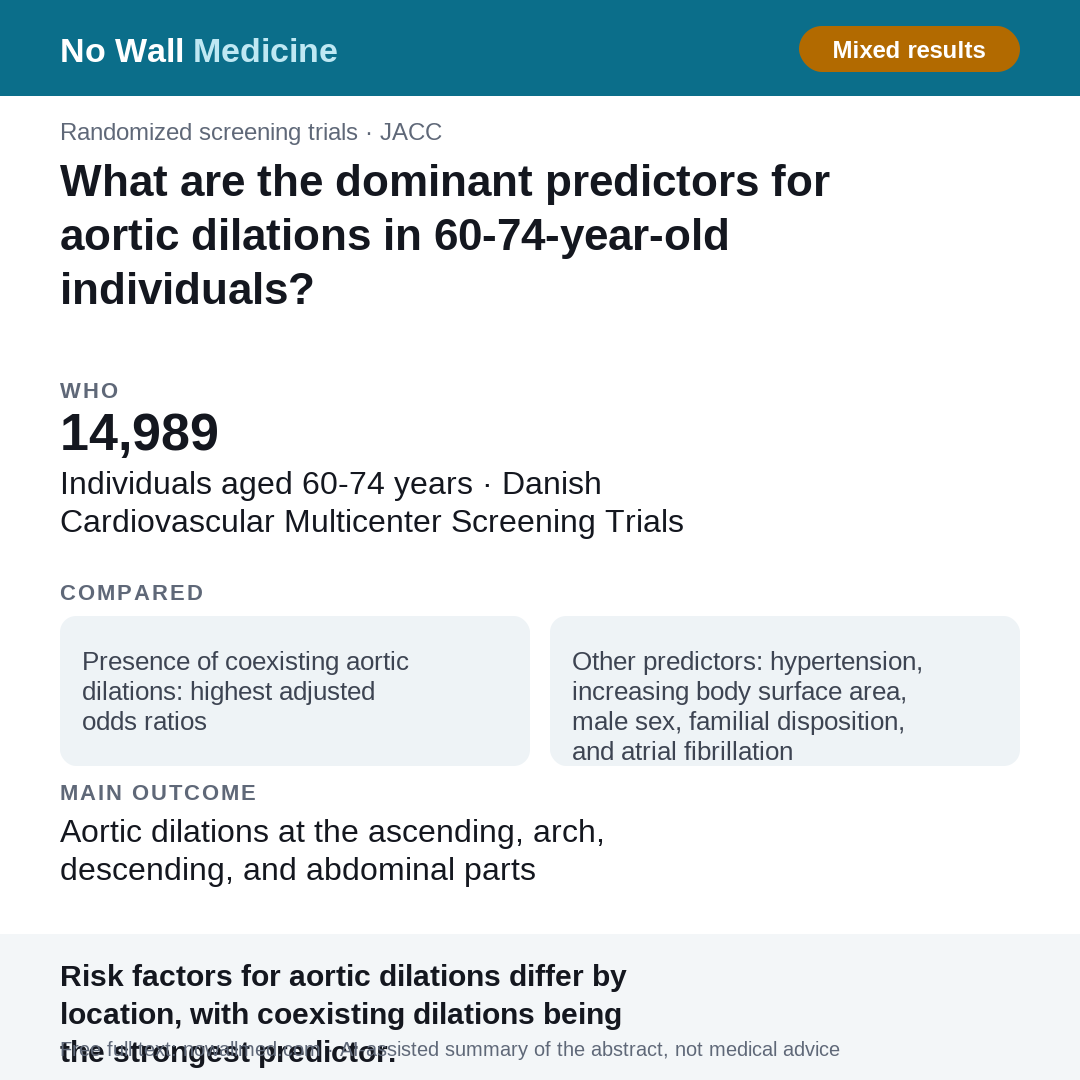
Clinical question: What are the dominant predictors for aortic dilations in 60-74-year-old individuals?
Why it matters: It is unknown if the causes and risk factors for aortic dilations are the same across all segments of the aorta.
Key points
- Researchers studied 14,989 participants aged 60-74 years to identify predictors for dilations in different segments of the aorta.
- The presence of a dilation in another part of the aorta was the most dominant predictor for having any aortic dilation.
- Other predictors included hypertension, male sex, atrial fibrillation (irregular heartbeat), and increasing body surface area.
Headline and key points written with AI from the paper’s abstract, with every number checked against it. Read the paper before relying on them.
Was this summary helpful?
Subject terms
Cite this article
Obel LM, Diederichsen AC, Steffensen FH, Frost L, Lambrechtsen J, Busk M. Population-Based Risk Factors for Ascending, Arch, Descending, and Abdominal Aortic Dilations for 60-74-Year-Old Individuals. JACC. 2021. doi:10.1016/j.jacc.2021.04.094
Spotted a mistake? Suggest a correction
Top studies every Monday
The week’s key trials and guidelines in your specialties, plus any topics you follow. By email, free.
Get the weekly digest