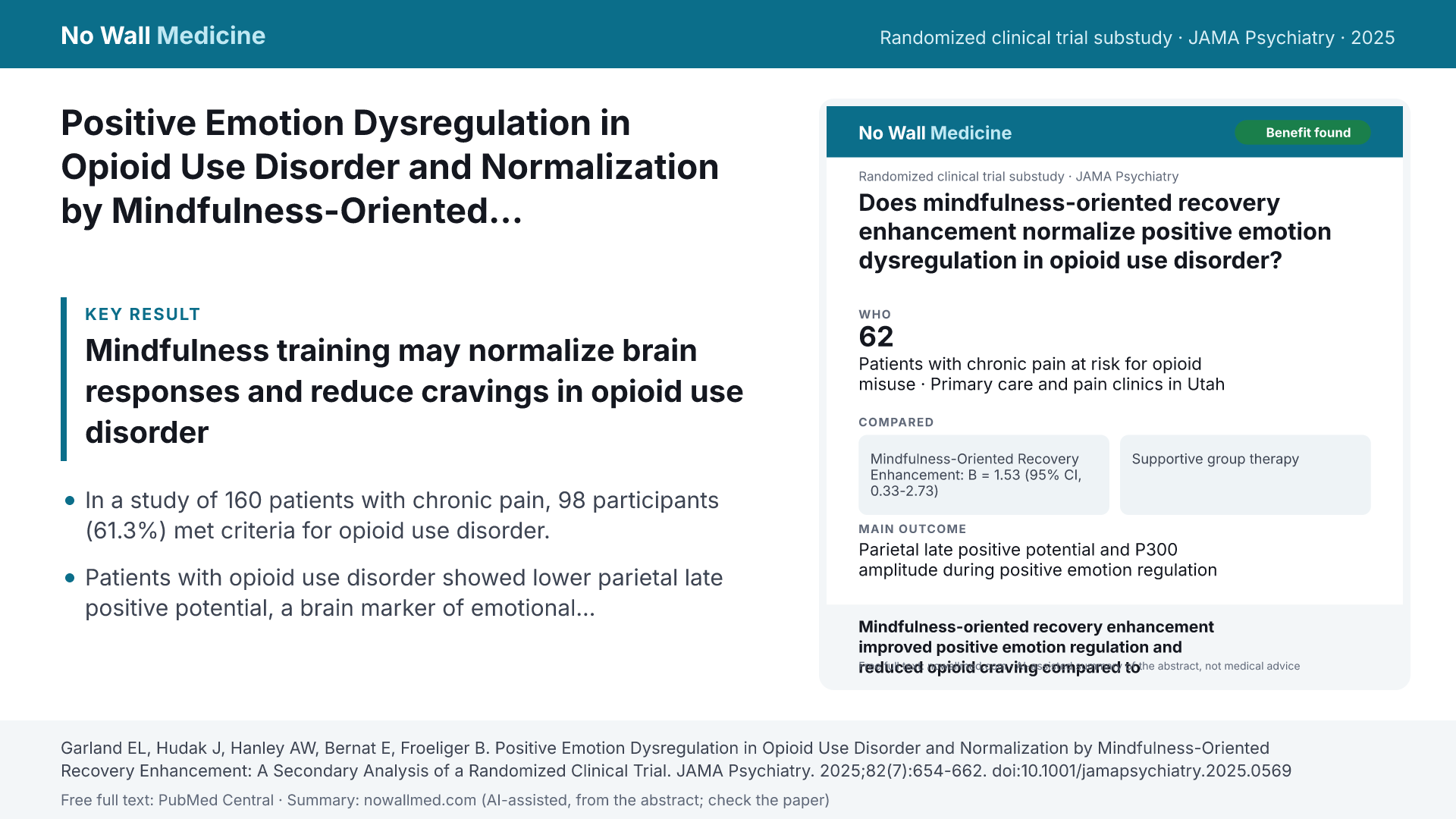
Mindfulness training may normalize brain responses and reduce cravings in opioid use disorder
Positive Emotion Dysregulation in Opioid Use Disorder and Normalization by Mindfulness-Oriented Recovery Enhancement: A Secondary Analysis of a Randomized Clinical Trial
Randomized clinical trial substudyBenefit found
Does mindfulness-oriented recovery enhancement normalize positive emotion dysregulation in opioid use disorder?
Who
62
Patients with chronic pain at risk for opioid misuse · Primary care and pain clinics in Utah
Compared
Mindfulness-Oriented Recovery Enhancement: B = 1.53 (95% CI, 0.33-2.73)
Supportive group therapy
Main outcome
Parietal late positive potential and P300 amplitude during positive emotion regulation
Result: B = 1.53 (95% CI, 0.33-2.73)
Bottom line: Mindfulness-oriented recovery enhancement improved positive emotion regulation and reduced opioid craving compared to supportive group therapy.
JAMA Psychiatry · 2025-04-30Download image
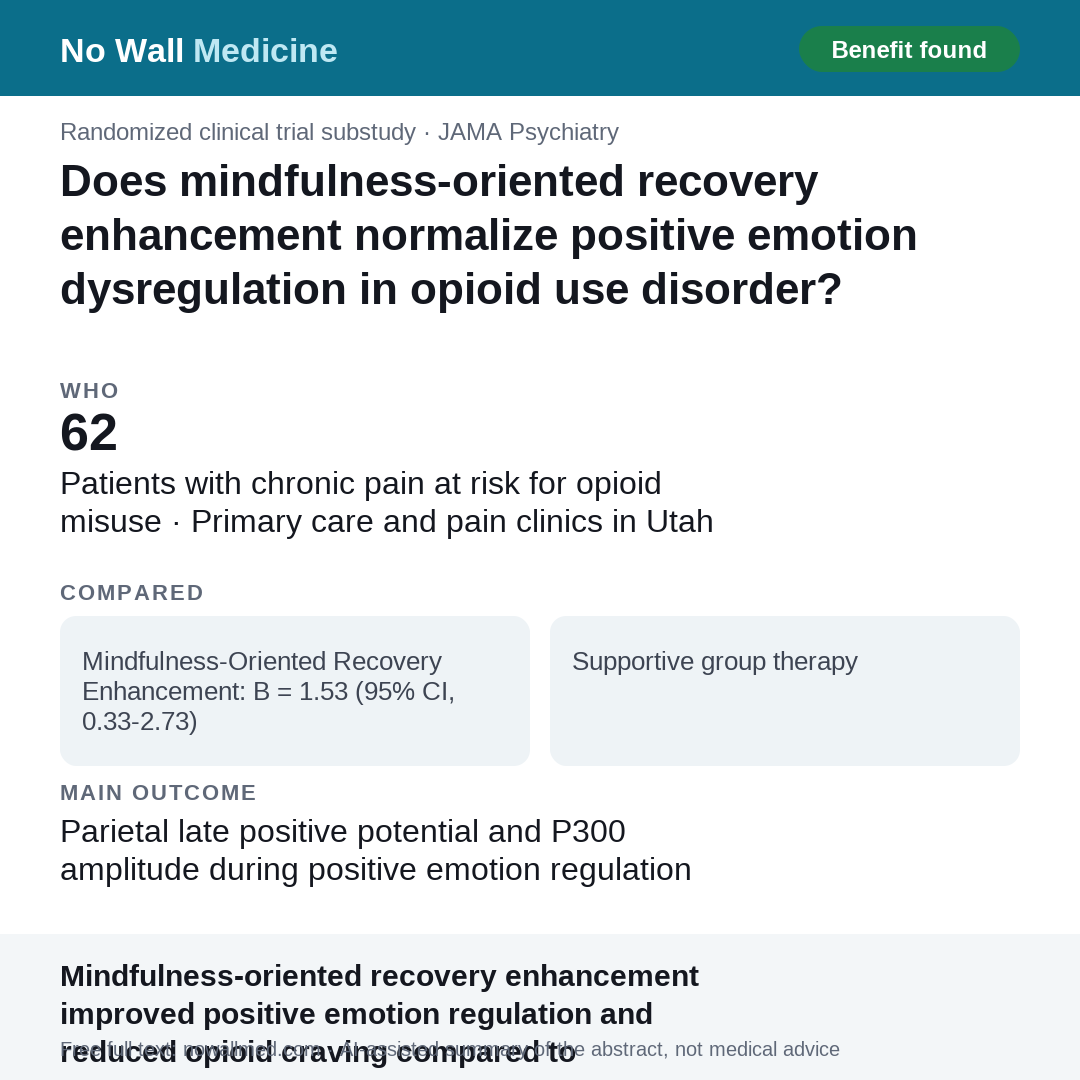
Clinical question: Does mindfulness-oriented recovery enhancement normalize positive emotion dysregulation in opioid use disorder?
Why it matters: It is unknown if difficulties in regulating positive emotions drive opioid use disorder and if these difficulties can be treated.
Key points
- In a study of 160 patients with chronic pain, 98 participants (61.3%) met criteria for opioid use disorder.
- Patients with opioid use disorder showed lower parietal late positive potential, a brain marker of emotional processing, during positive emotion regulation tasks.
- In a treatment subsample of 62 participants, Mindfulness-Oriented Recovery Enhancement was associated with greater increases in brain responses and improved attention to positive information compared to supportive group therapy.
Headline and key points written with AI from the paper’s abstract, with every number checked against it. Read the paper before relying on them.
Was this summary helpful?
Subject terms
Cite this article
Garland EL, Hudak J, Hanley AW, Bernat E, Froeliger B. Positive Emotion Dysregulation in Opioid Use Disorder and Normalization by Mindfulness-Oriented Recovery Enhancement: A Secondary Analysis of a Randomized Clinical Trial. JAMA Psychiatry. 2025. doi:10.1001/jamapsychiatry.2025.0569
Spotted a mistake? Suggest a correction