Positive Expiratory Pressure Therapy on Oxygen Saturation and Ventilation After Abdominal Surgery: A Randomized Controlled Trial
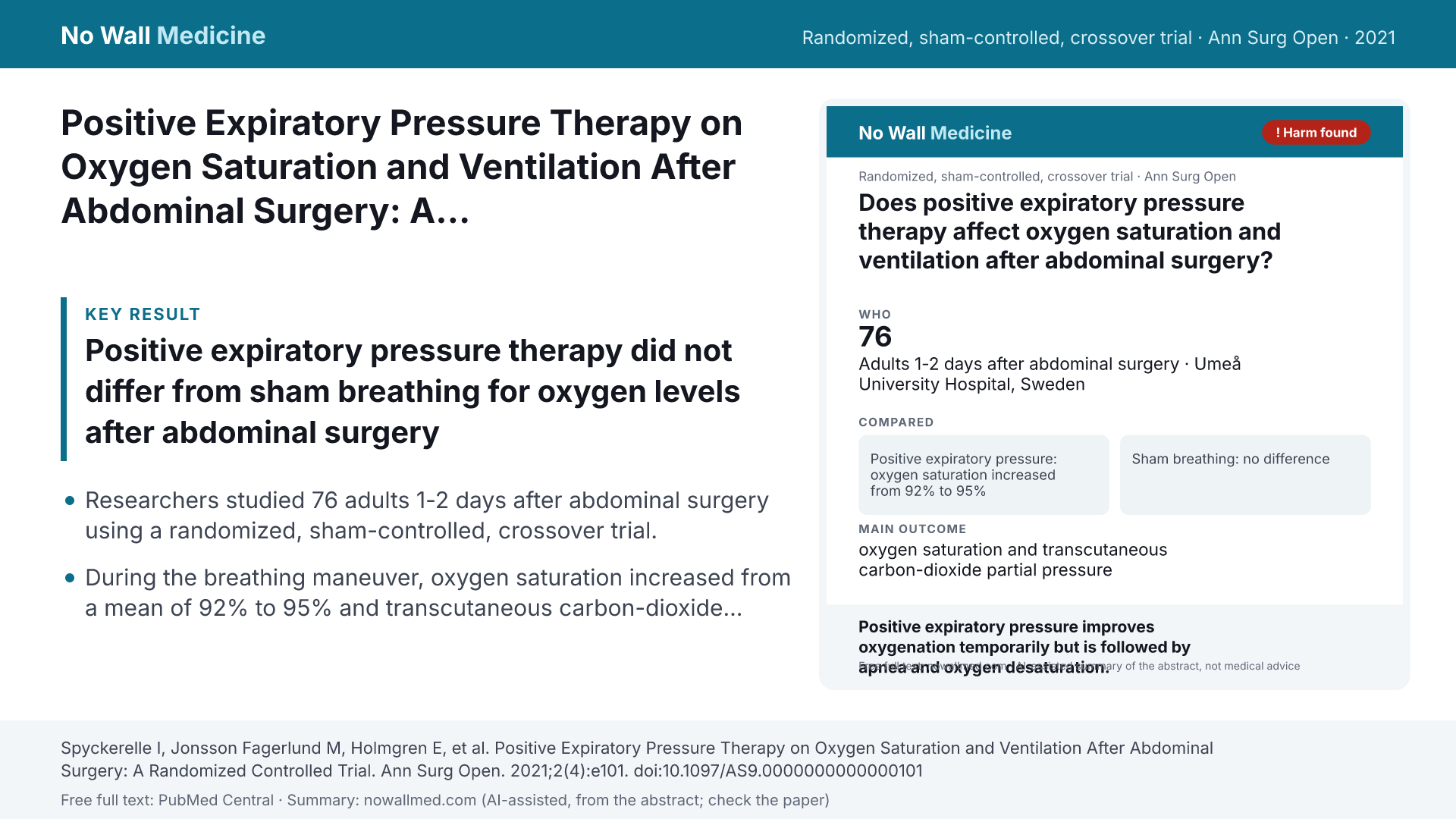
Key result: Positive expiratory pressure therapy did not differ from sham breathing for oxygen levels after abdominal surgery
Randomized, sham-controlled, crossover trialHarm found
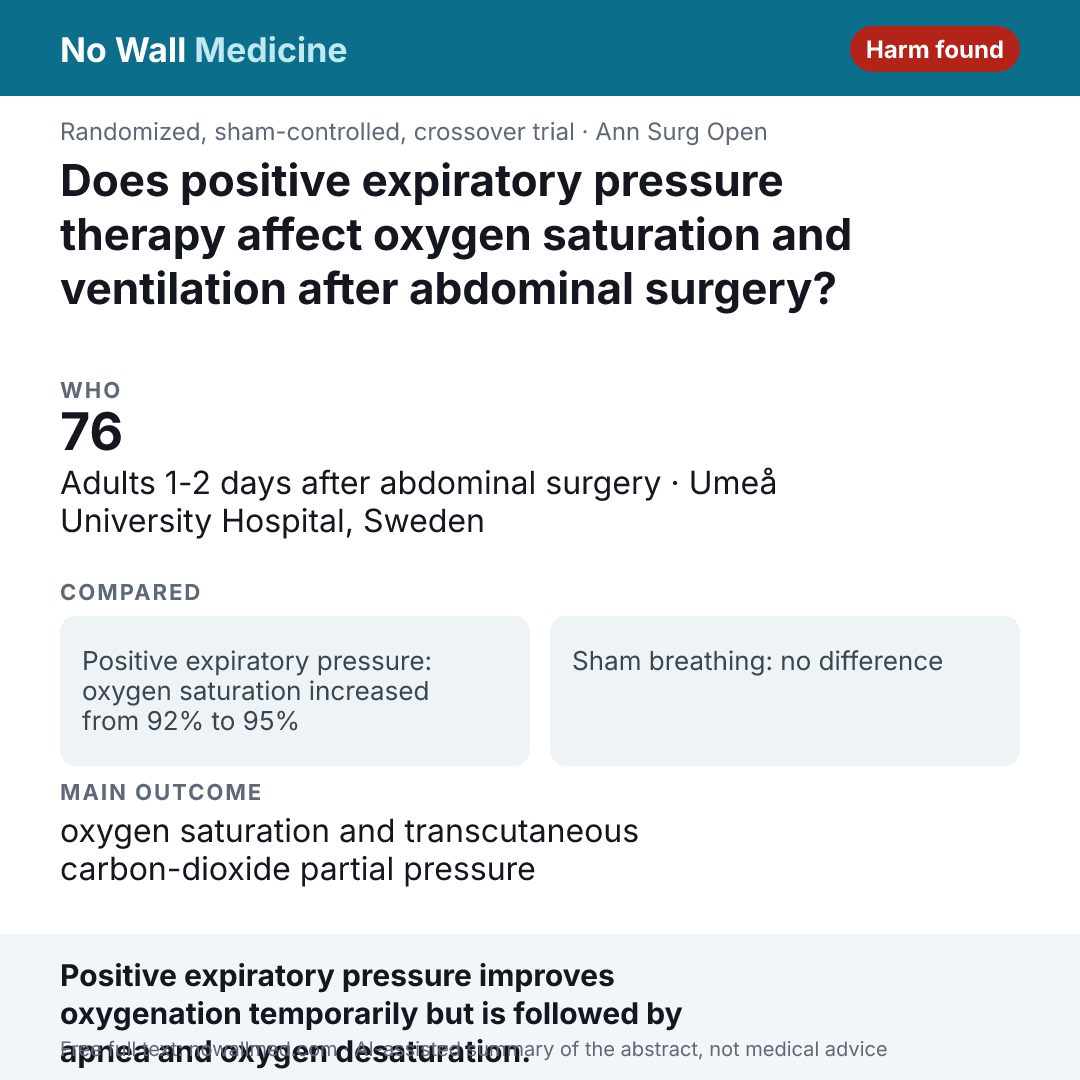
Does positive expiratory pressure therapy affect oxygen saturation and ventilation after abdominal surgery?
Who
76
Adults 1-2 days after abdominal surgery · Umeå University Hospital, Sweden
Compared
Positive expiratory pressure: oxygen saturation increased from 92% to 95%
Sham breathing: no difference
Main outcome
oxygen saturation and transcutaneous carbon-dioxide partial pressure
Bottom line: Positive expiratory pressure improves oxygenation temporarily but is followed by apnea and oxygen desaturation.
Ann Surg Open · 2021-10-01 · Save PNG
Key points
- Researchers studied 76 adults 1-2 days after abdominal surgery using a randomized, sham-controlled, crossover trial.
- During the breathing maneuver, oxygen saturation increased from a mean of 92% to 95% and transcutaneous carbon-dioxide partial pressure decreased from 36 to 33 mm Hg.
- These changes in oxygen saturation and carbon dioxide levels did not differ from sham breathing or deep-breathing maneuvers.
Discussion prompts
- Would these patients look like yours? Who was left out?
- Is the main outcome one that matters to patients?
- Is the difference large enough to change what you do?
Cite: Spyckerelle I, Jonsson Fagerlund M, Holmgren E, et al. Positive Expiratory Pressure Therapy on Oxygen Saturation and Ventilation After Abdominal Surgery: A Randomized Controlled Trial. Ann Surg Open. 2021;2(4):e101. doi:10.1097/AS9.0000000000000101
Free full text: PubMed Central · Summary and visual abstract: nowallmed.com/a/positive-expiratory-pressure-therapy-on-oxygen-saturation-and-1s6f3qn/ (AI-assisted from the abstract; check the paper before relying on it).