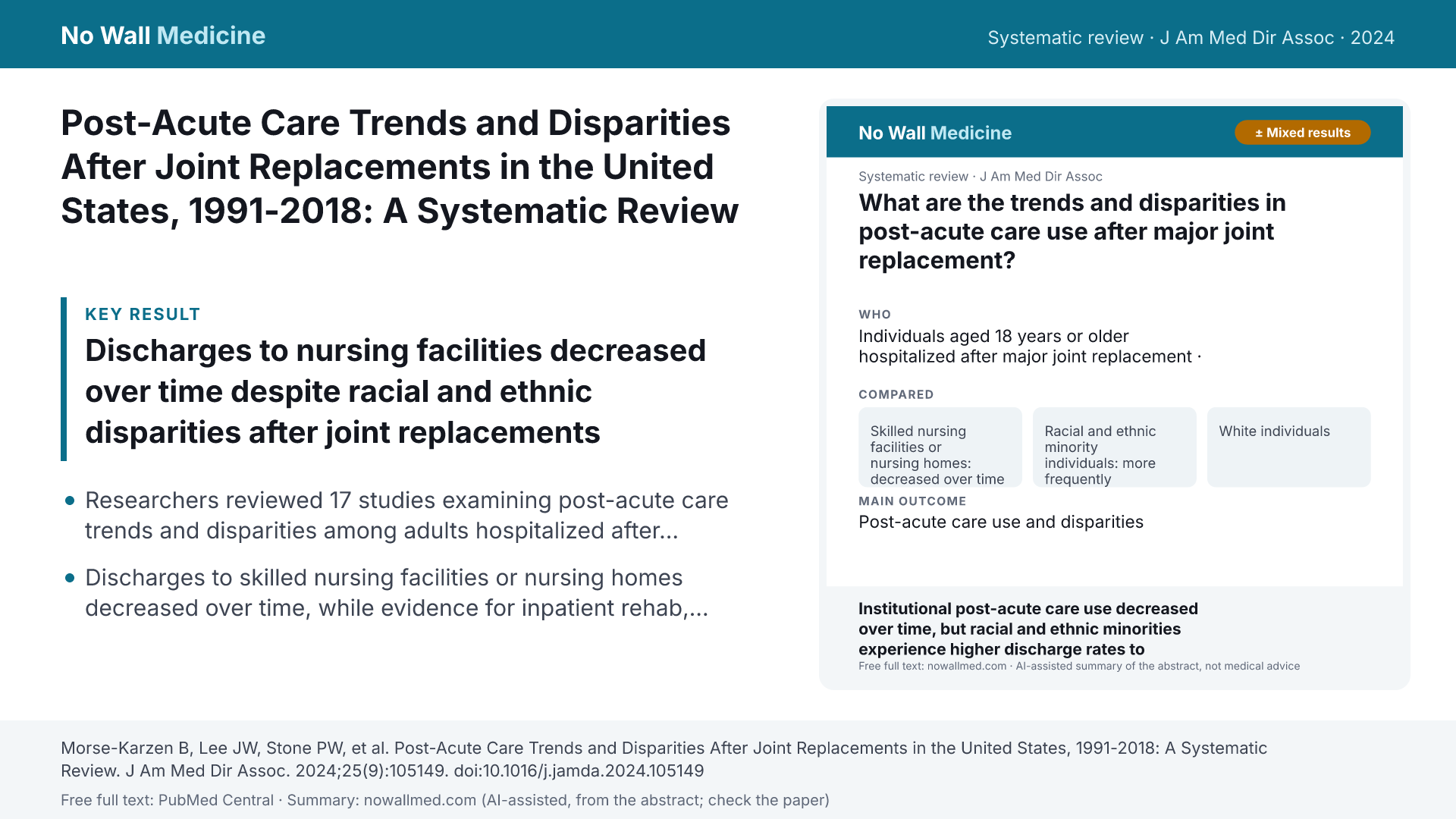
Discharges to nursing facilities decreased over time despite racial and ethnic disparities after joint replacements
Post-Acute Care Trends and Disparities After Joint Replacements in the United States, 1991-2018: A Systematic Review
Systematic reviewMixed results
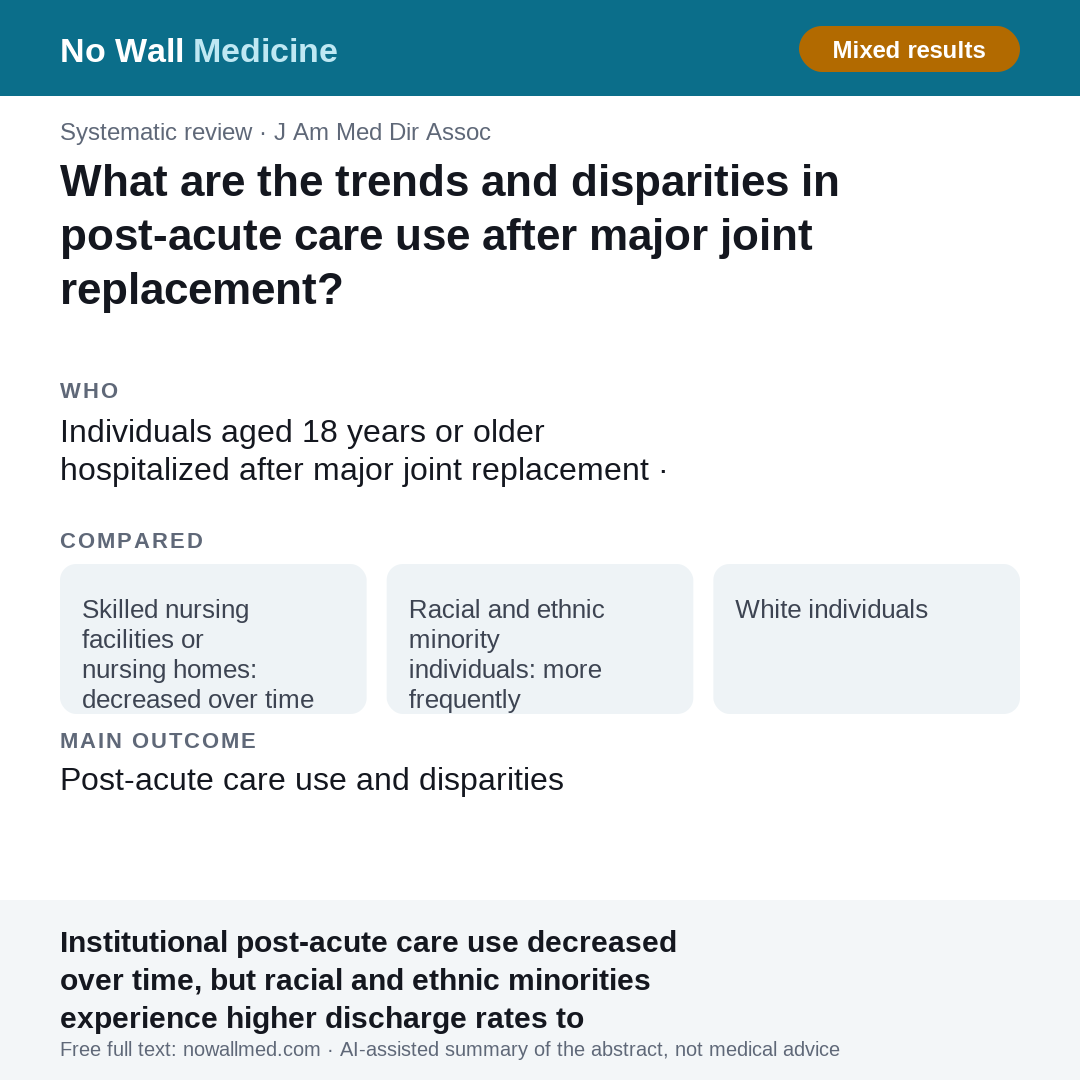
What are the trends and disparities in post-acute care use after major joint replacement?
Who
Individuals aged 18 years or older hospitalized after major joint replacement · United States
Compared
Skilled nursing facilities or nursing homes: decreased over time
Racial and ethnic minority individuals: more frequently discharged to post-acute care institutions
White individuals
Main outcome
Post-acute care use and disparities
Bottom line: Institutional post-acute care use decreased over time, but racial and ethnic minorities experience higher discharge rates to institutions.
J Am Med Dir Assoc · 2024-07-14Download image
Clinical question: What are the trends and disparities in post-acute care use after major joint replacement?
Why it matters: It was unknown how post-acute care use and disparities related to race, ethnicity, and rurality have changed following major joint replacement in the United States.
Key points
- Researchers reviewed 17 studies examining post-acute care trends and disparities among adults hospitalized after major joint replacement in the United States.
- Discharges to skilled nursing facilities or nursing homes decreased over time, while evidence for inpatient rehab, home health, or home care was mixed.
- Most studies found racial and ethnic minority individuals, particularly Black individuals, were more frequently discharged to post-acute care institutions than white individuals.
Headline and key points written with AI from the paper’s abstract, with every number checked against it. Read the paper before relying on them.
Was this summary helpful?
Subject terms
Cite this article
Morse-Karzen B, Lee JW, Stone PW, et al. Post-Acute Care Trends and Disparities After Joint Replacements in the United States, 1991-2018: A Systematic Review. J Am Med Dir Assoc. 2024. doi:10.1016/j.jamda.2024.105149
Spotted a mistake? Suggest a correction