Nipah virus survivors show high rates of long-term neurological deficits and relapsing symptoms
Post-acute sequelae after Nipah virus infection: a systematic review and meta-analysis
Systematic review and meta-analysisHarm found
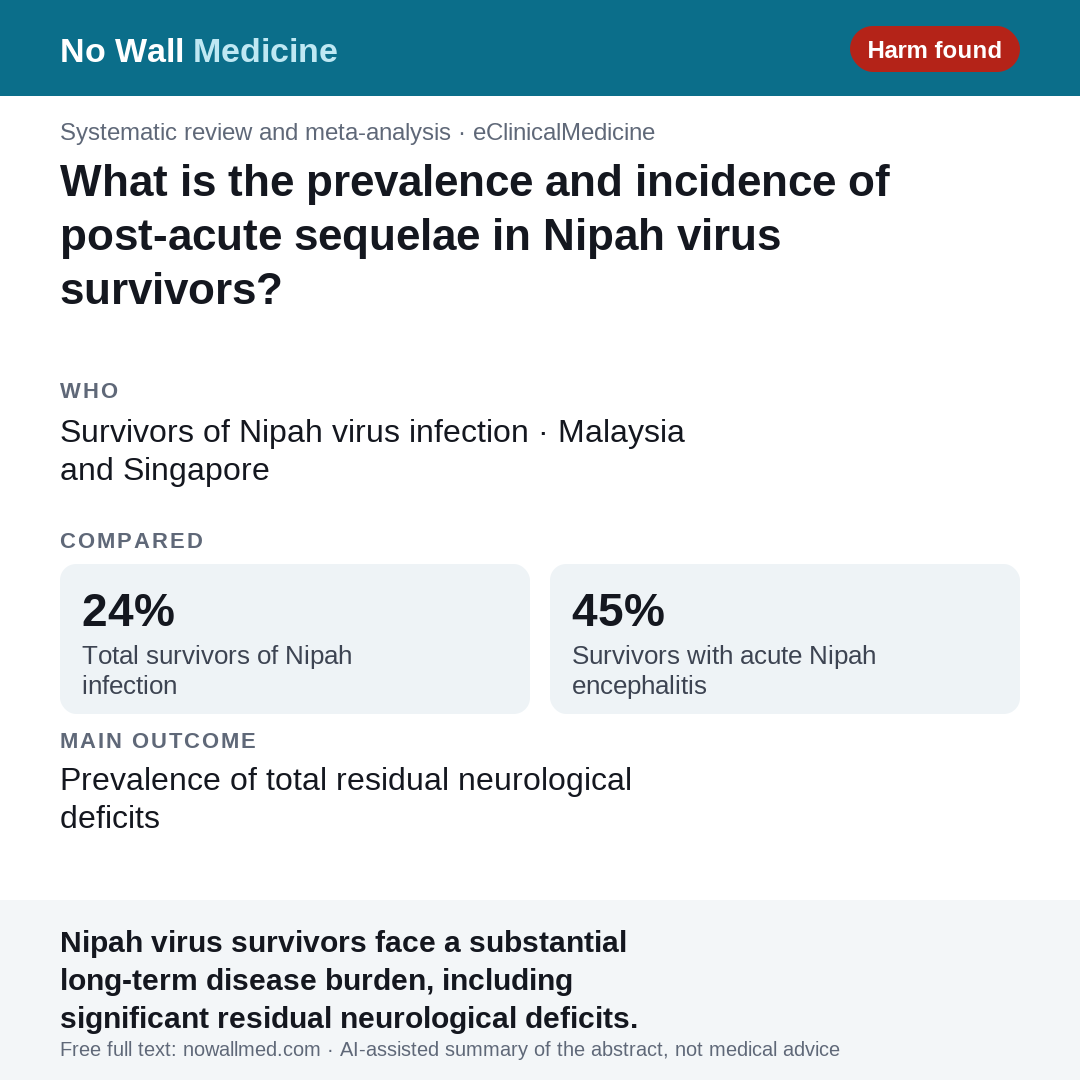
What is the prevalence and incidence of post-acute sequelae in Nipah virus survivors?
Who
Survivors of Nipah virus infection · Malaysia and Singapore
Compared
24%Total survivors of Nipah infection (95% CI 9-49; I2 = 0%)
45%Survivors with acute Nipah encephalitis (95% CI 11-85; I2 = 64%)
Main outcome
Prevalence of total residual neurological deficits
Bottom line: Nipah virus survivors face a substantial long-term disease burden, including significant residual neurological deficits.
Limitation: Estimates based on limited data, subjective outcome assessment, and heterogeneous populations.
eClinicalMedicine · 2026-04-09Download image
Clinical question: What is the prevalence and incidence of post-acute sequelae in Nipah virus survivors?
Why it matters: The incidence patterns of post-acute sequelae, which are symptoms that persist or appear after the initial infection, are not well documented after Nipah virus outbreaks.
Key points
- Researchers analyzed eight studies involving survivors of Nipah virus infection to measure long-term health issues following the initial illness.
- The pooled prevalence of total residual neurological deficits was 24% among all survivors and 45% among those who had acute Nipah encephalitis.
- An estimated 10% of survivors experience late-onset or relapsing neurological symptoms after their initial recovery from the virus.
Limitation the authors note: The authors state that estimates were based on limited data mainly from the Malaysia/Singapore outbreak and were subject to subjective outcome assessment.
Headline and key points written with AI from the paper’s abstract, with every number checked against it. Read the paper before relying on them.
Spotted a mistake? Suggest a correction