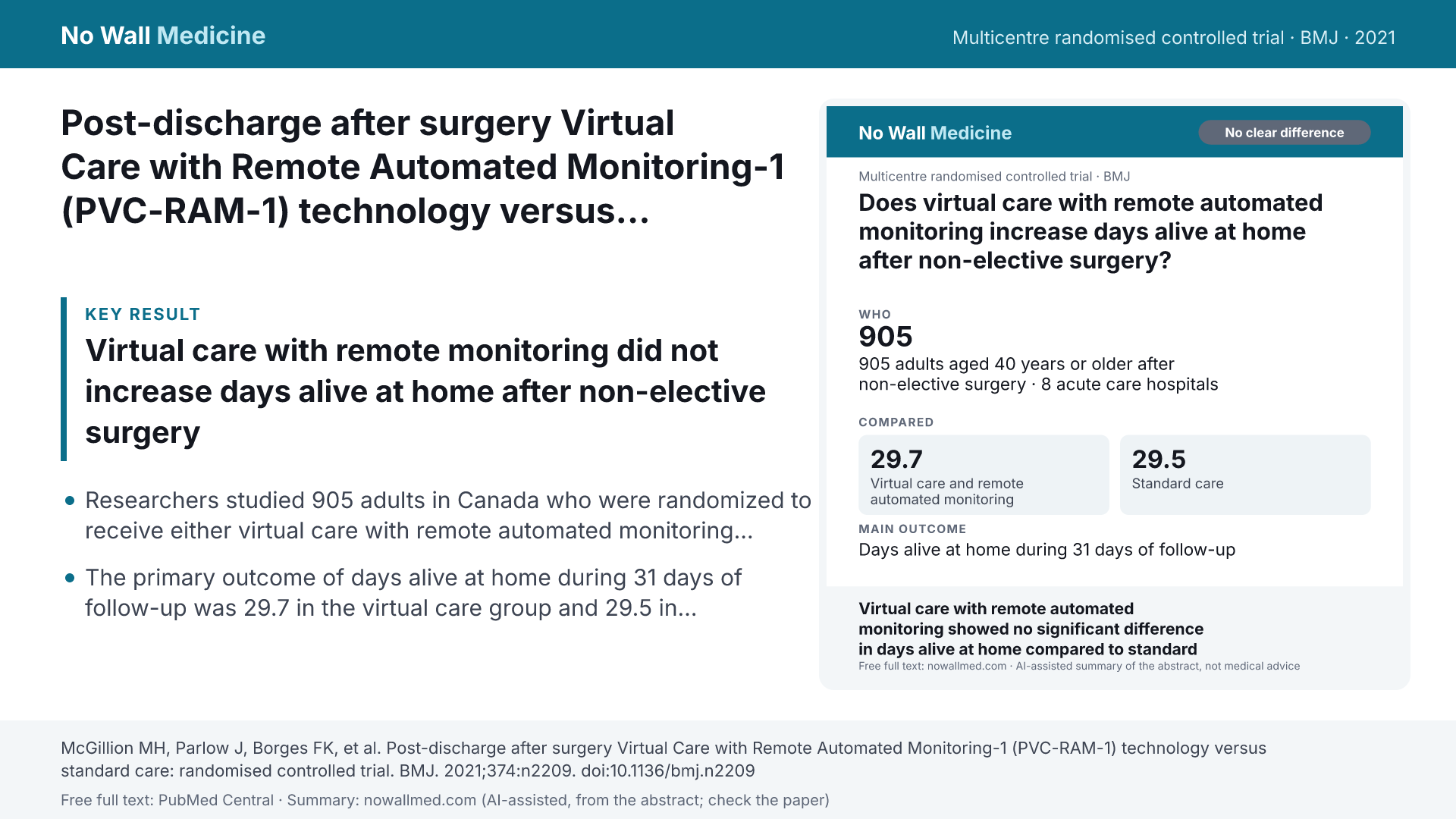
Post-discharge after surgery Virtual Care with Remote Automated Monitoring-1 (PVC-RAM-1) technology versus standard care: randomised controlled trial
Key result: Virtual care with remote monitoring did not increase days alive at home after non-elective surgery
Key points
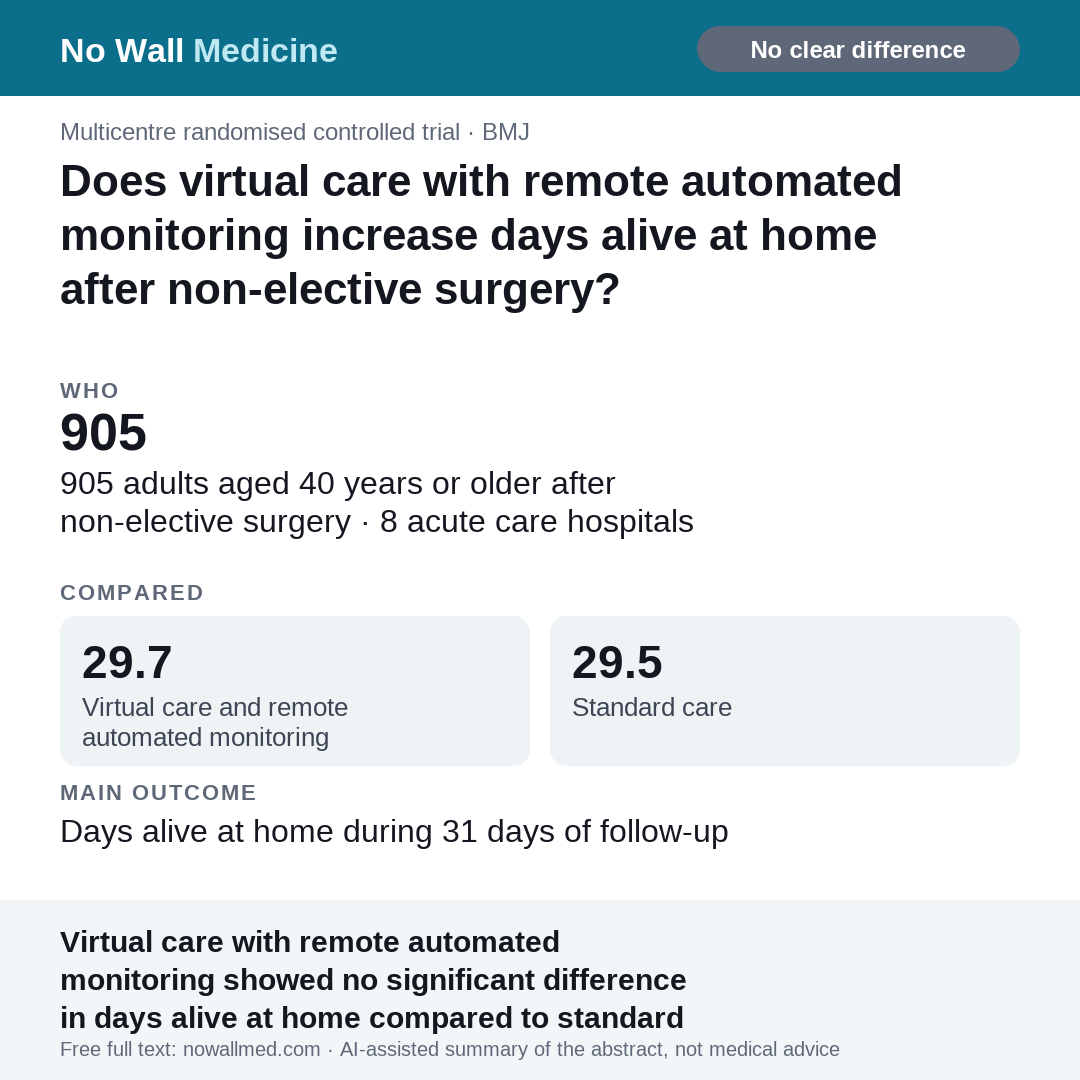
- Researchers studied 905 adults in Canada who were randomized to receive either virtual care with remote automated monitoring or standard care after non-elective surgery.
- The primary outcome of days alive at home during 31 days of follow-up was 29.7 in the virtual care group and 29.5 in the standard care group.
- More participants in the virtual care group had a drug error detected (29.7%) compared to the standard care group (5.5%).
Why it matters: It was unknown if using tablet computers and remote automated monitoring technology for daily biophysical measurements could increase the number of days patients spend alive at home after surgery.
Discussion prompts
- Would these patients look like yours? Who was left out?
- Is the main outcome one that matters to patients?
- Is the difference large enough to change what you do?
Cite: McGillion MH, Parlow J, Borges FK, et al. Post-discharge after surgery Virtual Care with Remote Automated Monitoring-1 (PVC-RAM-1) technology versus standard care: randomised controlled trial. BMJ. 2021. doi:10.1136/bmj.n2209
Free full text: PubMed Central · Summary and visual abstract: nowallmed.com/a/post-discharge-after-surgery-virtual-care-with-remote-automated-1rbdij0/ (AI-assisted from the abstract; check the paper before relying on it).