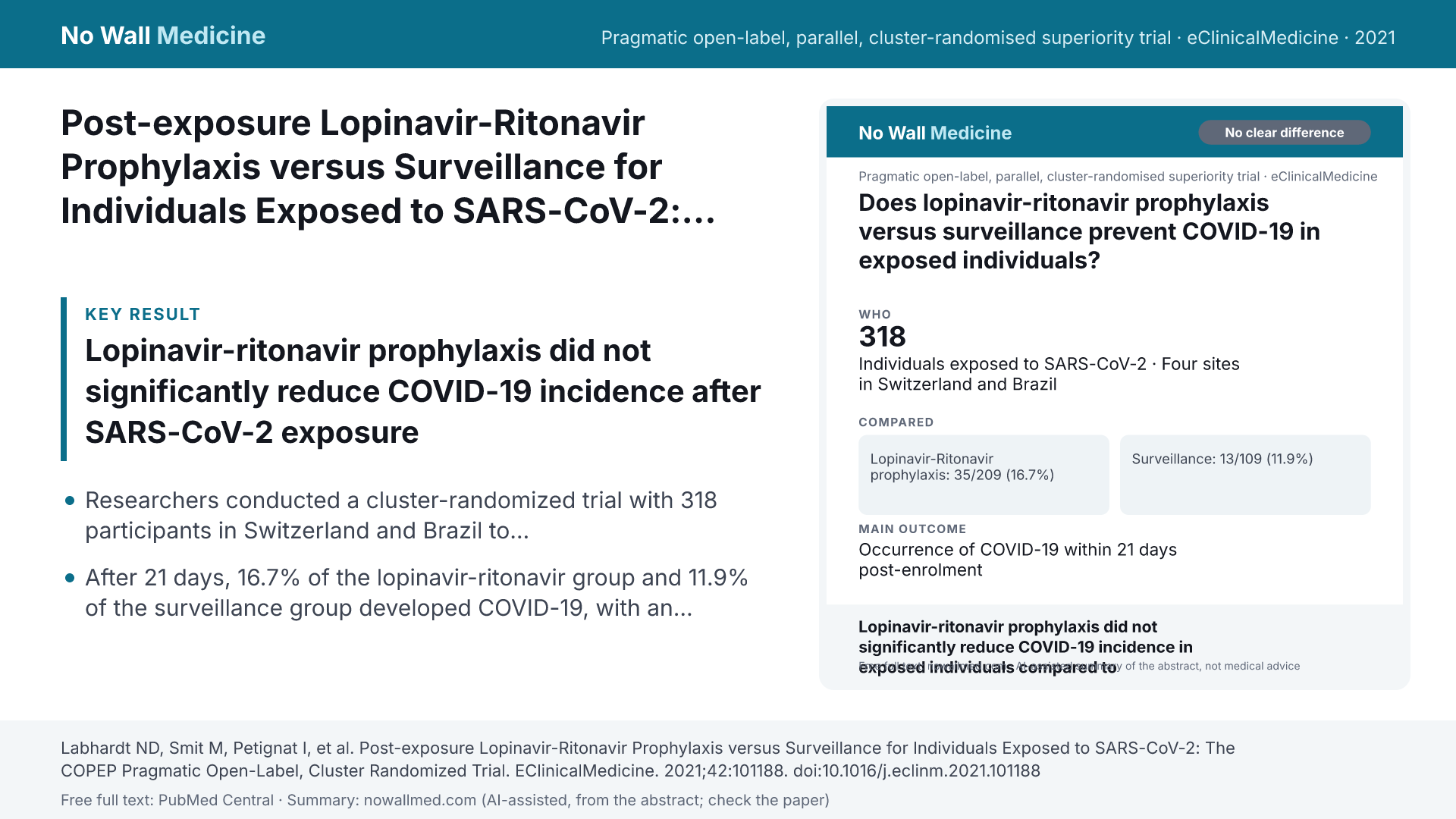
Post-exposure Lopinavir-Ritonavir Prophylaxis versus Surveillance for Individuals Exposed to SARS-CoV-2: The COPEP Pragmatic Open-Label, Cluster Randomized Trial
Key result: Lopinavir-ritonavir prophylaxis did not significantly reduce COVID-19 incidence after SARS-CoV-2 exposure
Key points
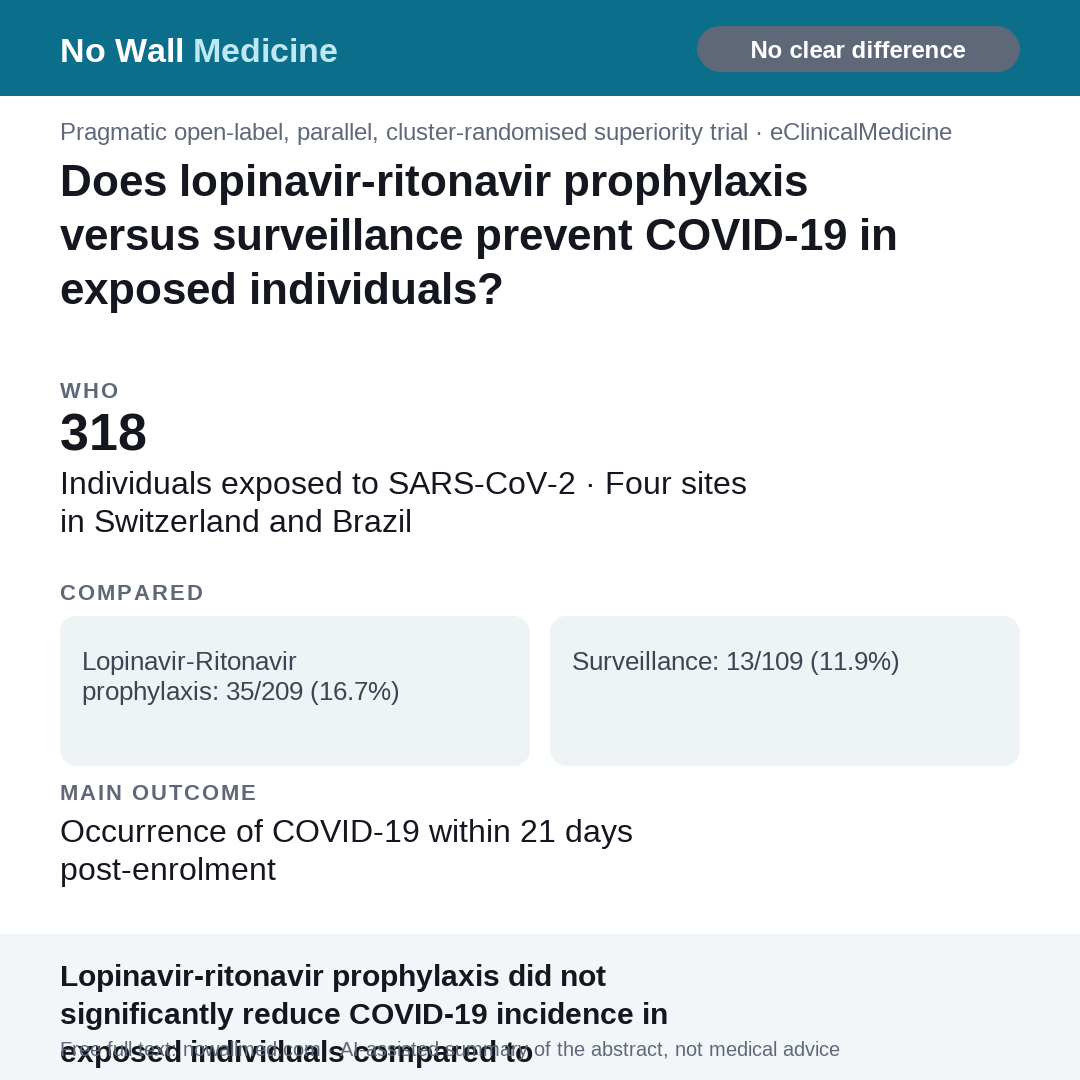
- Researchers conducted a cluster-randomized trial with 318 participants in Switzerland and Brazil to compare lopinavir-ritonavir prophylaxis against surveillance.
- After 21 days, 16.7% of the lopinavir-ritonavir group and 11.9% of the surveillance group developed COVID-19, with an adjusted hazard ratio of 0.60 (95% CI, 0.29-1.26; p = 0.18).
- Baseline SARS-CoV-2 PCR positivity was 3-fold more frequent in the lopinavir-ritonavir group (16.3%) compared to the surveillance group (5.5%).
Why it matters: It was unknown if lopinavir-ritonavir could serve as an effective post-exposure prophylaxis to prevent COVID-19 after close contact with an infected person.
Discussion prompts
- Would these patients look like yours? Who was left out?
- Is the main outcome one that matters to patients?
- Is the difference large enough to change what you do?
Cite: Labhardt ND, Smit M, Petignat I, et al. Post-exposure Lopinavir-Ritonavir Prophylaxis versus Surveillance for Individuals Exposed to SARS-CoV-2: The COPEP Pragmatic Open-Label, Cluster Randomized Trial. eClinicalMedicine. 2021. doi:10.1016/j.eclinm.2021.101188
Free full text: PubMed Central · Summary and visual abstract: nowallmed.com/a/post-exposure-lopinavir-ritonavir-prophylaxis-versus-surveillance-for-wfu5bd/ (AI-assisted from the abstract; check the paper before relying on it).