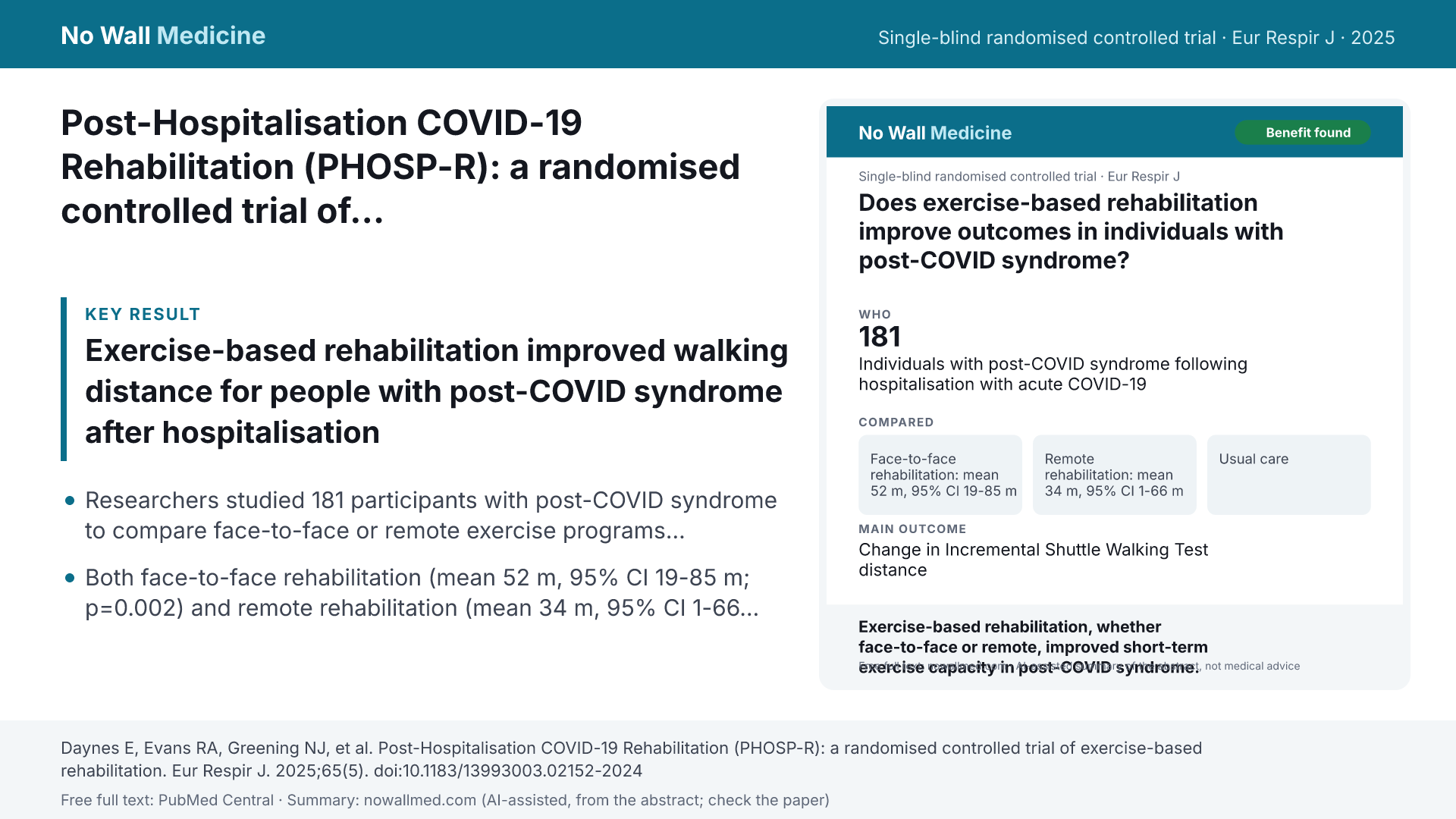
Exercise-based rehabilitation improved walking distance for people with post-COVID syndrome after hospitalisation
Post-Hospitalisation COVID-19 Rehabilitation (PHOSP-R): a randomised controlled trial of exercise-based rehabilitation
Single-blind randomised controlled trialBenefit found
Does exercise-based rehabilitation improve outcomes in individuals with post-COVID syndrome?
Who
181
Individuals with post-COVID syndrome following hospitalisation with acute COVID-19
Compared
Face-to-face rehabilitation: mean 52 m, 95% CI 19-85 m
Remote rehabilitation: mean 34 m, 95% CI 1-66 m
Usual care
Main outcome
Change in Incremental Shuttle Walking Test distance
Bottom line: Exercise-based rehabilitation, whether face-to-face or remote, improved short-term exercise capacity in post-COVID syndrome.
Eur Respir J · 2025-05-22 · Save PNG
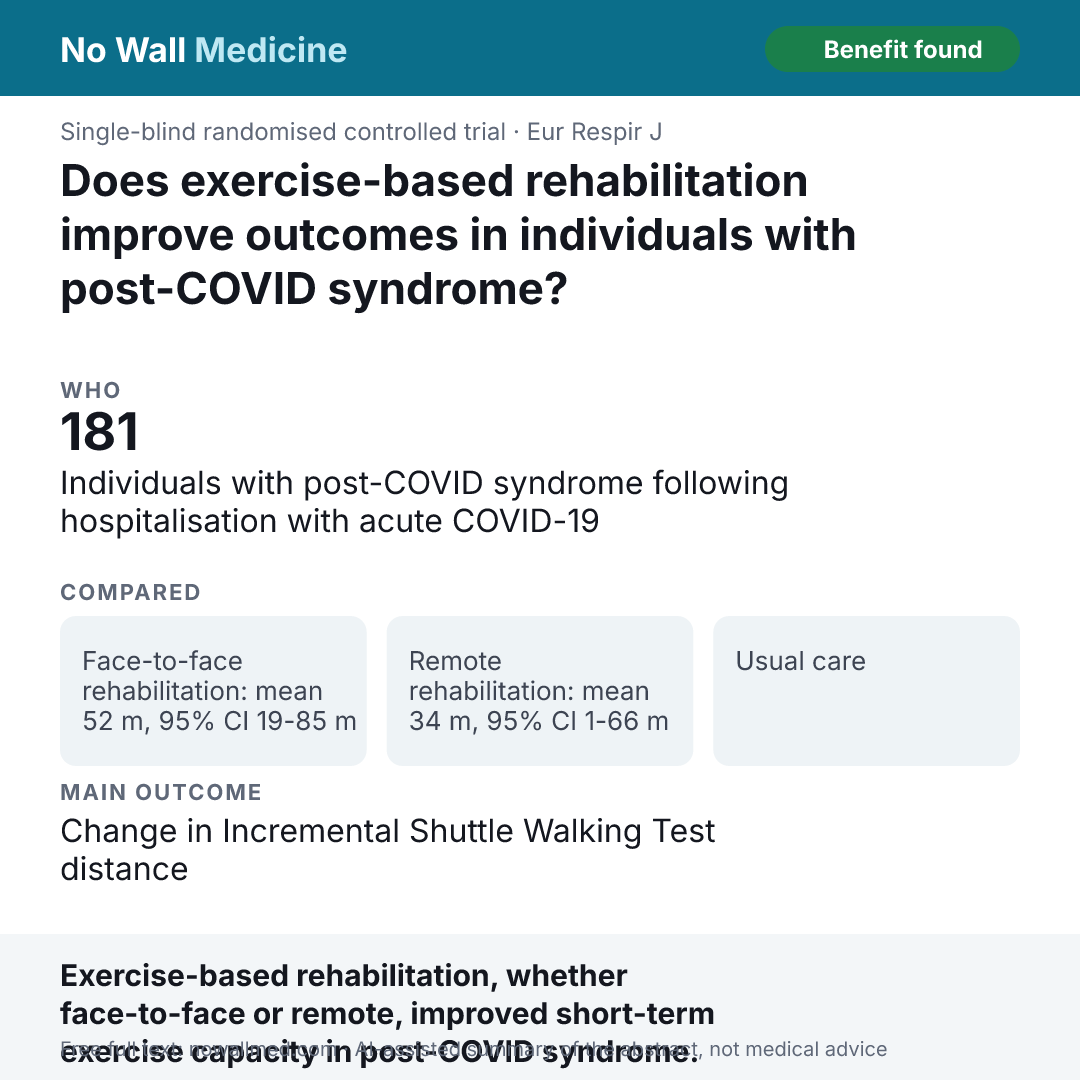
Clinical question: Does exercise-based rehabilitation improve outcomes in individuals with post-COVID syndrome?
Key points
- Researchers studied 181 participants with post-COVID syndrome to compare face-to-face or remote exercise programs against usual care.
- Both face-to-face rehabilitation (mean 52 m, 95% CI 19-85 m; p=0.002) and remote rehabilitation (mean 34 m, 95% CI 1-66 m; p=0.047) increased walking distance compared to usual care.
- Face-to-face rehabilitation was associated with significant increases in naïve and memory CD8+ T-cells, which are types of immune cells, compared to usual care.
Headline and key points written with AI from the paper’s abstract, with every number checked against it. Read the paper before relying on them.
Was this summary helpful?
Subject terms
Headline, design, result, key points, caveat and citation as plain text.
Cite this article
Daynes E, Evans RA, Greening NJ, et al. Post-Hospitalisation COVID-19 Rehabilitation (PHOSP-R): a randomised controlled trial of exercise-based rehabilitation. Eur Respir J. 2025;65(5). doi:10.1183/13993003.02152-2024
Spotted a mistake? Suggest a correction