Post-Transcatheter Aortic Valve Replacement Antithrombotic Treatment in Nonindicated Patients: Updated Systematic Review and Network Meta-Analysis
Systematic review and network meta-analysisBenefit found
What is the optimal antithrombotic strategy after transcatheter aortic valve replacement without anticoagulation indication?
Who
5,821
Patients undergoing transcatheter aortic valve replacement without indication for chronic oral anticoagulation
Compared
Single antiplatelet therapy: significantly reduced the risk of life-threatening/major bleeding
Dual antiplatelet therapy
Direct oral anticoagulants
Oral anticoagulant plus single antiplatelet therapy
Main outcome
life-threatening or major bleeding
Result: OR: 0.53 (95% CI: 0.35-0.80) vs DAPT; OR: 0.52 (95% CI: 0.28-0.99) vs OAC; OR: 0.32 (95% CI: 0.13-0.76) vs OAC + SAPT
Bottom line: Single antiplatelet therapy is the preferred strategy post-TAVR for safety without compromising efficacy in patients without anticoagulation indications.
JACC Adv · 2025-03-31Download image
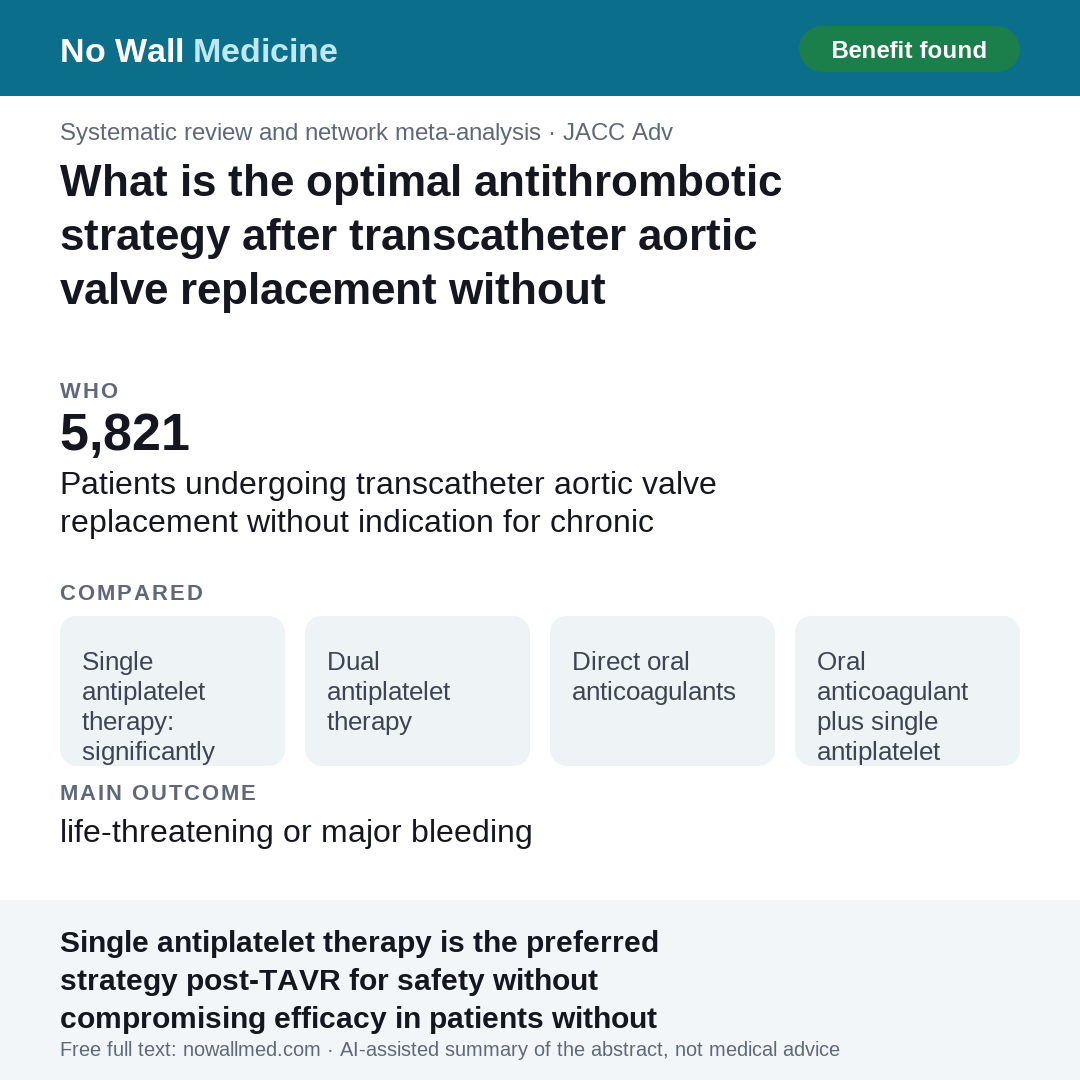
Clinical question: What is the optimal antithrombotic strategy after transcatheter aortic valve replacement without anticoagulation indication?
Abstract
Background
The optimal antithrombotic strategy following transcatheter aortic valve replacement (TAVR) remains controversial. Objectives
The authors aimed to determine the safety and efficacy of various antithrombotic regimens in patients without an indication for anticoagulation following TAVR. Methods
We conducted a systematic search in PubMed, Embase, Scopus, and ClinicalTrials.gov until August 2024 for studies investigating antithrombotic regimens after TAVR in patients without an indication for chronic oral anticoagulation. The analysis compared single antiplatelet therapy (SAPT), dual antiplatelet therapy (DAPT), direct oral anticoagulants, and oral anticoagulant (OAC) plus SAPT. A frequentist network meta-analysis was employed to evaluate the post-TAVR risk of all-cause mortality, cardiovascular mortality, myocardial infarction, stroke, total bleeding, and life-threatening or major bleeding. Results
Eleven studies (8 randomized controlled trials and 3 propensity score-matched cohorts) comprising 5,821 patients undergoing TAVR were included. SAPT significantly reduced the risk of life-threatening/major bleeding compared with DAPT (OR: 0.53; 95% CI: 0.35-0.80), OAC (OR: 0.52; 95% CI: 0.28-0.99), and OAC + SAPT (OR: 0.32; 95% CI: 0.13-0.76). No significant differences were observed in the risk of cardiovascular mortality, stroke, or myocardial infarction between antithrombotic regimens. Subgroup analysis indicated an increased risk of mortality with low-dose rivaroxaban+3-month SAPT compared with SAPT (OR: 0.56; 95% CI: 0.35-0.89) and DAPT (OR: 0.58; 95% CI: 0.38-0.88). Meta-regression identified chronic obstructive pulmonary disease as the only significant modifier of bleeding risk following TAVR. Conclusions
Our findings support current guidelines recommending SAPT as the preferred antithrombotic strategy post-TAVR in patients without an indication for anticoagulation, demonstrating optimal safety without compromising efficacy.
Cite this article
Siami S, Kazemian S, Maleki S, Ebrahimi E, Jodeiri F, Ebrahimzade M. Post-Transcatheter Aortic Valve Replacement Antithrombotic Treatment in Nonindicated Patients: Updated Systematic Review and Network Meta-Analysis. JACC Adv. 2025. doi:10.1016/j.jacadv.2025.101719
Spotted a mistake? Suggest a correction
Top studies every Monday
The week’s key trials and guidelines in your specialties, plus any topics you follow. By email, free.
Get the weekly digest