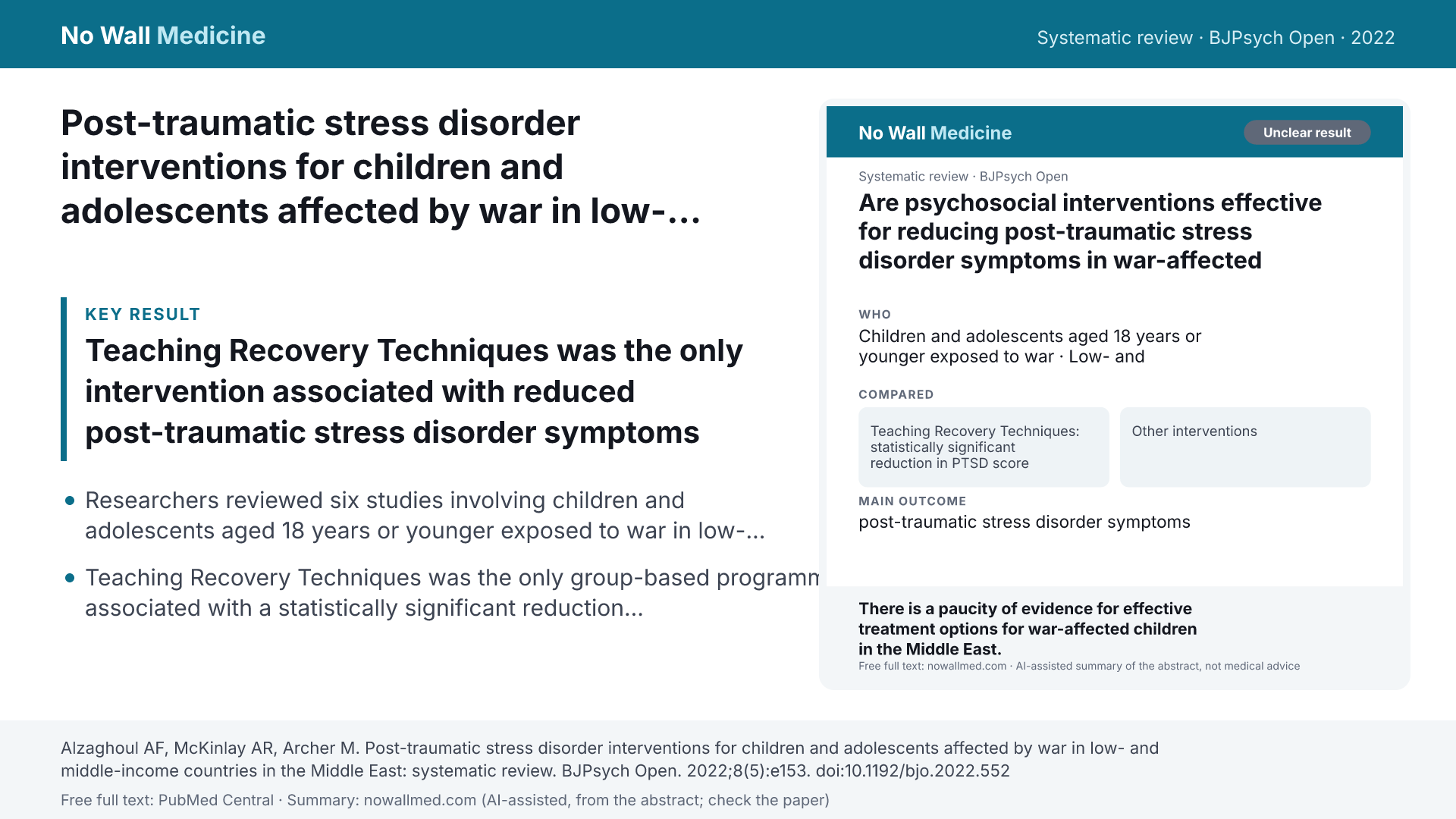
Post-traumatic stress disorder interventions for children and adolescents affected by war in low- and middle-income countries in the Middle East: systematic review
Key result: Teaching Recovery Techniques was the only intervention associated with reduced post-traumatic stress disorder symptoms
Key points
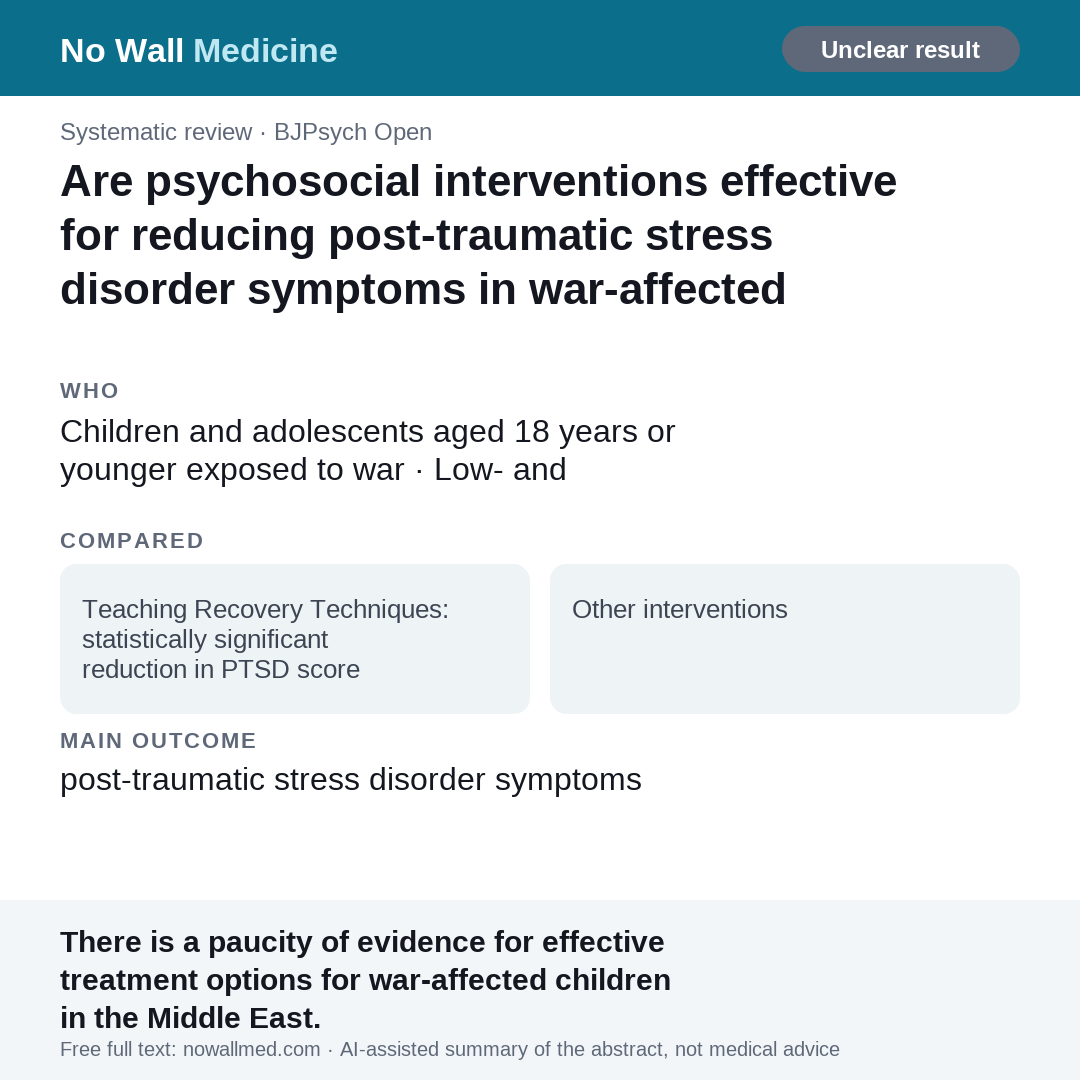
- Researchers reviewed six studies involving children and adolescents aged 18 years or younger exposed to war in low- and middle-income countries in the Middle East.
- Teaching Recovery Techniques was the only group-based programme associated with a statistically significant reduction in post-traumatic stress disorder scores.
- Most interventions were associated with positive experiences and improved social skills among the participants.
Why it matters: The effectiveness of psychosocial interventions for reducing post-traumatic stress disorder symptoms in children and adolescents affected by war in Middle Eastern low- and middle-income countries is unknown.
Limitation the authors note: Differences in follow-up intervals between the studies limited the comparability of outcomes.
Discussion prompts
- Would these patients look like yours? Who was left out?
- Is the main outcome one that matters to patients?
- Is the difference large enough to change what you do?
Cite: Alzaghoul AF, McKinlay AR, Archer M. Post-traumatic stress disorder interventions for children and adolescents affected by war in low- and middle-income countries in the Middle East: systematic review. BJPsych Open. 2022. doi:10.1192/bjo.2022.552
Free full text: PubMed Central · Summary and visual abstract: nowallmed.com/a/post-traumatic-stress-disorder-interventions-for-children-and-1o6mg8t/ (AI-assisted from the abstract; check the paper before relying on it).