Doxycycline taken after condomless sex was associated with fewer bacterial sexually transmitted infections
Postexposure Doxycycline to Prevent Bacterial Sexually Transmitted Infections
Open-label, randomized studyBenefit found
Does doxycycline postexposure prophylaxis prevent bacterial sexually transmitted infections?
Who
501
Men who have sex with men and transgender women
Compared
Doxycycline postexposure prophylaxis: 10.7% (PrEP cohort) and 11.8% (PLWH cohort)
Standard care: 31.9% (PrEP cohort) and 30.5% (PLWH cohort)
Main outcome
Incidence of at least one sexually transmitted infection per follow-up quarter
Result: relative risk 0.34 (95% CI, 0.24 to 0.46) in PrEP cohort
Bottom line: Doxycycline postexposure prophylaxis reduced the combined incidence of gonorrhea, chlamydia, and syphilis by two thirds.
Funded by: National Institutes of Health
NEJM · 2023-04-05Download image
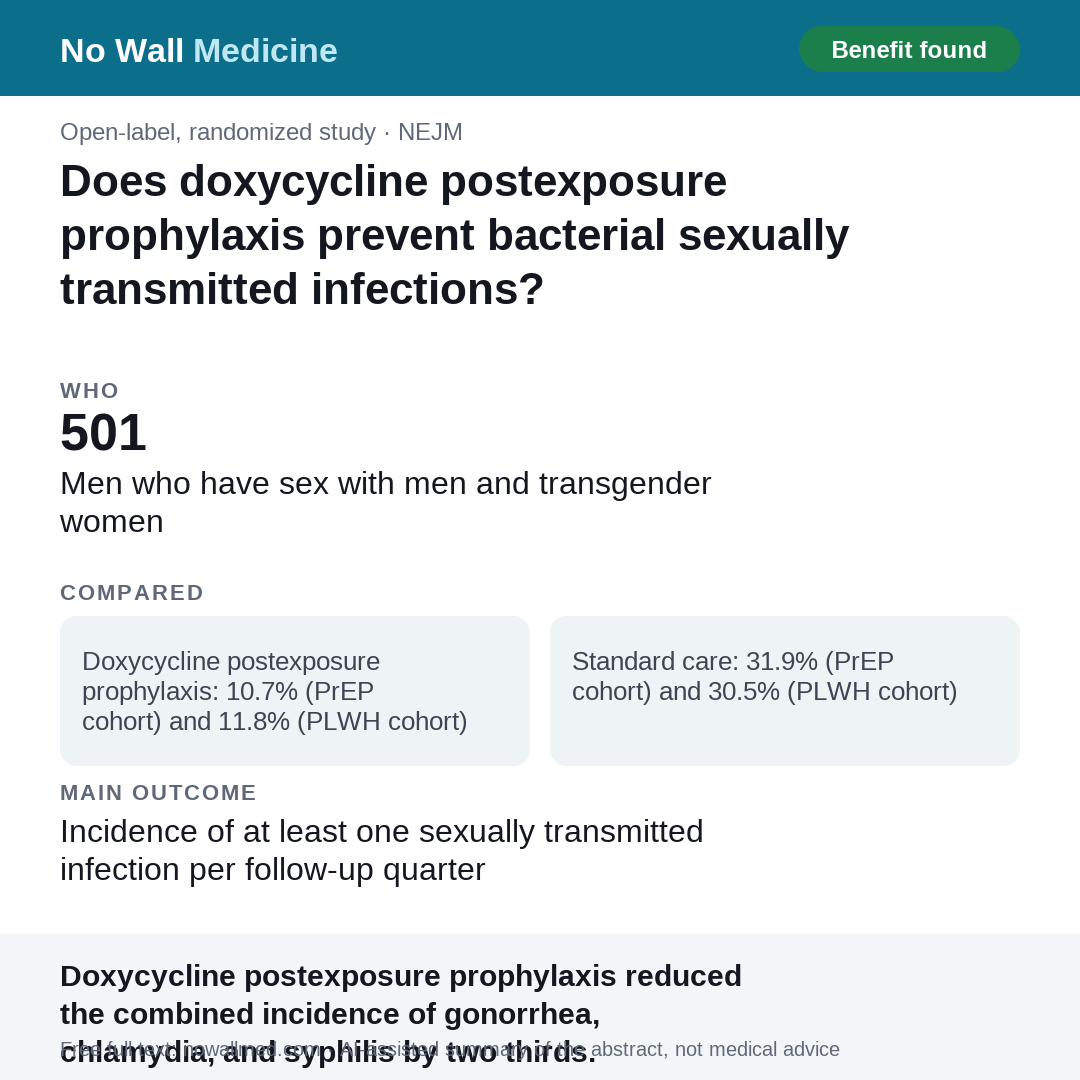
Clinical question: Does doxycycline postexposure prophylaxis prevent bacterial sexually transmitted infections?
Why it matters: Interventions to reduce sexually transmitted infections among men who have sex with men and transgender women are needed.
In absolute numbers
Doxycycline postexposure prophylaxis: 10.7% · Standard care: 31.9% → a difference of 21.2 percentage points, so about 5 people would need the treatment for 1 more to benefit (number needed to treat) over the trial’s follow-up.
Worked out by us from the two group results above, not reported by the authors. Check the paper for the exact outcome and timing.
Key points
- The study randomized 501 men who have sex with men and transgender women to receive either 200 mg of doxycycline after condomless sex or standard care.
- In the group taking preexposure prophylaxis for HIV, the incidence of sexually transmitted infections was 10.7% with doxycycline compared to 31.9% with standard care.
- In the group living with HIV, the incidence of sexually transmitted infections was 11.8% with doxycycline compared to 30.5% with standard care.
Headline and key points written with AI from the paper’s abstract, with every number checked against it. Read the paper before relying on them.
Was this summary helpful?
Subject terms
Cite this article
Luetkemeyer AF, Donnell D, Dombrowski JC, Cohen S, Grabow C, Brown CE. Postexposure Doxycycline to Prevent Bacterial Sexually Transmitted Infections. NEJM. 2023. doi:10.1056/NEJMoa2211934
Spotted a mistake? Suggest a correction
Top studies every Monday
The week’s key trials and guidelines in your specialties, plus any topics you follow. By email, free.
Get the weekly digest