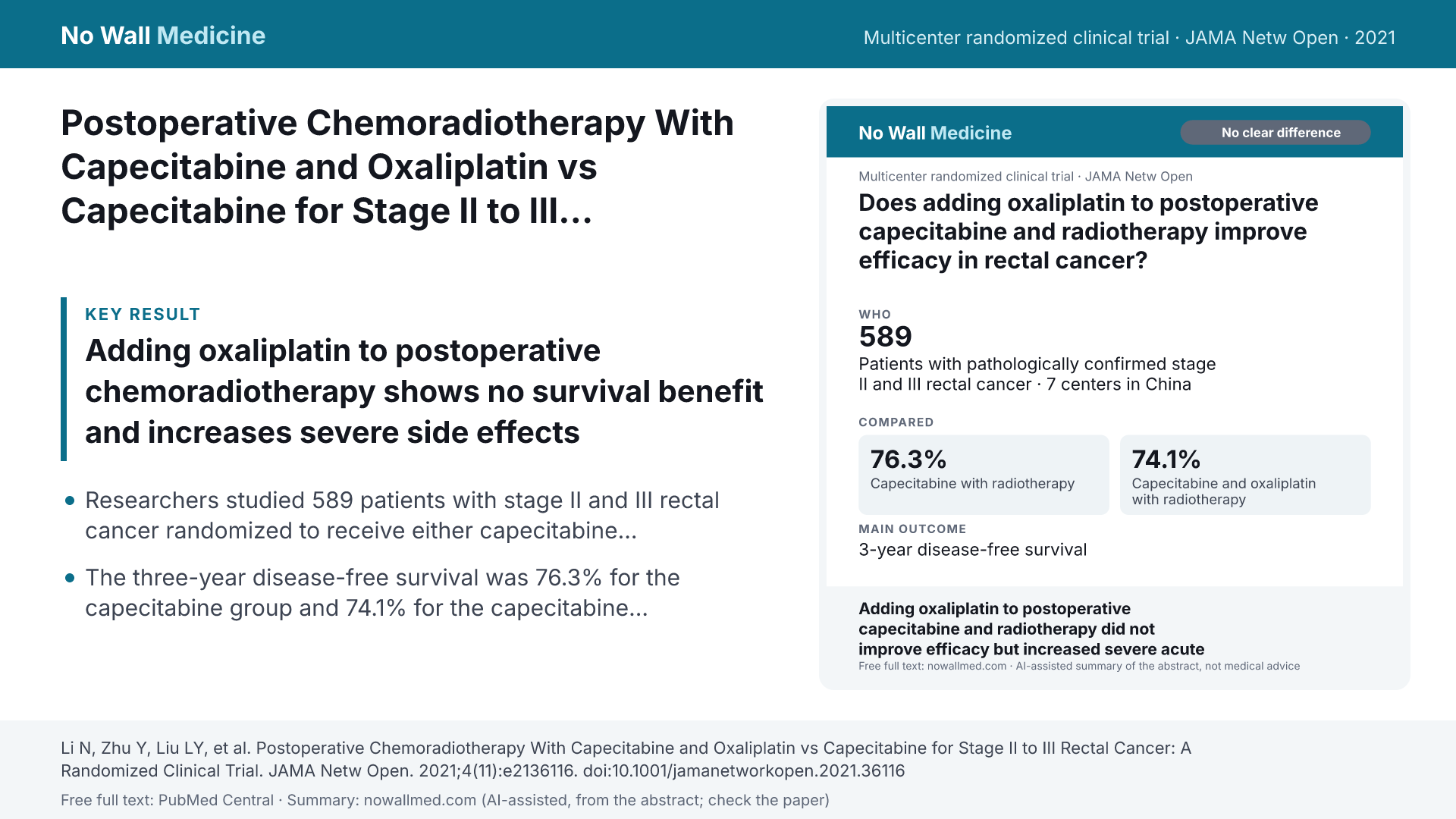
Adding oxaliplatin to postoperative chemoradiotherapy shows no survival benefit and increases severe side effects
Postoperative Chemoradiotherapy With Capecitabine and Oxaliplatin vs Capecitabine for Stage II to III Rectal Cancer: A Randomized Clinical Trial
Multicenter randomized clinical trialNo clear difference
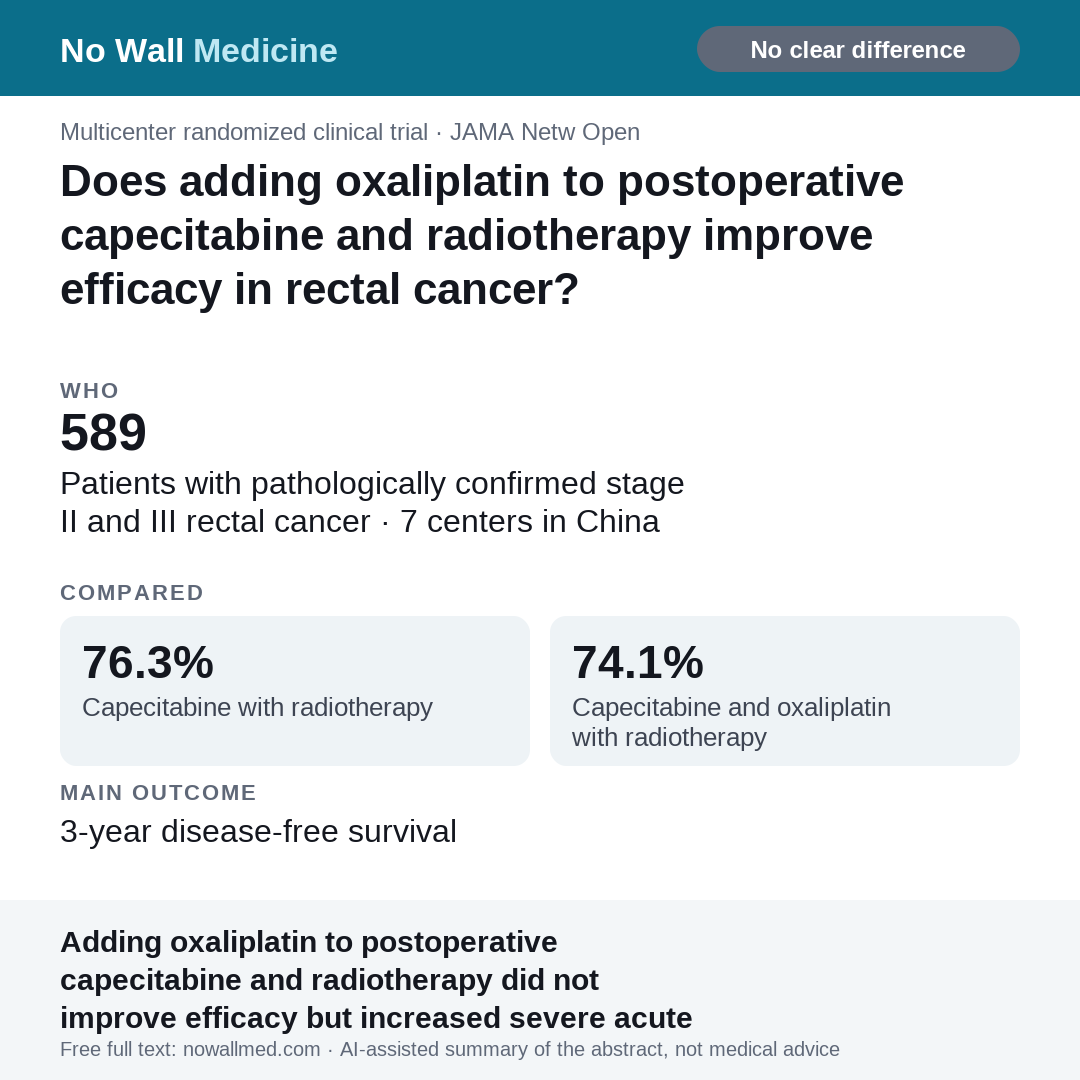
Does adding oxaliplatin to postoperative capecitabine and radiotherapy improve efficacy in rectal cancer?
Who
589
Patients with pathologically confirmed stage II and III rectal cancer · 7 centers in China
Compared
76.3%Capecitabine with radiotherapy
74.1%Capecitabine and oxaliplatin with radiotherapy
Main outcome
3-year disease-free survival
Result: hazard ratio 1.07 (95% CI 0.79-1.44)
Bottom line: Adding oxaliplatin to postoperative capecitabine and radiotherapy did not improve efficacy but increased severe acute toxic effects.
JAMA Netw Open · 2021-11-01Download image
Clinical question: Does adding oxaliplatin to postoperative capecitabine and radiotherapy improve efficacy in rectal cancer?
Why it matters: It was unknown whether adding oxaliplatin to postoperative chemoradiotherapy improves outcomes for patients with stage II and III rectal cancer.
Key points
- Researchers studied 589 patients with stage II and III rectal cancer randomized to receive either capecitabine with radiotherapy or capecitabine plus oxaliplatin with radiotherapy.
- The three-year disease-free survival was 76.3% for the capecitabine group and 74.1% for the capecitabine and oxaliplatin group, showing no significant difference.
- Grade 3 and 4 acute toxic effects were more frequent in the capecitabine and oxaliplatin group at 38.6% compared to 28.6% in the capecitabine group.
Headline and key points written with AI from the paper’s abstract, with every number checked against it. Read the paper before relying on them.
Was this summary helpful?
Subject terms
Cite this article
Li N, Zhu Y, Liu LY, et al. Postoperative Chemoradiotherapy With Capecitabine and Oxaliplatin vs Capecitabine for Stage II to III Rectal Cancer: A Randomized Clinical Trial. JAMA Netw Open. 2021. doi:10.1001/jamanetworkopen.2021.36116
Spotted a mistake? Suggest a correction