Force modulating tissue bridge was associated with lower wound opening rates after breast reduction surgery
Postoperative Mechanomodulation Decreases T-Junction Dehiscence After Reduction Mammaplasty: Early Scar Analysis From a Randomized Controlled Trial
Prospective, single-center, randomized, within-subject clinical trialBenefit found
Does force modulating tissue bridge reduce T-junction dehiscence after reduction mammaplasty?
Who
68
Patients undergoing Wise-pattern reduction mammaplasty · Single-center
Compared
Force modulating tissue bridge: n = 1
Standard of care: n = 11
Main outcome
T-junction dehiscence and vertical incision wound area
Bottom line: Force modulating tissue bridge reduces T-junction wound dehiscence and decreases nascent scar dimensions after reduction mammaplasty.
Aesthet Surg J · 2023-08-22Download image
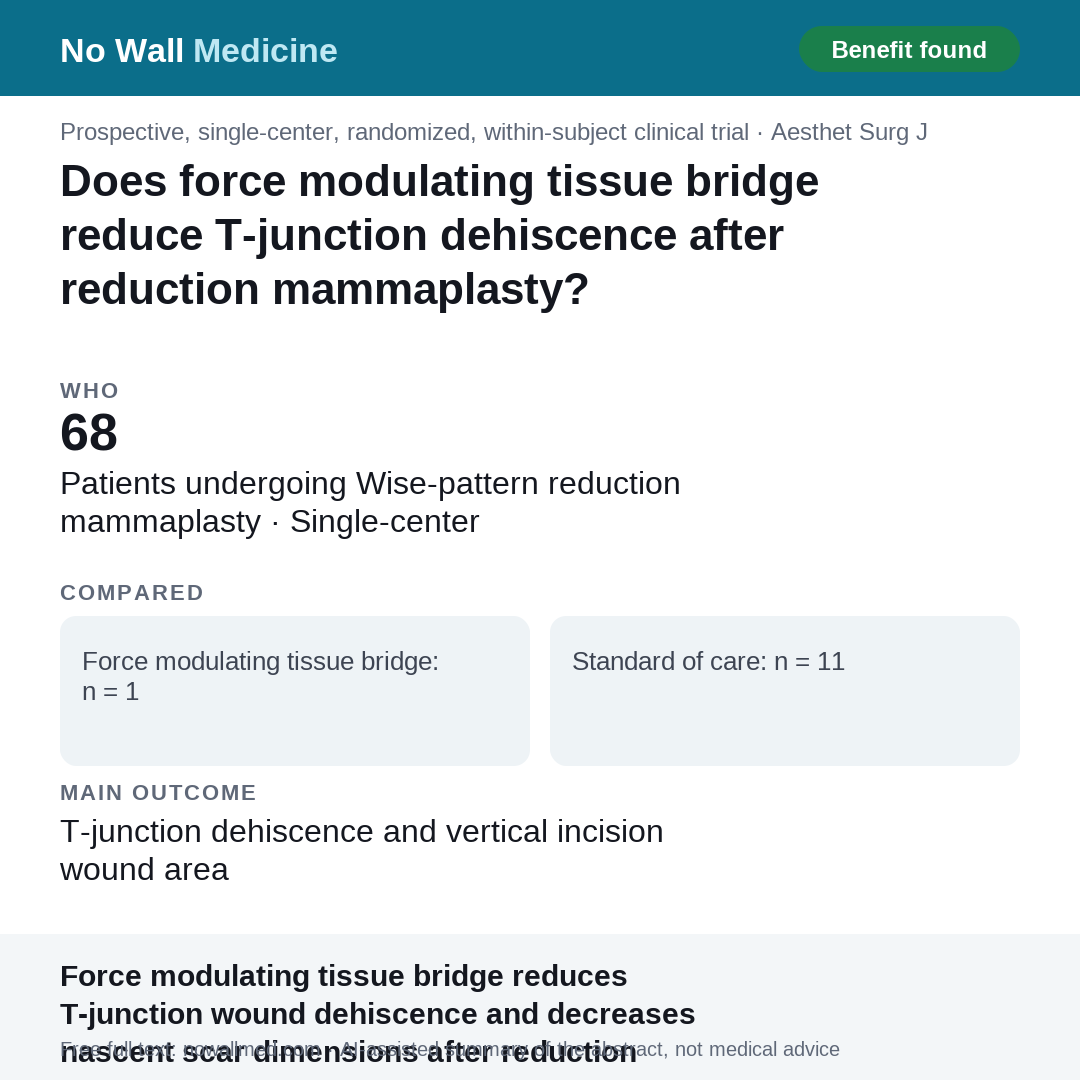
Clinical question: Does force modulating tissue bridge reduce T-junction dehiscence after reduction mammaplasty?
Why it matters: It is unknown if using a force modulating tissue bridge to reduce mechanical tension can decrease wound opening and scar size after breast reduction surgery.
Key points
- Thirty-four patients, involving 68 breasts, were studied using a randomized trial comparing standard subcuticular closure to a force modulating tissue bridge.
- The force modulating tissue bridge was associated with fewer T-junction dehiscence (wound opening) events, with 1 breast in the experimental group versus 11 in the standard care group.
- The mean vertical incision wound area was 1.5 cm2 in the experimental group compared to 2.1 cm2 in the standard care group.
Headline and key points written with AI from the paper’s abstract, with every number checked against it. Read the paper before relying on them.
Topics
Cite this article
Panton J, Vingan N, Barillas J, Akgul Y, Lazzarini A, Coroneos CJ. Postoperative Mechanomodulation Decreases T-Junction Dehiscence After Reduction Mammaplasty: Early Scar Analysis From a Randomized Controlled Trial. Aesthet Surg J. 2023. doi:10.1093/asj/sjad269
Spotted a mistake? Suggest a correction
Top studies every Monday
The week’s key trials and guidelines in your specialties, plus any topics you follow. By email, free.
Get the weekly digest