High oxygen levels after liver transplantation did not reduce infection rates in randomized trial
Postoperative Supplemental Oxygen in Liver Transplantation (PSOLT) does not reduce the rate of infections: results of a randomized controlled trial
Randomized controlled trialNo clear difference
Does postoperative hyperoxygenation reduce infection rates after liver transplantation?
Who
193
Patients undergoing liver transplantation
Compared
23.2%28% fraction of inspired oxygen (23/99)
34.0%80% fraction of inspired oxygen (32/94)
Main outcome
Infections occurring during 30-day post-transplant period
Bottom line: Postoperative hyperoxygenation does not reduce infection rates after liver transplantation and may increase severe complications.
BMC Med · 2023-02-13Download image
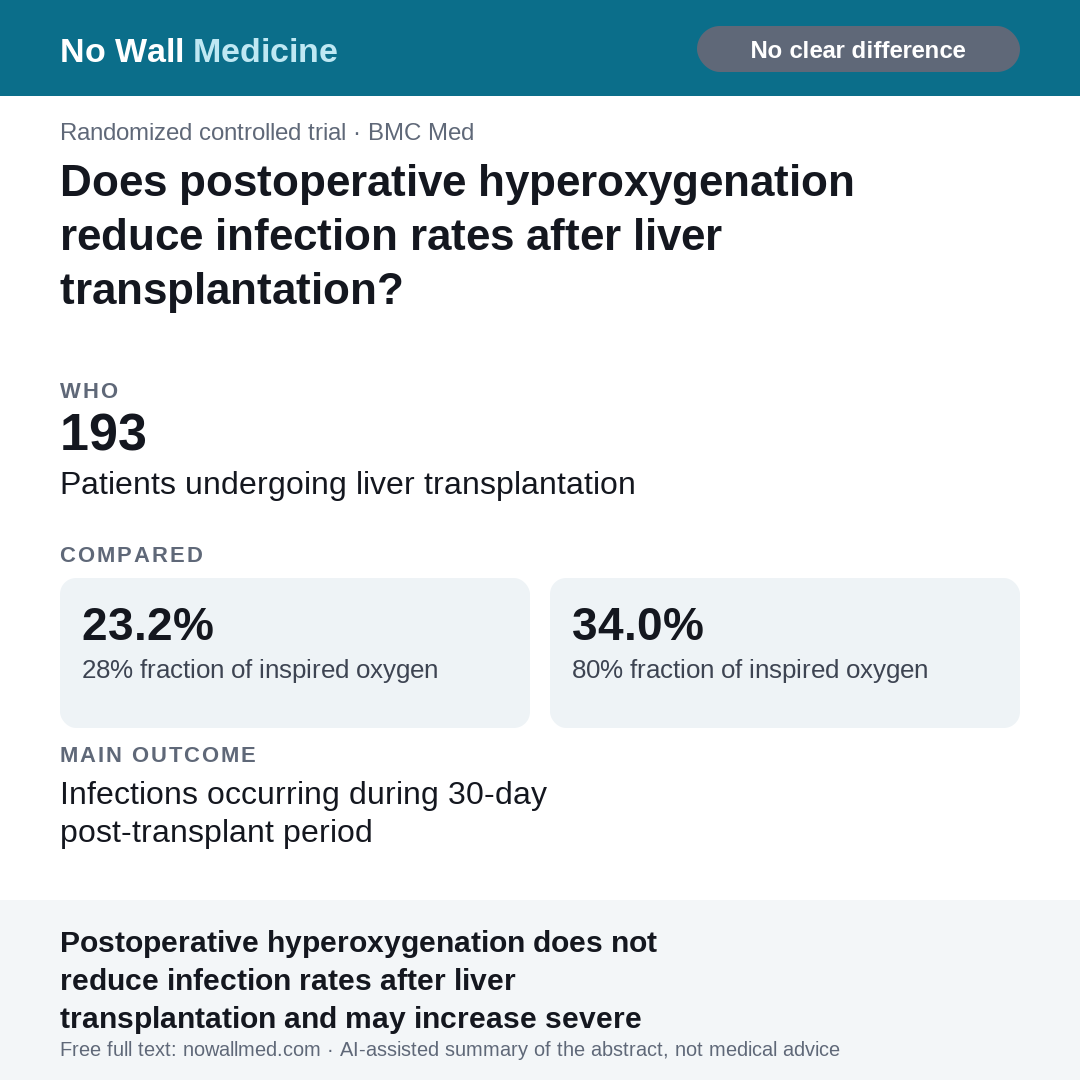
Clinical question: Does postoperative hyperoxygenation reduce infection rates after liver transplantation?
Why it matters: Evidence is inconsistent regarding whether providing extra oxygen after surgery can prevent infections, and data for liver transplantation specifically is lacking.
Key points
- Researchers studied 193 patients undergoing liver transplantation who were assigned to receive either 28% or 80% fraction of inspired oxygen for 6 hours.
- Infections occurred in 34.0% of the 80% oxygen group compared to 23.2% of the 28% oxygen group, which was not a statistically significant difference.
- Patients receiving 80% oxygen more frequently developed severe complications, had longer intensive care unit stays, and had higher bilirubin concentrations over the first 5 days.
Headline and key points written with AI from the paper’s abstract, with every number checked against it. Read the paper before relying on them.
Was this summary helpful?
Subject terms
Cite this article
Figiel W, Niewiński G, Grąt M, Krawczyk M, Stypułkowski J, Lewandowski Z. Postoperative Supplemental Oxygen in Liver Transplantation (PSOLT) does not reduce the rate of infections: results of a randomized controlled trial. BMC Med. 2023. doi:10.1186/s12916-023-02741-w
Spotted a mistake? Suggest a correction
Top studies every Monday
The week’s key trials and guidelines in your specialties, plus any topics you follow. By email, free.
Get the weekly digest