Educational smartphone app did not change self-reported opioid use after surgery in clinical trial
Postsurgical Medication Awareness, Recovery, and Tracking using a Phone-Based App (SMART-APP): a randomized clinical trial
Randomized clinical trialNo clear difference
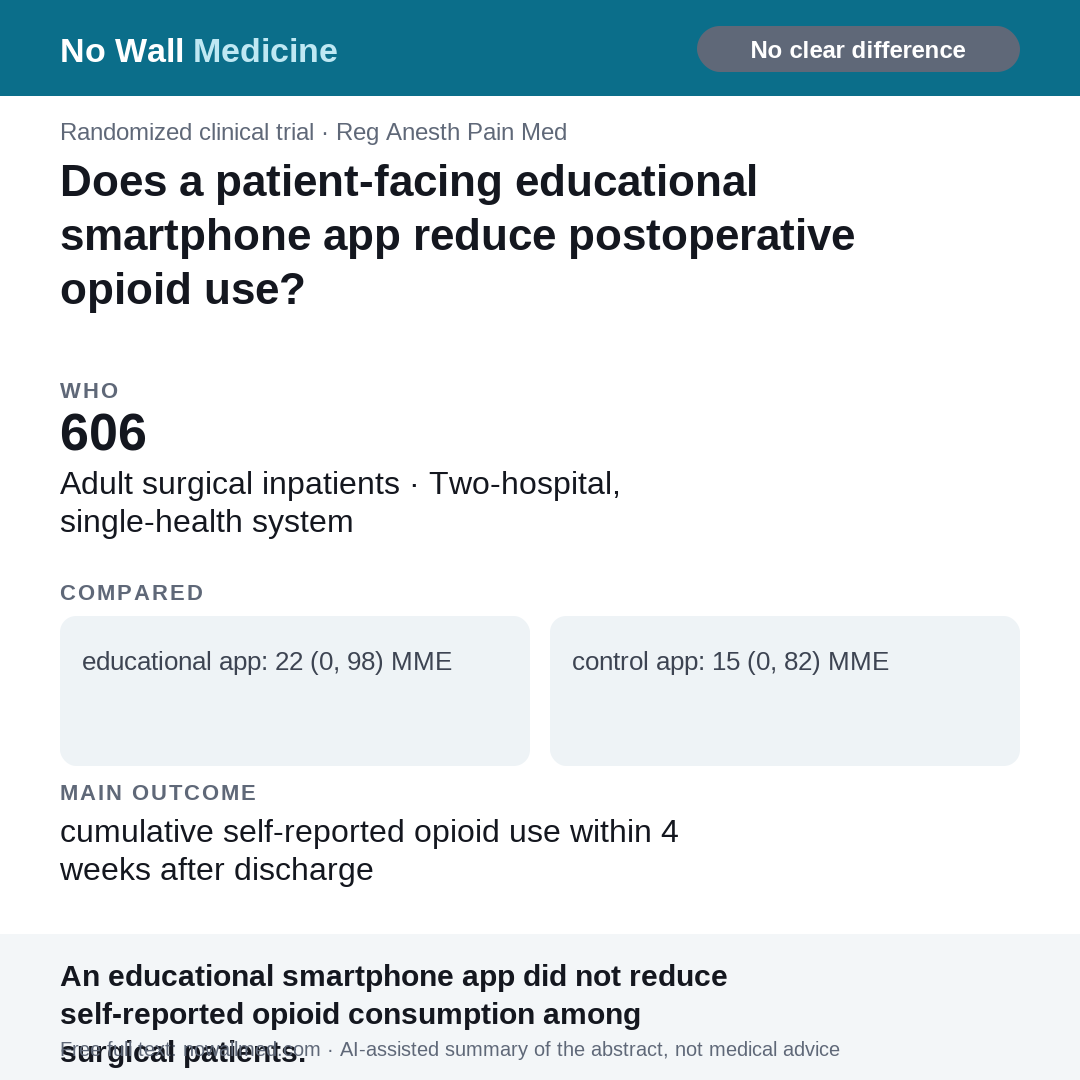
Does a patient-facing educational smartphone app reduce postoperative opioid use?
Who
606
Adult surgical inpatients · Two-hospital, single-health system
Compared
educational app: 22 (0, 98) MME
control app: 15 (0, 82) MME
Main outcome
cumulative self-reported opioid use within 4 weeks after discharge
Result: ratio of geometric means 1.21 (95% CI 0.87 to 1.69)
Bottom line: An educational smartphone app did not reduce self-reported opioid consumption among surgical patients.
Reg Anesth Pain Med · 2025-07-02Download image
Clinical question: Does a patient-facing educational smartphone app reduce postoperative opioid use?
Why it matters: Excessive use of opioids after surgery can be harmful, and researchers wanted to see if a patient-facing educational app could help manage pain while using fewer opioids.
Key points
- Researchers studied 606 adult surgical patients who were randomized to receive either an educational smartphone app or a data collection only app.
- The median self-reported cumulative opioid use 4 weeks after discharge was 22 MME for the educational app group and 15 MME for the control group.
- The use of a clinician-facing electronic decision-support tool, which provides guidance to doctors, did not modify opioid consumption.
Headline and key points written with AI from the paper’s abstract, with every number checked against it. Read the paper before relying on them.
Cite this article
Rolfzen ML, Shah K, Sanchez Rodriguez E, Hoffman JT, Clauw D, Mascha E. Postsurgical Medication Awareness, Recovery, and Tracking using a Phone-Based App (SMART-APP): a randomized clinical trial. Reg Anesth Pain Med. 2025. doi:10.1136/rapm-2025-106783
Spotted a mistake? Suggest a correction