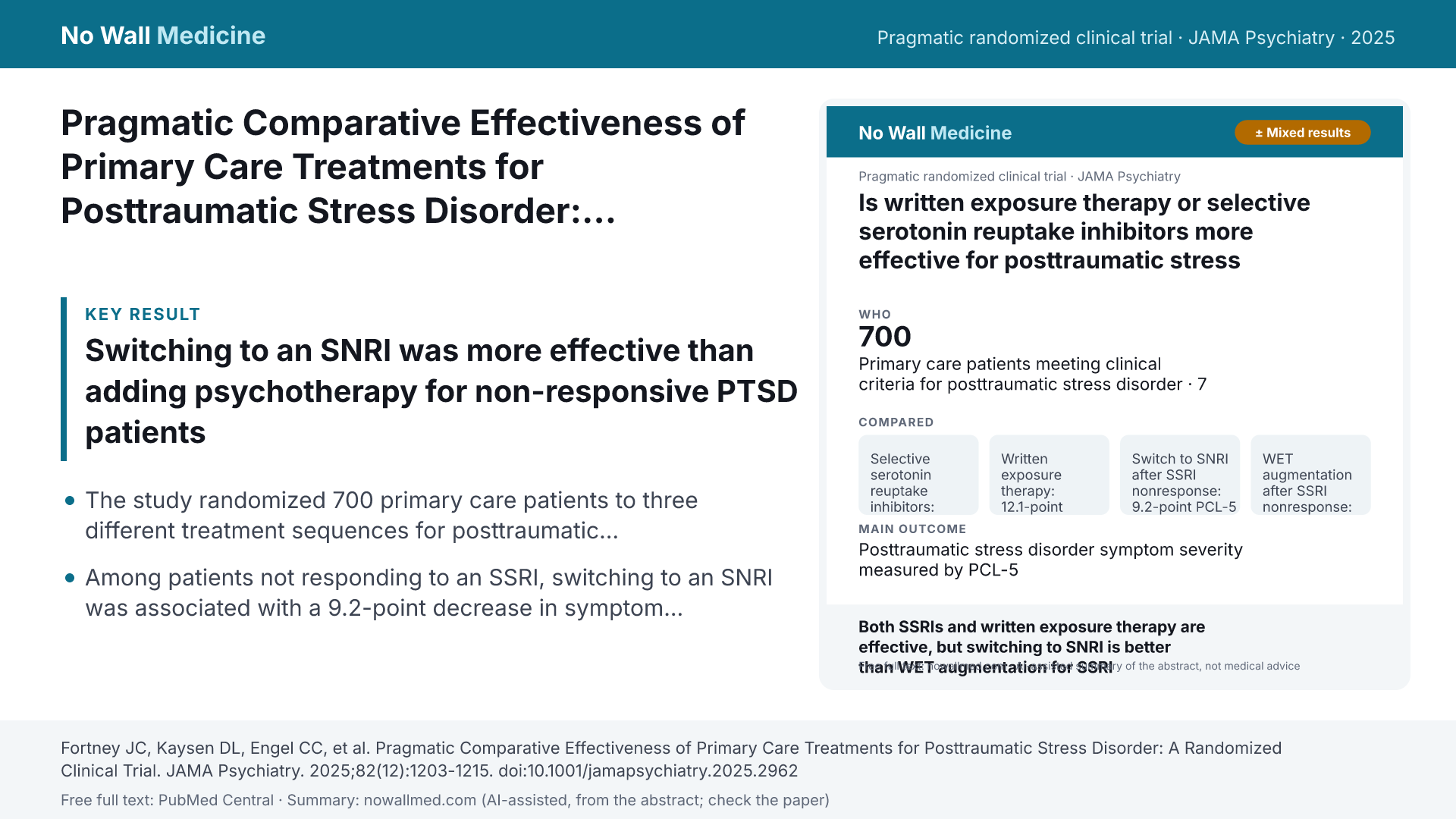
Switching to an SNRI was more effective than adding psychotherapy for non-responsive PTSD patients
Pragmatic Comparative Effectiveness of Primary Care Treatments for Posttraumatic Stress Disorder: A Randomized Clinical Trial
Pragmatic randomized clinical trialMixed results
Is written exposure therapy or selective serotonin reuptake inhibitors more effective for posttraumatic stress disorder?
Who
700
Primary care patients meeting clinical criteria for posttraumatic stress disorder · 7 federally qualified health centers and 8 Department of Veterans Affairs medical centers
Compared
Selective serotonin reuptake inhibitors: 14.0-point PCL-5 decrease
Written exposure therapy: 12.1-point PCL-5 decrease
Switch to SNRI after SSRI nonresponse: 9.2-point PCL-5 decrease
WET augmentation after SSRI nonresponse: 2.3-point PCL-5 decrease
Main outcome
Posttraumatic stress disorder symptom severity measured by PCL-5
Result: adjusted mean difference 1.79 (95% CI -0.76 to 4.34) for initial treatment; adjusted MD 10.19 (95% CI 4.97-15.41) for nonresponders
Bottom line: Both SSRIs and written exposure therapy are effective, but switching to SNRI is better than WET augmentation for SSRI nonresponders.
JAMA Psychiatry · 2025-10-15 · Save PNG
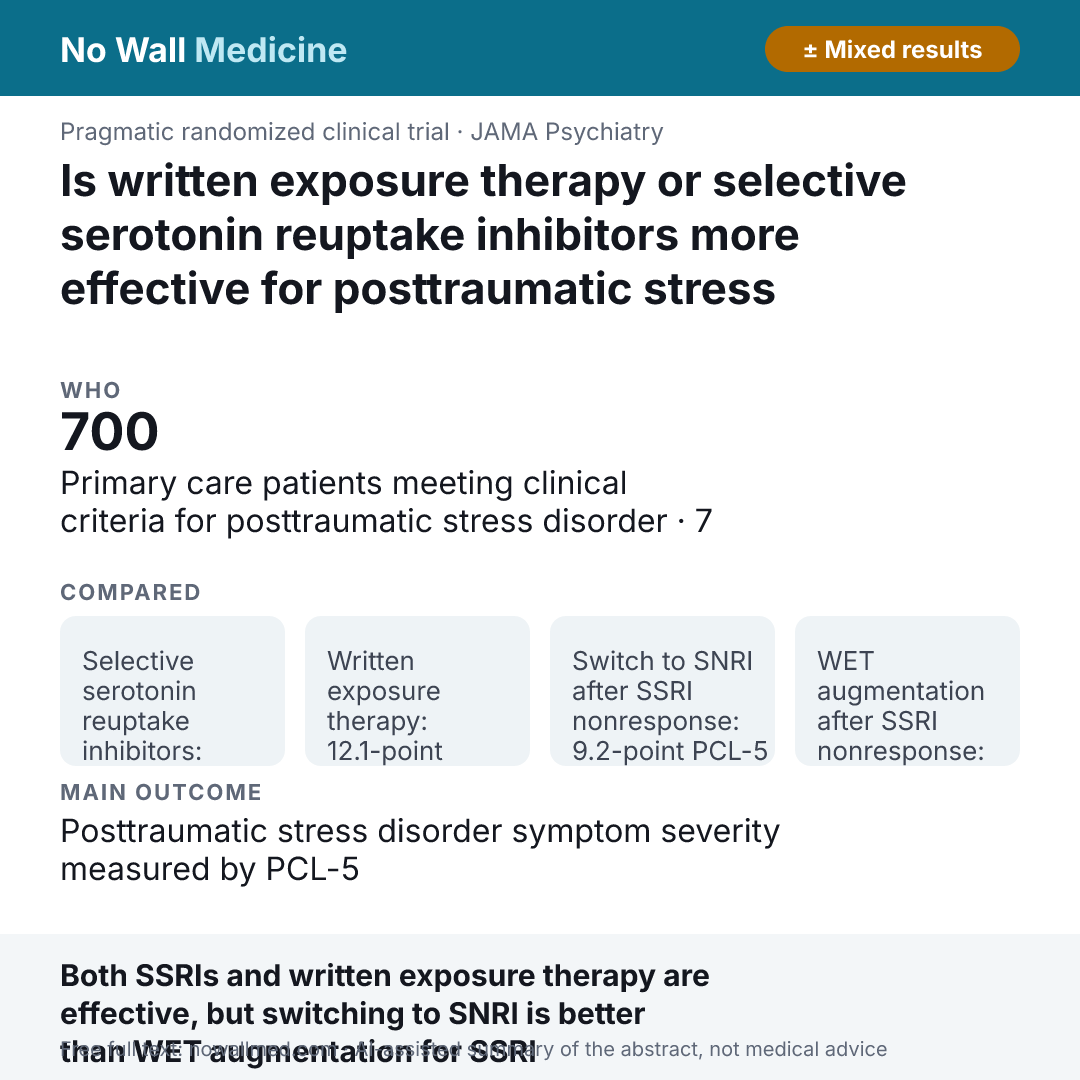
Clinical question: Is written exposure therapy or selective serotonin reuptake inhibitors more effective for posttraumatic stress disorder?
Why it matters: There are few head-to-head comparisons of medication and psychotherapy for posttraumatic stress disorder in primary care settings, and little evidence on treatment sequences for non-responders.
Key points
- The study randomized 700 primary care patients to three different treatment sequences for posttraumatic stress disorder.
- Among patients not responding to an SSRI, switching to an SNRI was associated with a 9.2-point decrease in symptom scores compared to a 2.3-point decrease for adding written exposure therapy.
- At 4 months, patients randomized to an SSRI reported a 14.0-point symptom decrease, while those randomized to written exposure therapy reported a 12.1-point decrease, showing no significant difference between groups.
Headline and key points written with AI from the paper’s abstract, with every number checked against it. Read the paper before relying on them.
Was this summary helpful?
Subject terms
Headline, design, result, key points, caveat and citation as plain text.
Cite this article
Fortney JC, Kaysen DL, Engel CC, et al. Pragmatic Comparative Effectiveness of Primary Care Treatments for Posttraumatic Stress Disorder: A Randomized Clinical Trial. JAMA Psychiatry. 2025;82(12):1203-1215. doi:10.1001/jamapsychiatry.2025.2962
Spotted a mistake? Suggest a correction