Adding postoperative data improves prediction of organ dysfunction or death after cardiac surgery
Pre- and Immediate Postoperative Prediction Model for Organ Dysfunction or Death Early After Cardiac Surgery: A Post Hoc Analysis of a Multicenter Randomized Trial
Post hoc analysis of a multicenter randomized controlled trialBenefit found
Can preoperative and postoperative variables predict organ dysfunction or death after cardiac surgery?
Who
1394
Patients undergoing cardiac surgery · International, multicenter
Compared
Preoperative model: area under the receiver operating characteristic curve 0.644 (95% CI 0.610-0.678)
Preoperative and postoperative model: area under the receiver operating characteristic curve 0.773 (95% CI 0.745-0.801)
Main outcome
Organ dysfunction or death 48 hours after surgery
Result: area under the receiver operating characteristic curve 0.773 (95% CI 0.745-0.801)
Bottom line: Adding postoperative variables significantly improves the prediction of organ dysfunction or death after cardiac surgery.
J Am Heart Assoc · 2026-07-17Download image
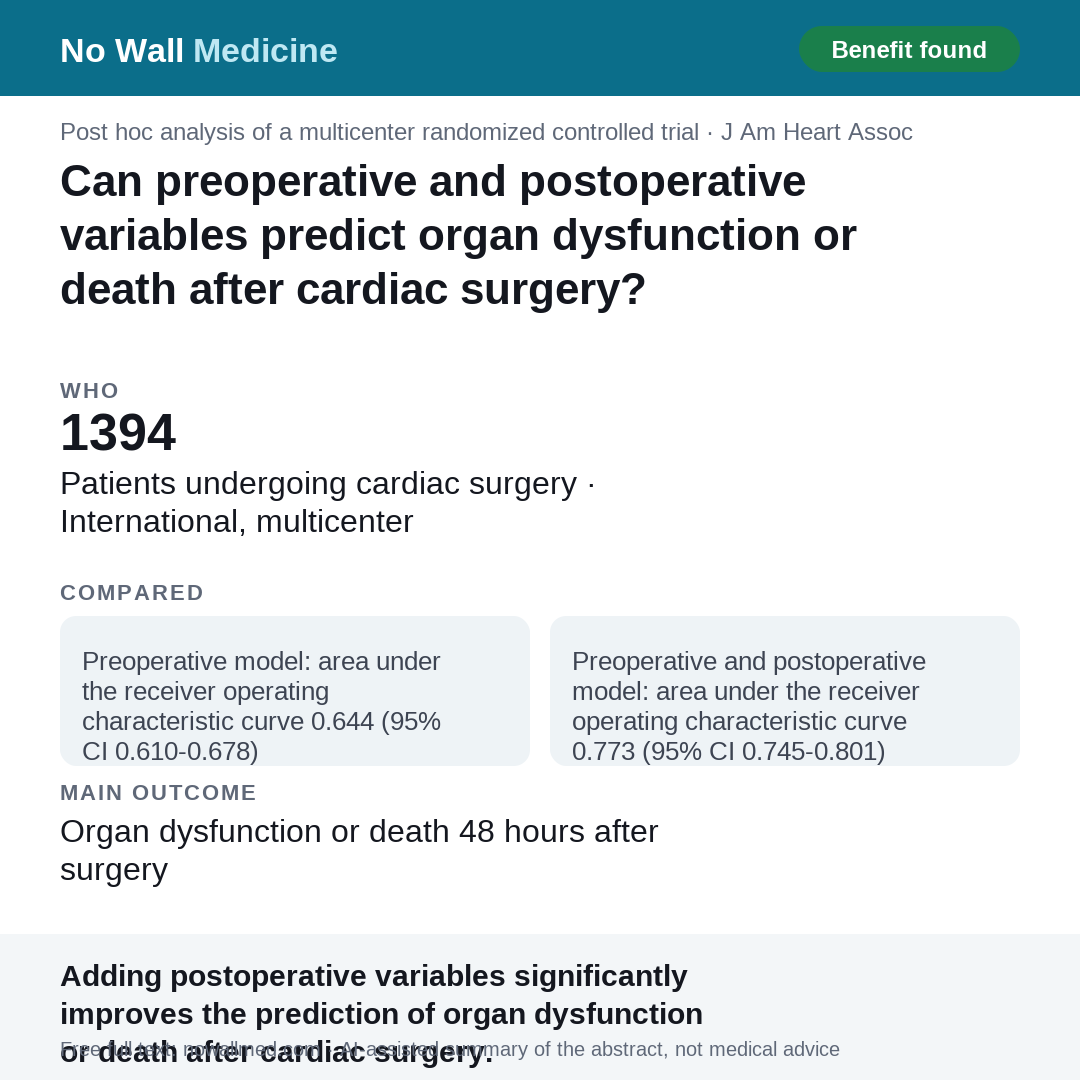
Clinical question: Can preoperative and postoperative variables predict organ dysfunction or death after cardiac surgery?
Why it matters: Current risk stratification tools fail to adequately incorporate both preoperative vulnerability and immediate postoperative physiological derangements.
Key points
- Researchers analyzed 1394 patients undergoing cardiac surgery to develop a model for predicting organ dysfunction or death within 48 hours.
- The preoperative model had an area under the receiver operating characteristic curve of 0.644, while adding postoperative variables increased this to 0.773.
- A total of 434 patients, or 31.1%, experienced organ dysfunction or died within 48 hours after their surgery.
Headline and key points written with AI from the paper’s abstract, with every number checked against it. Read the paper before relying on them.
Topics
Spotted a mistake? Suggest a correction
More in Cardiology
Clonal hematopoiesis mutations linked to higher atrial fibrillation risk in cancer populations
Association of Clonal Hematopoiesis Mutations With Incident Atrial Fibrillation: A Systematic Review and Meta-Analysis
Deep learning model detects aortic stenosis from finger-cuff pressure waveforms accurately
Aortic Valve Stenosis Screening Using Deep Learning on Noninvasive Arterial Pressure Waveforms
Spontaneous coronary artery dissection affects younger women more often than expected
Spontaneous coronary artery dissection: implications for women's health, clinical care, and future research
Early lipid-lowering strategies may reduce atherosclerotic cardiovascular disease risk
Lipid-Lowering Strategies in the Era of Early Atherosclerosis Detection: 2026 ACC Scientific Statement: A Report of the American College of Cardiology