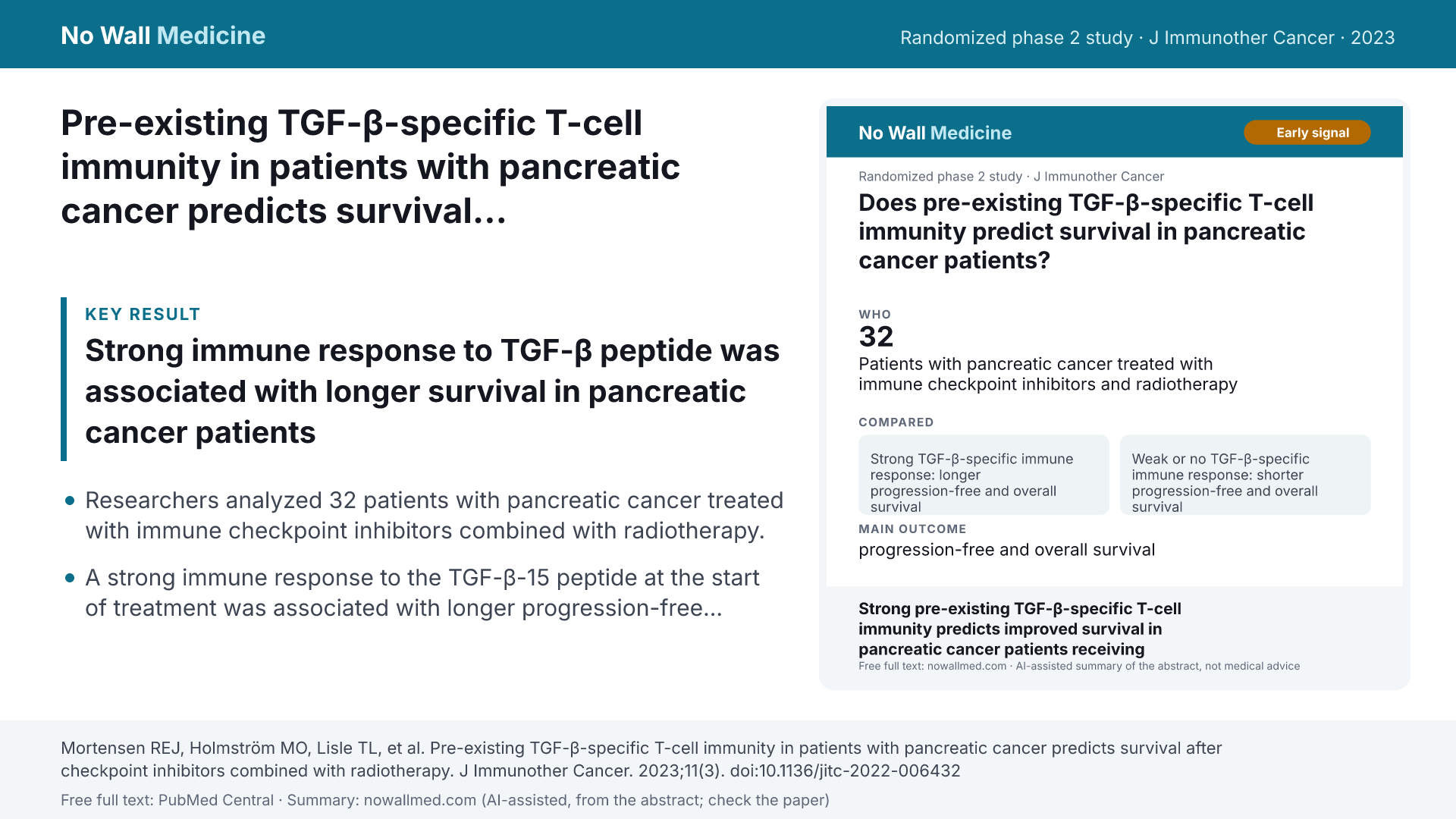
Strong immune response to TGF-β peptide was associated with longer survival in pancreatic cancer patients
Pre-existing TGF-β-specific T-cell immunity in patients with pancreatic cancer predicts survival after checkpoint inhibitors combined with radiotherapy
Randomized phase 2 studyEarly signal
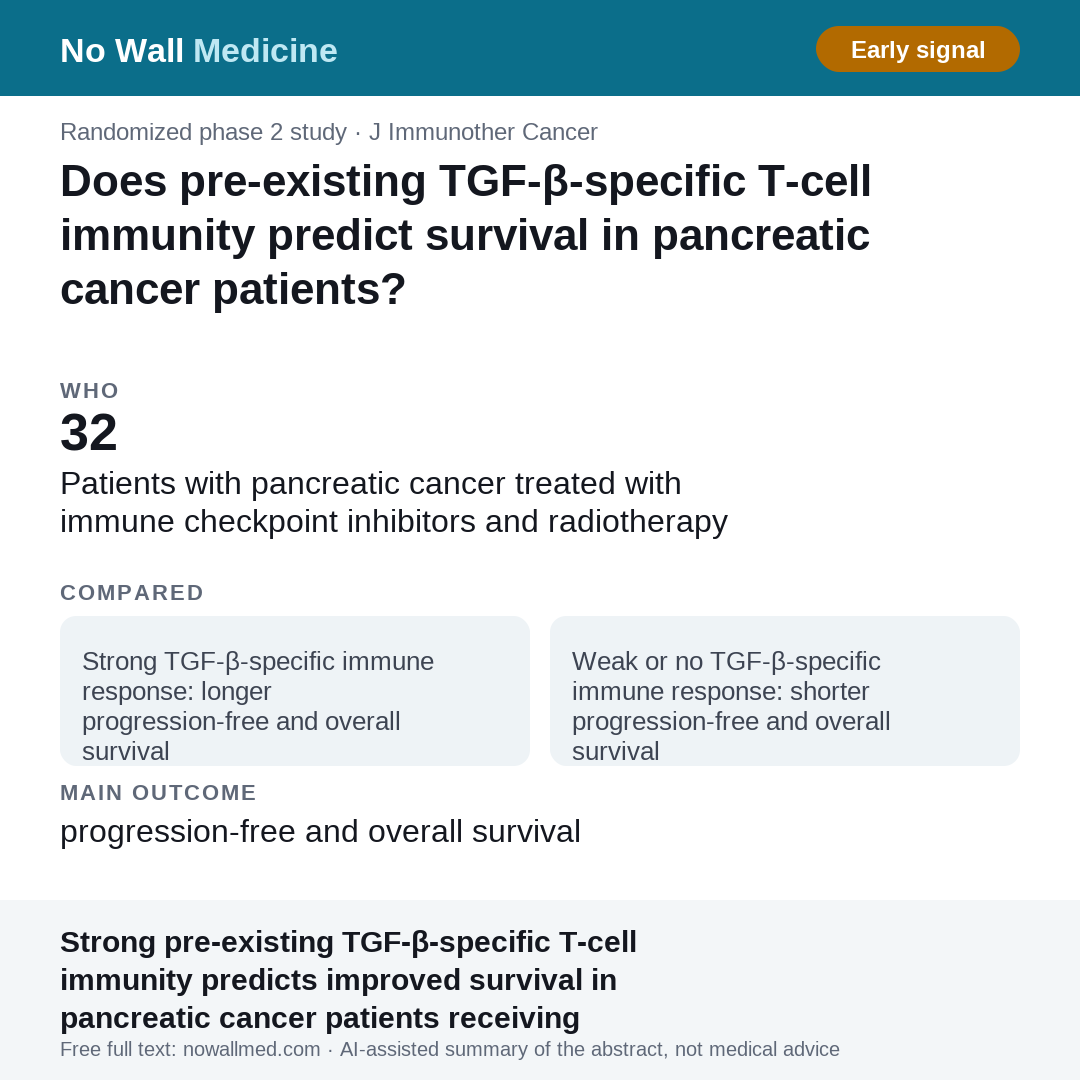
Does pre-existing TGF-β-specific T-cell immunity predict survival in pancreatic cancer patients?
Who
32
Patients with pancreatic cancer treated with immune checkpoint inhibitors and radiotherapy
Compared
Strong TGF-β-specific immune response: longer progression-free and overall survival
Weak or no TGF-β-specific immune response: shorter progression-free and overall survival
Main outcome
progression-free and overall survival
Bottom line: Strong pre-existing TGF-β-specific T-cell immunity predicts improved survival in pancreatic cancer patients receiving checkpoint inhibitors and radiotherapy.
J Immunother Cancer · 2023-03-22Download image
Clinical question: Does pre-existing TGF-β-specific T-cell immunity predict survival in pancreatic cancer patients?
Key points
- Researchers analyzed 32 patients with pancreatic cancer treated with immune checkpoint inhibitors combined with radiotherapy.
- A strong immune response to the TGF-β-15 peptide at the start of treatment was associated with longer progression-free and overall survival.
- The lack of these specific immune cells was not associated with a general dysfunction of the immune system.
Headline and key points written with AI from the paper’s abstract, with every number checked against it. Read the paper before relying on them.
Was this summary helpful?
Abstract
Background
Circulating transforming growth factor-β (TGF-β)-specific T cells that recognize TGF-β-expressing immune regulatory cells have been described in patients with cancer. TGF-β-derived peptide vaccination modulates the tumor microenvironment and has shown clinical effects in animal models of pancreatic cancer (PC). TGF-β-expressing regulatory cells are especially elevated in PC and may prevent the clinical response to immune checkpoint inhibitors (ICIs). Thus, in the present study we investigated the significance of TGF-β-specific T-cell immunity in patients with PC treated with ICI combined with radiotherapy in a randomized phase 2 study (CheckPAC). Methods
Immune responses to a TGF-β-derived epitope entitled TGF-β-15 as well as epitopes from Clostridium tetani (tetanus) and influenza were measured in peripheral blood mononuclear cells (PBMCs) with interferon-ɣ enzyme-linked immunospot assays. PBMCs were isolated before and after treatment. Correlations between immune response data and clinical data were evaluated with parametric and non-parametric statistical methods. Survival was analyzed with univariate and multivariate Cox-regression. TGF-β-15 specific T cells were isolated and expanded and examined for recognition of autologous regulatory immune cells by flow cytometry. Results
PBMCs from 32 patients were analyzed for immune responses to the TGF-β-derived epitope entitled TGF-β-15. Patients with a strong TGF-β-specific immune response at treatment initiation had longer progression-free and overall survival, compared with patients with a weak or no TGF-β-specific immune response. This remained significant in multivariate analysis. Patients with weak and strong TGF-β-specific responses displayed similar responses towards viral antigens. Furthermore, we show that TGF-β-specific T cells from a clinical responder specifically reacted to and lysed autologous, regulatory immune cells. Finally, mimicking a TGF-β-15 vaccination, we showed that repeated stimulations with the TGF-β-15 epitope in vitro enhanced the immune response to TGF-β-15. Conclusion
A strong TGF-β-15 specific immune response was associated with clinical benefit and improved survival after ICI/radiotherapy for patients with PC. Importantly, the lack of TGF-β-specific T cells in some patients was not caused by a general immune dysfunction. TGF-β-specific T cells recognized regulatory immune cells and could be introduced in vitro in patients without spontaneous responses. Taken together, our data suggest that combining TGF-β-based vaccination with ICI/radiotherapy will be beneficial for patients with PC.
Abstract reproduced under the article’s CC BY NC licence.
Subject terms
Cite this article
Mortensen REJ, Holmström MO, Lisle TL, et al. Pre-existing TGF-β-specific T-cell immunity in patients with pancreatic cancer predicts survival after checkpoint inhibitors combined with radiotherapy. J Immunother Cancer. 2023. doi:10.1136/jitc-2022-006432
Spotted a mistake? Suggest a correction