Poor subjective functional capacity was linked to higher risks after non-cardiac surgery
Pre-operative subjective functional capacity and postoperative outcomes in adult non-cardiac surgery: a systematic review and meta-analysis
Systematic review and meta-analysisHarm found
Does subjective functional capacity affect postoperative outcomes in adults undergoing non-cardiac surgery?
Who
Adults undergoing non-cardiac surgery
Compared
Poor functional capacity (< 4 metabolic equivalents): OR 1.84 (95%CI 1.62-2.08) for major adverse cardiovascular events
Good functional capacity (≥ 4 metabolic equivalents)
Main outcome
Postoperative major adverse cardiovascular events
Result: OR 1.84 (95%CI 1.62-2.08)
Bottom line: Poor subjective functional capacity is associated with higher risks of cardiovascular events, mortality, and postoperative complications.
Limitation: Diverse measures used to assess functional capacity.
Anaesthesia · 2025-01-23Download image
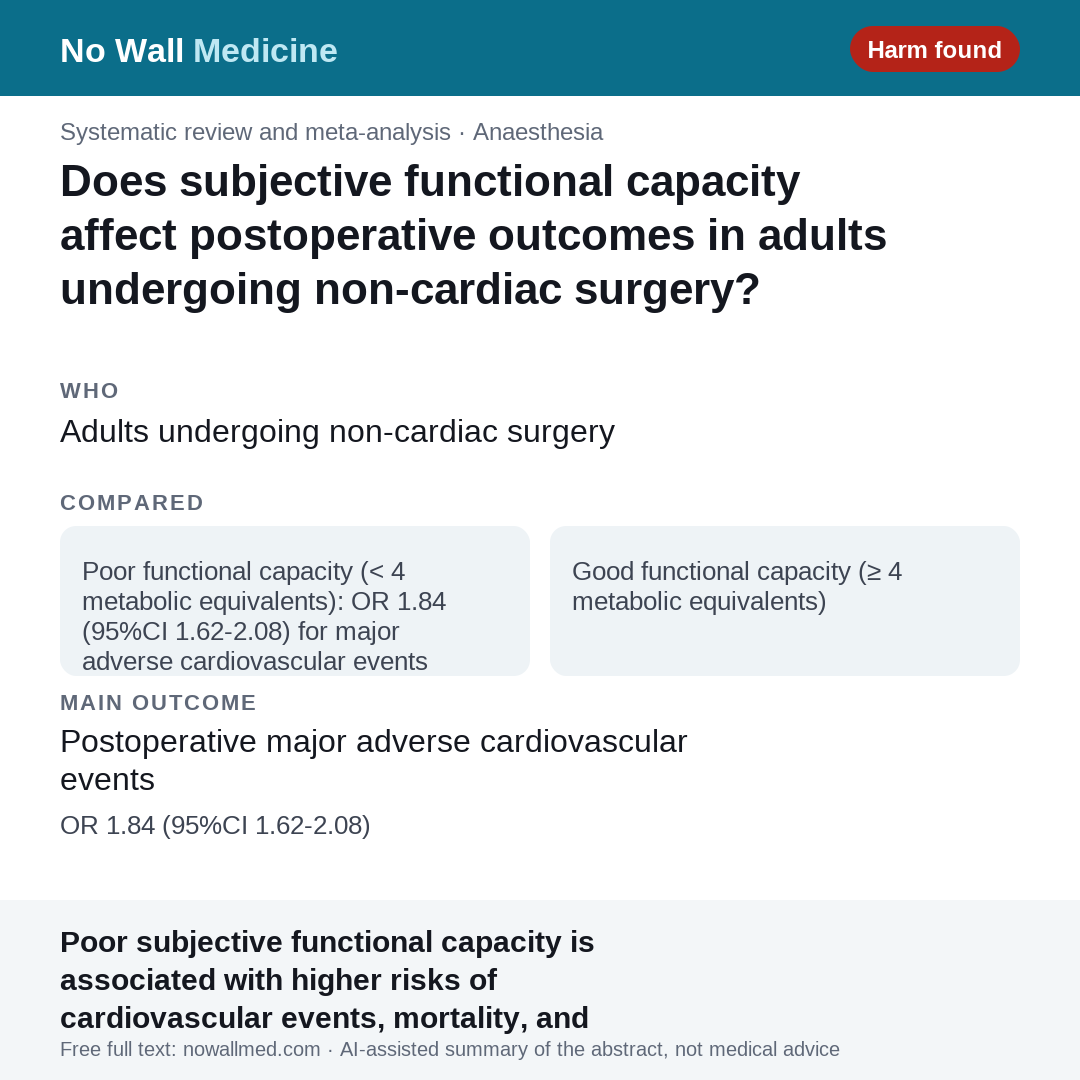
Clinical question: Does subjective functional capacity affect postoperative outcomes in adults undergoing non-cardiac surgery?
Why it matters: The association between how patients subjectively perceive their own physical fitness and their risk of complications after non-cardiac surgery had not been established.
Key points
- Researchers analyzed 23 studies involving adults undergoing non-cardiac surgery to compare outcomes between those with poor and good functional capacity.
- Poor functional capacity, defined as less than 4 metabolic equivalents, was associated with an odds ratio of 1.84 for major adverse cardiovascular events.
- Patients with poor functional capacity also showed higher odds of mortality with an odds ratio of 2.48 and postoperative complications with an odds ratio of 1.85.
Limitation the authors note: The results should be interpreted with caution because the studies used diverse measures to assess functional capacity.
Headline and key points written with AI from the paper’s abstract, with every number checked against it. Read the paper before relying on them.
Topics
Cite this article
Takahashi K, Chiba K, Honda A, Iizuka Y, Yoshinaga K, Deo AS. Pre-operative subjective functional capacity and postoperative outcomes in adult non-cardiac surgery: a systematic review and meta-analysis. Anaesthesia. 2025. doi:10.1111/anae.16543
Spotted a mistake? Suggest a correction
Top studies every Monday
The week’s key trials and guidelines in your specialties, plus any topics you follow. By email, free.
Get the weekly digest