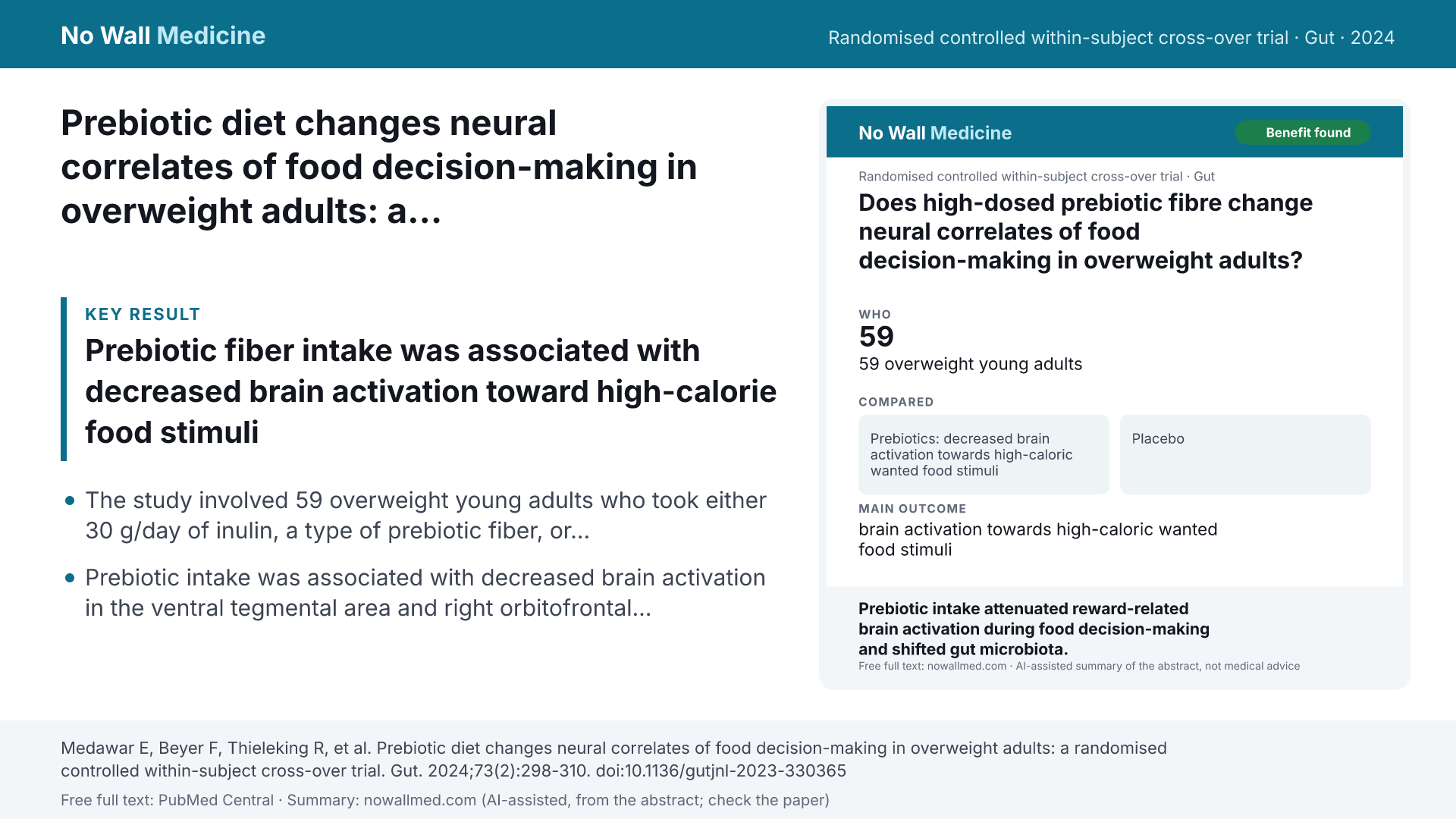
Prebiotic fiber intake was associated with decreased brain activation toward high-calorie food stimuli
Prebiotic diet changes neural correlates of food decision-making in overweight adults: a randomised controlled within-subject cross-over trial
Randomised controlled within-subject cross-over trialBenefit found
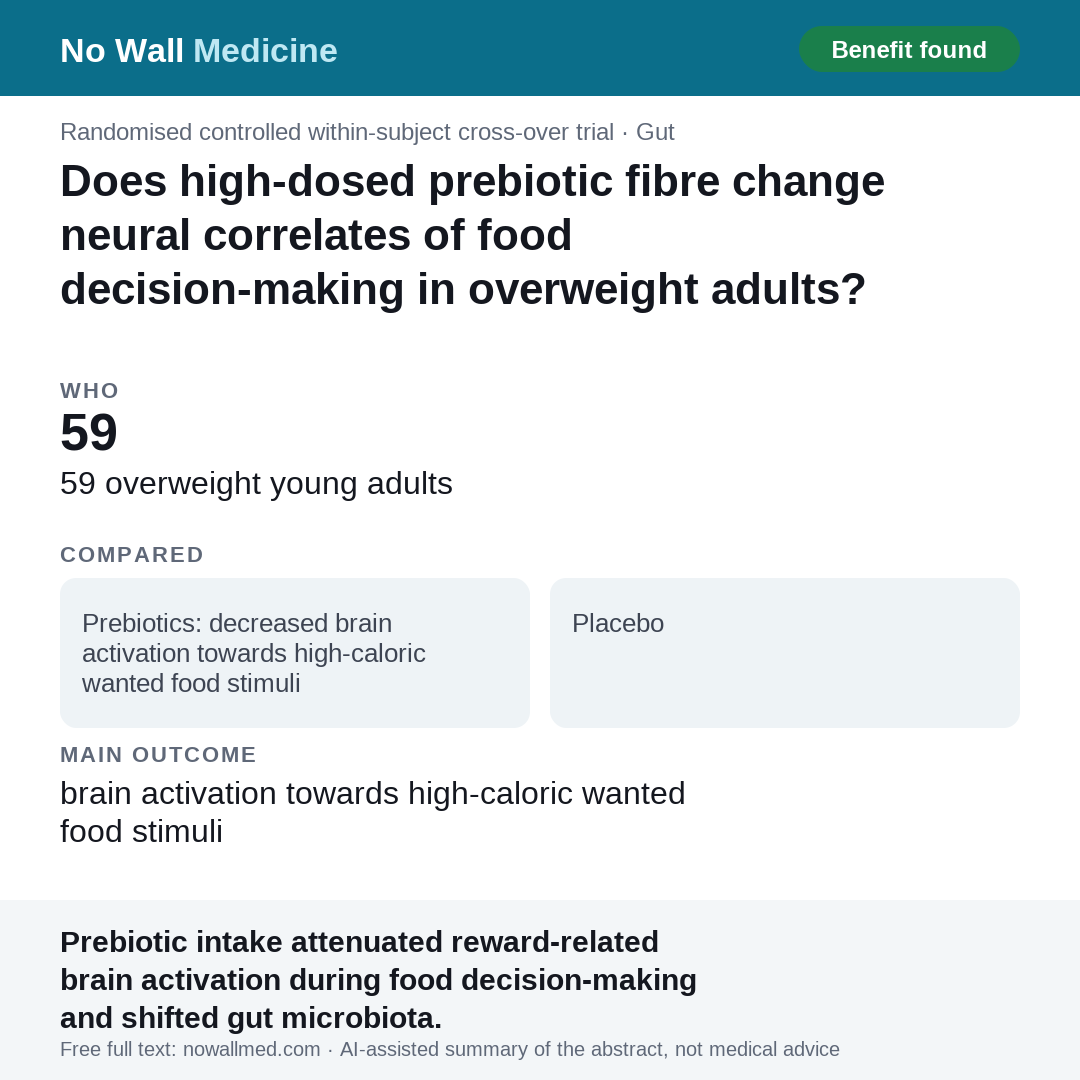
Does high-dosed prebiotic fibre change neural correlates of food decision-making in overweight adults?
Who
59
59 overweight young adults
Compared
Prebiotics: decreased brain activation towards high-caloric wanted food stimuli
Placebo
Main outcome
brain activation towards high-caloric wanted food stimuli
Bottom line: Prebiotic intake attenuated reward-related brain activation during food decision-making and shifted gut microbiota.
Limitation: This is a proof-of-concept study
Gut · 2024-01-05Download image
Clinical question: Does high-dosed prebiotic fibre change neural correlates of food decision-making in overweight adults?
Key points
- The study involved 59 overweight young adults who took either 30 g/day of inulin, a type of prebiotic fiber, or an equal-calorie placebo for 14 days.
- Prebiotic intake was associated with decreased brain activation in the ventral tegmental area and right orbitofrontal cortex when viewing high-calorie wanted food stimuli.
- The prebiotic intervention was associated with shifts in the gut microbiome, including an increased occurrence of Bifidobacteriaceae and changes in >60 predicted functional signaling pathways.
Headline and key points written with AI from the paper’s abstract, with every number checked against it. Read the paper before relying on them.
Was this summary helpful?
Abstract
Objective
Animal studies suggest that prebiotic, plant-derived nutrients could improve homoeostatic and hedonic brain functions through improvements in microbiome-gut-brain communication. However, little is known if these results are applicable to humans. Therefore, we tested the effects of high-dosed prebiotic fibre on reward-related food decision-making in a randomised controlled within-subject cross-over study and assayed potential microbial and metabolic markers. Design
59 overweight young adults (19 females, 18-42 years, body mass index 25-30 kg/m2) underwent functional task MRI before and after 14 days of supplementary intake of 30 g/day of inulin (prebiotics) and equicaloric placebo, respectively. Short chain fatty acids (SCFA), gastrointestinal hormones, glucose/lipid and inflammatory markers were assayed in fasting blood. Gut microbiota and SCFA were measured in stool. Results
Compared with placebo, participants showed decreased brain activation towards high-caloric wanted food stimuli in the ventral tegmental area and right orbitofrontal cortex after prebiotics (preregistered, family wise error-corrected p <0.05). While fasting blood levels remained largely unchanged, 16S-rRNA sequencing showed significant shifts in the microbiome towards increased occurrence of, among others, SCFA-producing Bifidobacteriaceae, and changes in >60 predicted functional signalling pathways after prebiotic intake. Changes in brain activation correlated with changes in Actinobacteria microbial abundance and associated activity previously linked with SCFA production, such as ABC transporter metabolism. Conclusions
In this proof-of-concept study, a prebiotic intervention attenuated reward-related brain activation during food decision-making, paralleled by shifts in gut microbiota. Trial registration number
NCT03829189.
Abstract reproduced under the article’s CC BY NC licence.
Subject terms
Headline, design, result, key points, caveat and citation as plain text.
Cite this article
Medawar E, Beyer F, Thieleking R, et al. Prebiotic diet changes neural correlates of food decision-making in overweight adults: a randomised controlled within-subject cross-over trial. Gut. 2024. doi:10.1136/gutjnl-2023-330365
Spotted a mistake? Suggest a correction