Chlamydia infection before pregnancy was linked to lower live birth rates and higher pregnancy loss
Preconception Chlamydia trachomatis seropositivity and fecundability, live birth, and adverse pregnancy outcomes
Preconception cohort studyHarm found
Does preconception Chlamydia trachomatis seropositivity impact fecundability, live birth, and pregnancy loss?
Who
1228
Individuals with proven fecundity and history of 1-2 pregnancy losses
Compared
Chlamydia trachomatis seropositive: RR 0.77 (95% CI 0.59, 0.99) for live birth
Chlamydia trachomatis seronegative
Main outcome
fecundability, live birth, and pregnancy loss
Result: relative risk 0.77 (95% CI 0.59, 0.99) for live birth
Bottom line: Chlamydia trachomatis seropositivity was associated with reduced live birth likelihood and increased risk of pregnancy loss.
Limitation: The sample size reduced precision.
Fertil Steril · 2024-12-18Download image
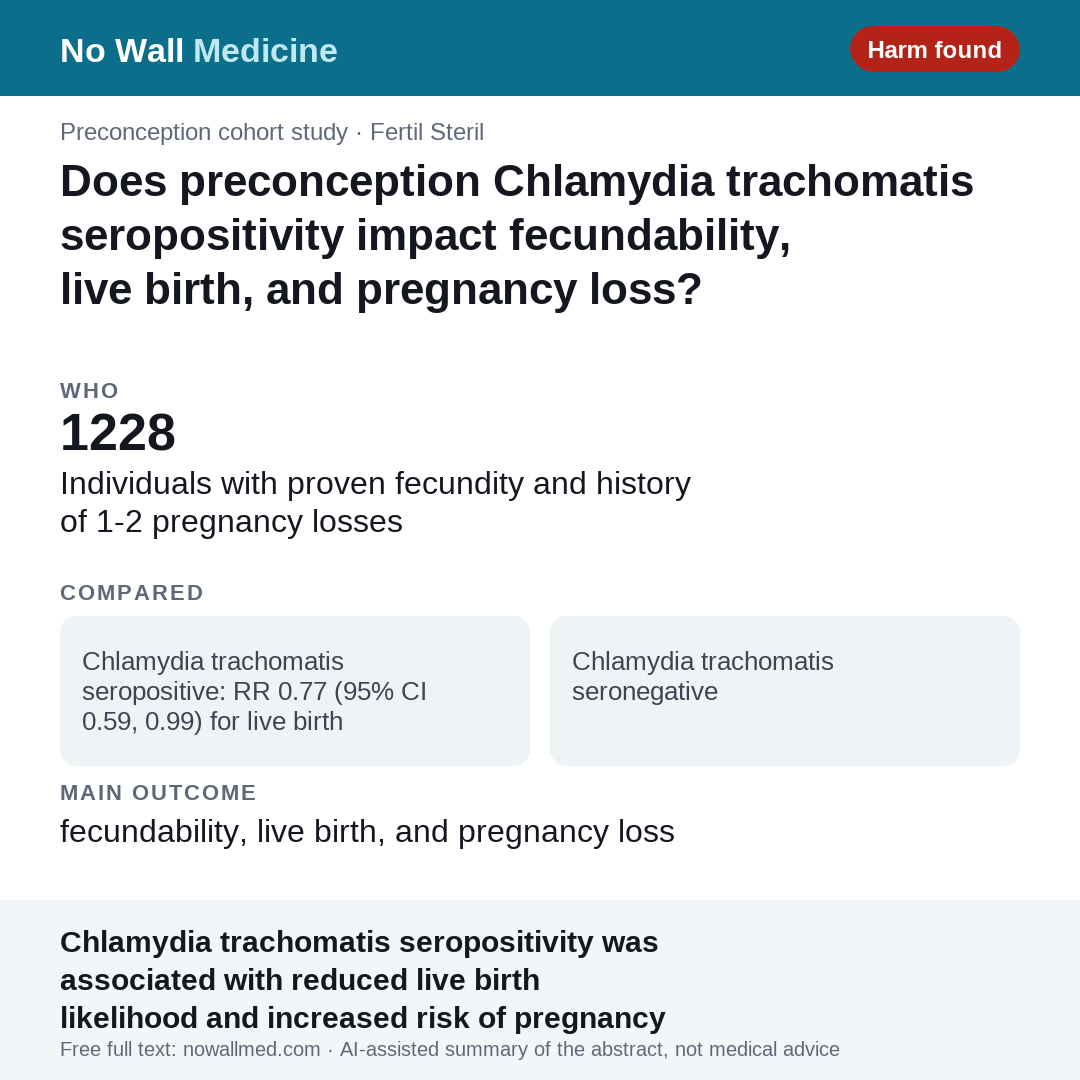
Clinical question: Does preconception Chlamydia trachomatis seropositivity impact fecundability, live birth, and pregnancy loss?
Why it matters: It is unknown how prior exposure to Chlamydia trachomatis affects the ability to achieve live birth and the risk of pregnancy loss in individuals with a history of loss.
Key points
- Researchers studied 1,228 individuals with proven fertility and a history of 1-2 pregnancy losses to measure the impact of Chlamydia trachomatis antibodies.
- Chlamydia seropositivity was associated with a reduced live birth likelihood (relative risk: 0.77) and an increased risk of pregnancy loss (relative risk: 1.16).
- Chlamydia seropositivity was not associated with fecundability, which is the probability of conceiving during a single menstrual cycle.
Limitation the authors note: The sample size for the subset of individuals with chronic inflammation reduced precision.
Headline and key points written with AI from the paper’s abstract, with every number checked against it. Read the paper before relying on them.
Topics
Cite this article
Chakraborti Y, Hinkle SN, Jensen JS, Haggerty CL, Darville T, Mumford SL. Preconception Chlamydia trachomatis seropositivity and fecundability, live birth, and adverse pregnancy outcomes. Fertil Steril. 2024. doi:10.1016/j.fertnstert.2024.12.017
Spotted a mistake? Suggest a correction
Top studies every Monday
The week’s key trials and guidelines in your specialties, by email. Free.
Get the weekly digest