Computational model predictions did not improve naming gains in bilingual aphasia therapy trial
Predicting bilingual aphasia treatment outcomes using digital twins: a double-blind randomized controlled trial
Double-blind randomized controlled trialMixed results
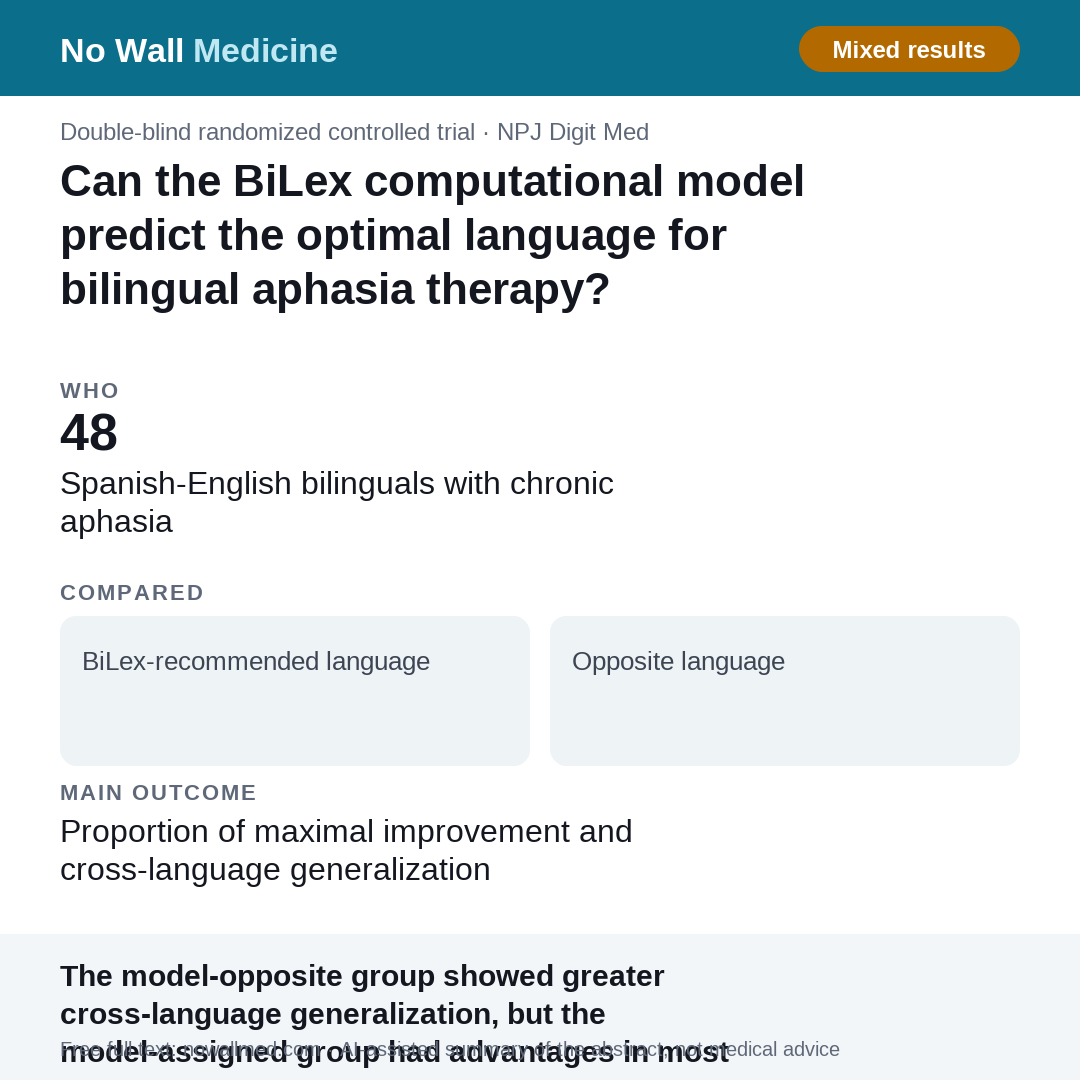
Can the BiLex computational model predict the optimal language for bilingual aphasia therapy?
Who
48
Spanish-English bilinguals with chronic aphasia
Compared
BiLex-recommended language
Opposite language
Main outcome
Proportion of maximal improvement and cross-language generalization
Result: Difference (SE) -0.16 (0.07) for cross-language generalization
Bottom line: The model-opposite group showed greater cross-language generalization, but the model-assigned group had advantages in most subgroups.
Limitation: The model-opposite group showed higher response variability.
NPJ Digit Med · 2026-04-10Download image
Clinical question: Can the BiLex computational model predict the optimal language for bilingual aphasia therapy?
Why it matters: Clinicians face challenges in determining which language to target during rehabilitation to maximize recovery across both languages in bilingual patients.
Key points
- Researchers studied 48 Spanish-English bilinguals with chronic aphasia, comparing treatment in a language recommended by the BiLex computational model versus the opposite language.
- Both groups showed similar gains in naming within the treated language, with no significant difference in the proportion of maximal improvement (p = 0.65).
- The group treated in the language opposite to the model's recommendation showed significantly greater cross-language generalization (p = 0.02) but had higher response variability.
Headline and key points written with AI from the paper’s abstract, with every number checked against it. Read the paper before relying on them.
Spotted a mistake? Suggest a correction